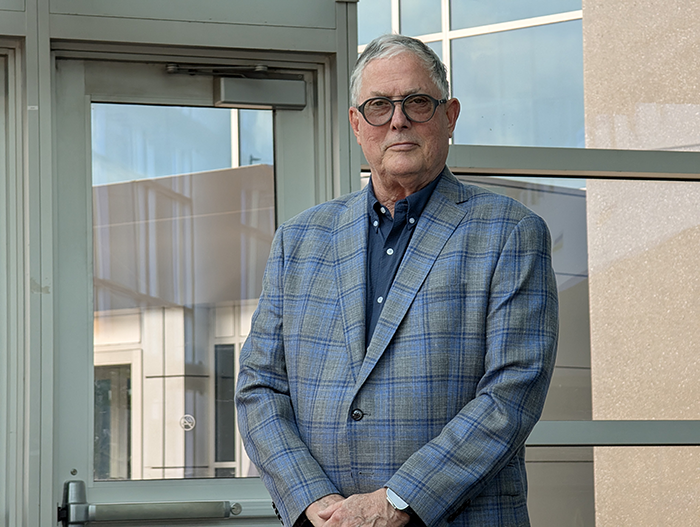
Roger Dixon announced his retirement from MECA last week after 25 years. We interviewed him on Friday.
Omaha.Nebraska.com here with…
Roger Dixon
You’ve led MECA since the beginning. What was your original vision for the organization, and how has it evolved?
I came in September of 2000. And we were at the Twin Towers [also called The Duo], which are now being converted into an apartment complex. Basically it was me and my executive assistant, and basically our first mission was to bring on some staff. I brought on a contract administrator for construction, a director of operations, and a finance person, and the process at that point was to validate the GMP, which is the gross maximum price of what this facility did working with DLR, the architect, and Kiewit, our construction management company. We went through the process, and then we got through that, and then construction started in March 1 of 2001. We kept bringing on staff. The vision was to operate this facility at the most optimum level that we could. David Sokol, the chair at the time, said he wanted the staff to be as Disney-like as possible in how we treated our customers, and fortunately in my career I had participated at Disney University in Orlando. And so I had a little background in how they did it, and it’s basically that you treat your front-of-house customers the same as you do your back-of-house customers, so it’s making sure everybody was as happy as they could be… they got what they needed and either enjoyed the event or enjoyed working here. So we just progressed through that and went through the construction aspect. We opened in September of 2003, and then it was just “Katie bar the doors” because it all started coming out so quickly.
Wow. So the successes here helped other things be attracted to it?
So this area, as everybody knows, was the Union Pacific Railroad yard. They were starting to close it down, move it over to, I think Council Bluffs is where it ended up. And to see it today and to see it back then, I tell the story and most people have heard it from me before. My first interview was in June of 2000. I landed at the airport, got in a cab, came down. Back then there was a viaduct that went…which was actually part of Abbott Drive, and it came up, and I looked to the left as I was coming into town. At that time it loaded into Dodge Street, I believe, and to the left was what was left of the smelt plant, not much… dilapidated oil tanks, the Port of Omaha, and to the right was the beginning of the shutdown for the railroad yard. And I asked the cab driver, “Where is the new arena convention center going in?” and he pointed to the right. I thought to myself, “This community has vision.” And that night I was at the DoubleTree. That’s where I spent the night, and I had all the material, and I was reading everything. One of the most fantastic thunderstorms I’ve ever seen. So a nice little welcome to Nebraska.
So there was no Convention Center, just the idea of it and blueprints?
So they had done a design, they had basically priced it out, and there were some glitches in that, and we figured it out. Found out we were… in the pricing out of it, they had forgot to put in a lot of the pilings that needed to go in, so there was a big gap in what was there. So…went back to DLR, went back to Kiewit, went back to the City, and we had to increase the price of the facility by about 20 million.
Which…it all worked out. There were some design changes. The initial renderings showed more of a spaceship-type roof on the facilities. In the pricing out of the project, that didn’t fit the budget, so that had to go. There was a walkway up on the upper level. You walked, and it went to the back end of the property, and there was kind of a room up there. It could have been an observation room, it could have been a restaurant, but it looked into the arena, looked into the exhibit hall. That didn’t work in pricing either. So we ended up with what we have now.
Wow. So you had to make a lot of changes and pivot because of the extra 20 million in one location?
Well, you design it, they price it out, and then you come back in. They call it value engineering. You start cutting things out that just doesn’t work or can’t afford to do it.

You had the previous experience. You just told me about Disney and prior roles in other cities. How did that influence your approach for Omaha?
So I’ve been in the business 49 years. Been here 25, so 24 prior to that. I started out in Louisville, KY, as an event coordinator, got promoted to assistant director of the new convention center downtown. It was open, but we hadn’t done all the furniture and equipment: F and E. I got to finish that off, so that was experience I got.
I was in Louisville for approximately 9 years and then went to Miami, FL, and that was more of a large theater, 5,000, but you could play basketball there, so we did a lot of concerts there—we would do 70, 80 concerts a year. That’s about all we did. And then they took out the retail space in that building and put in meeting rooms and exhibit space. Not a lot. So I had some experience in the construction aspect of that. Again, fitting the furniture and equipment.
Left there, went to Saint Louis. If you’re familiar with Saint Louis, you may remember what was called the Checker Dome. That’s where the Saint Louis Blues Hockey Club played. And that was just keeping up an old, old facility. Not really any… other than just maintaining a facility at the time that was probably 70, 75 years old.
Left there and went to Philadelphia and worked at the Spectrum and was there three years, and during that time they were negotiating with the city to build what is now Wells Fargo Center, which is the new facility, and had a little experience in that…not much.
Came back to Saint Louis and then helped build, then manage, what is now Enterprise Center. It was the Kiel Center back in those days. Again, that’s where the hockey team moved to. So I got a little bit more experience in the construction aspect of it and more of the F and E aspect of fitting out a new facility. I was in Saint Louis another 8 years and then came up here, been here ever since.
There was a little interplay. I went to Cincinnati for about 3 or 4 months in the summer of 2000. And that was just babysitting an old facility. Then came up here, been here ever since.
I’ve fallen in love with Nebraska and the Omaha area since I’ve been here. You must have so many favorite things and stories of your time here.
Too many that…most of them I can tell; some of them I can’t.
Well, it’s always interesting to be involved in the construction and then the opening and the management of a facility. Just the number of people that you encounter, and even on the aspect of when it was under construction, the number of people that weren’t in favor of this facility.
I’ve always found that interesting.
I’ve always said it was the vocal minority, because the vote to get this place was well over 60%. So the overall community supported it, but it’s just the vocal minority as I say, the few people that were in the newspaper and on radio talk shows. But I think we proved everybody wrong, because this place would never work. Actually, I was told from a lot of the concert promoters that I dealt with prior to coming up here that Omaha was never a city you could make money in, and all they had was the Civic Auditorium. And I got that, because it wasn’t big enough. And so I thought once this happens…we started out with 16,000 seats. We upped that number in 2006 up to 18,300. And even with 16, we made things work. We have been profitable from day one. Even through the COVID period we were profitable.
Wow.
And all the monies that we have generated came back in to make this facility what it is and it remains to be, because most people that come in here, they will look around and say, “This facility is 20, 22 years old,” and it is, because we maintain everything.
With COVID, a lot of businesses and organizations had to pivot or at least do some things a little differently. What did you do here?
So we were a little bit different than what most of my contemporaries did in the business. Most people just shut their facilities down. We had a little bit more progressive governor, as far as business-wise, and Governor Ricketts allowed us to stay open and set percentages that we could do. So we turned in, as far as the number of people in attendance, and more so the numbers of people watching, not really participants…and so we kind of turned into volleyball central, basketball central. I didn’t lay off much staff because we let the part-time people go, but we started bringing them back because we became so busy. And I think the fact that we stayed quasi open… I think it saved several of the hotels in the downtown area. And I’m not taking credit for that. That goes to the governor. But we made it through it.
I know there are so many businesses here and then related businesses that really depend on Omaha being alive and active and attractive for a variety of things, including the College World Series being open. It’s amazing the amount of economic impact that MECA has had.
I think the number is, we generate probably about 90 to 100 million a year, just on a normal year, as far as economic impact. So it’s been several billion dollars that we’ve generated for this community. It’s been more than enough to offset the cost of the city’s expense to build this place.
Yeah. I didn’t do the math, but it’s pretty impressive.
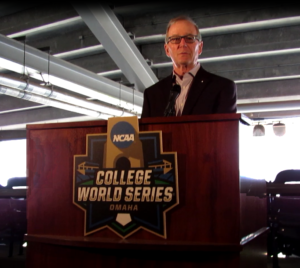
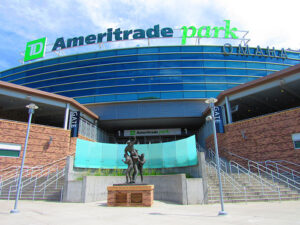
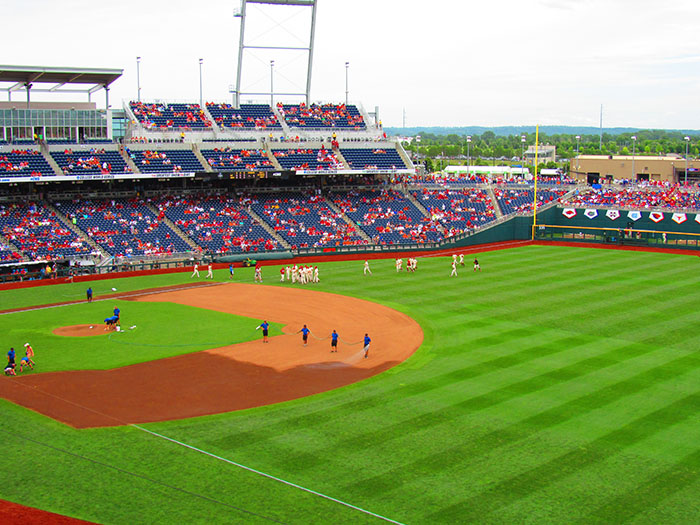
Yeah. And it’s the same with Charles Schwab Field, where we have… Creighton baseball plays there, and NCAA with the Men’s College World Series. Most people are like, you know, “It just sits empty.” And it does, a lot, but it was built primarily for the College World Series. It’s not a drain on the taxpayers; it pays for itself, both to retire the debt and to operate it. So it’s kind of a hybrid stadium. It’s too big for Minor League Baseball. It’s too small for a lot of the touring shows that go out in stadiums over the summer, so we kind of deal with that as much as we can. We’ve done some concerts there, but it’s not like what some of the other stadiums do in the country that have 60, 70, 80 thousand seats.
The College World Series is coming up on 75 years. Hard to imagine.
Well, I’ve not been around for that long…at least I’ve not been in Omaha that long. I’ve been around…I’m almost 75. But it’s an exciting time of year. People look forward to it. We’re gearing up. Everybody’s gearing up. We’ll find out the teams that are going to play Sunday, maybe Monday if there’s playoff games that have to have them. But there’s a 16 field out there now. It’s going to pare down to 8. We’ll see who shows up.
One thing that’s going to be a lot of fun, and having covered this for several years now, it’s always an amazing experience and always a positive experience.
Yeah, we do thousands of people that come in…and most of them, they’ll start out in the parking lot or some of the area bars and restaurants, and then they all come in. We’ll put 24, 25 thousand people in the facility, and it’s baseball, and it’s good baseball.

What legacy do you hope to leave behind in Omaha? And what’s up next for you?
I’ve always operated as a—this is a for-profit business and whoever replaces me after I move on at the end of the year, hopefully they’ll continue that process. And I’ve always kept in the back of my mind this facility was built for the city, so it has to benefit the city, either in putting people in hotel rooms, restaurants, or utilizing, where we can, vendors that provide service to it that are from local business. So whoever replaces me, I hope they’re as successful at running this facility as this team has been.
Thank you. What qualities are you hoping that the new person will have and bring to here?
My hope is it’s someone from the industry that understands…but we’re unique. Not many facilities that have an arena have a convention center attached. A baseball stadium sits right off and then a 70-some-acre park that they have to do. That was a little stretch, but I think we’ve done a nice job of running all of them.
My office is right across from the Leahy Mall, and it’s been real interesting to watch all the development here…going on.
Yeah, downtown…I think, from what they did at the riverfront, which is the Gene Leahy, Heartland of America Park, Lewis and Clark…especially at Gene Leahy, filling that lagoon in or whatever you want to call it, really brought the south downtown area and connected with the north downtown area. I thought that was a great idea.
I love watching the economic development, and when I do different stories…you know, what was it like before or how did it thrive or fall into decline… and your story earlier, too, about what this earlier area was and all of that is really a great testament to the work you’ve done and how people have thought about things in the city. And thank you.
Well, I can’t take credit for much other than operating this facility to the point where people want to develop around it. But that’s a driver by the business community and the city administration, so they’ve done a great job. Just had 12 years with Mayor Stothert, and she was an excellent shepherd in getting projects through and getting them done. The streetcar is going to be here. I know there’s a lot of naysayers out there about it, but there’s also a lot of businesses that are…and facilities being built that wouldn’t happen without the streetcar. So I think it’s all good.
Thank you very much.
My pleasure.




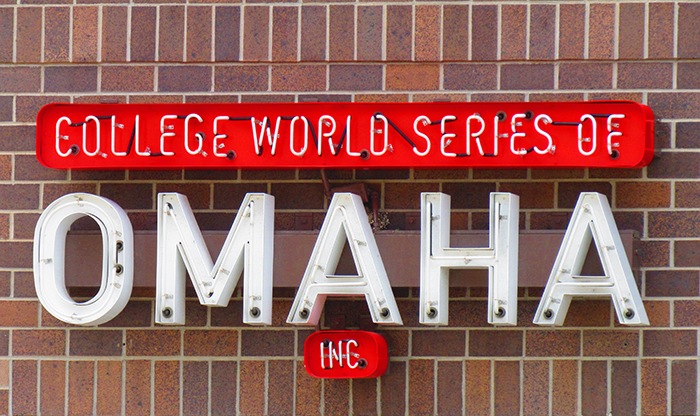
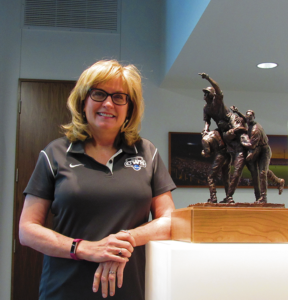
 Kathryn Morrissey, Executive Director, College World Series of Omaha, Inc.