Millard Days 5:00–10:00 PM Carnival
6:00–11:00 PM Beer garden
6:00 PM Jeep Night
Andersen Park
13625 Cottner St.
Omaha, NE 68137 https://www.millarddays.com/schedule
Thursday, August 27, 2026
Millard Days 5:00–10:00 PM Carnival
6:00–11:00 PM Beer garden Andersen Park 13625 Cottner St.
Omaha, NE 68137 Community carnival and beer-garden evening https://www.millarddays.com/schedule
Issa Trap Symphony-Afro-Fusion Guided gallery experiences 4:00–6:00 PM; concert and mixer 6:30–9:30 PM Joslyn Art Museum 2200 Dodge Street Omaha, NE 68102 Paid Admission
Registration required
Walk-ins accepted if space permits. Kevin Paradise, Joe.EZ, AJII and Kusher Snazzy perform with Omaha Symphony string musicians. The program also features Ray Bae, Afrobaddie, Big Wade & Black Swan Theory, Jevon Woods and Menice “Mars” Blackman https://joslyn.org/events/issa-trap-symphony-afrofusion/
Friday, August 28, 2026
Millard Days 5:00–11:00 PM Carnival
6:00 PM Beer garden
7:00–11:00 PM The Damones Andersen Park 13625 Cottner St.
Omaha, NE 68137 Friday’s principal attraction is a four-hour live performance by The Damones https://www.millarddays.com/schedule
Night Market, presented by Veridian Credit Union 6:00–10:00 PM Turner Park at Midtown Crossing 3110 Farnam Street Omaha, NE 68131 Free and open to the public More than 50 local vendors, artists and makers, plus BluesEd, Omaha Street Percussion, Chad Lee, The Pinheads and other musicians https://midtowncrossing.com/things-to-do/events/night-market/
Millard Days Horseshoe registration 10:30 AM; tournament 11:00 AM; family activities noon–3:00 PM; carnival 1:00–6:00 PM Andersen Park 13625 Cottner St.
Omaha, NE 68137 Family schedule: face painting and balloon animals at noon, Dino Bus from noon–1:00 PM, kids’ tractor pull at 1:30 PM and ice-cream social at 3:00 PM. https://www.millarddays.com/family-day
North Omaha Music & Arts Festival (NOMAFEST) – Masterclass & Frank McComb
5:00 PM Masterclass
7:00 PM Concert
North Omaha Music & Arts
2510 N 24th St
Omaha, NE 68110 https://nomafest.org/
Omaha Chalk Art Festival
10:00 AM – 6:00 PM
Turner Park at Midtown Crossing
3110 Farnam St
Omaha, NE 68131 https://midtowncrossing.com/
Millwork Market
11:00 AM – 3:00 PM
The Ashton / The Dock
1229 Millwork Ave
Omaha, NE 68102 https://millworkcommons.org/
North Omaha Music & Arts Festival (NOMAFEST) – The Bar-Kays, MonoNeon & Keyon Harrold
6:00 PM – 10:00 PM
Gene Leahy Mall
1001 Douglas St
Omaha, NE 68102 https://nomafest.org/
Sunday, August 16
Omaha Farmers Market – Aksarben Village
9:00 AM – 1:00 PM
67th St & Mercy Rd
Omaha, NE 68106 https://omahafarmersmarket.com/
Omaha Chalk Art Festival
10:00 AM – 6:00 PM
Turner Park at Midtown Crossing
3110 Farnam St
Omaha, NE 68131 https://midtowncrossing.com/
North Omaha Music & Arts Festival (NOMAFEST) – Richie Love
North Omaha Music & Arts
2510 N 24th St
Omaha, NE 68110 https://nomafest.org/
Always check with the organizer for exact time and any changes.
Kris Pierce, Chief of Public Affairs for Offutt Air Force Base.
What should visitors know for this year’s air show? Any changes they need to know of?
The biggest change is that we have brought parking back onto the base. Last year, because of flood recovery, we couldn’t have parking on the base, so we had various parking locations around the surrounding area and we had buses shuttling everybody. That’s changed. We’re bringing parking back on base, but in order to get on base, you have to have a parking pass, which is free. The event is still free, but it helps our organizers park everybody on base in different areas. So a parking pass will be required this year, which is very different from last year.
How do people go about getting the parking pass?
We only need one parking pass per vehicle. To get one, you go to our website, which is offutt.af.mil/air-show. The web page tells you how to get the parking pass, and it also provides a list of the do’s and don’ts, such as what not to bring and so on. Also on that website is a very elaborate FAQ. If anyone has questions, many of them probably are going to be on our FAQ page.
How is this air show different from the last one two years ago?
There will be different acts. We have the F-35 demo team this year. We also have Tora Tora Tora, which is a reenactment of Pearl Harbor with huge explosions, fireballs. We haven’t had that in many years.
That’s one of my favorites. I always miss it when it’s not there.
We’ll have the Air Force Academy parachute team here. And then we’ll have some of the regular favorites. We’ll have Randy Ball and the Red Bull team. We’re going to have the B1, the B2, and the B52. So yeah, we’re going to have some different ones. The type of assets we’re able to bring this time will be a little different because of what’s going on in the world, but I think it’s going to be a great show. Hopefully it’s not going to be as hot as it was in 2024, but we’re prepared for that. We have quadrupled the amount of water that we will have available to everybody throughout the air show area, so whether it be water buffaloes or with our spigots, they can refill reusable water bottles. We’ll also have two misters if things get too hot. Our medical staff are well prepared this year for a big heat wave. So we are much more prepared weather wise than we were last before, although we are having the air show in early August rather than late August like last time. But we learned a lot last time, and we’re putting those lessons learned into practice this year.
I think that’s a great idea to try to find a better time of year, because with so many events in Omaha in August, the heat is pretty hard on people.
Yeah, and we have a little bit of control over that, but ultimately the Air Force decides what the final date of the air show will be. We make recommendations, but ultimately the Air Force will tell us, “If you want to host an air show, these are the dates when you can host it.” But we’ve gotten lucky that we now have a little earlier air show than we did last time.
Thank you. It takes a tremendous amount of people, both military and civilian and volunteers, to put on the air show. Do you have an idea of what kind of numbers are there?
Well, I can tell you some specific numbers. We have over 800 military volunteers working the air show each day, and over 300 of them will be there just to help organize our parking strategy. So we’re putting a real effort into making sure that people get on base, they get to where they need to park and get on the air show as quickly and as easily as possible. So we’re investing a lot of manpower into this air show. One caveat: While every parking area will have handicapped accessibility areas, depending on where you actually end up being parked, you may have to walk a distance to get to the air show. It just depends on where you park. So people should be prepared that it’s not going to be that you park and then walk a few hundred feet to the air show. Parking spaces are all over the base and we’re utilizing them all, so wear comfortable shoes.
If people have questions, let’s say for the parking or something else that comes up with the air show, what’s the contact information for that?
So they can contact us, and again, this is also on the website, but 55WG.PA@us.af.mil is the e-mail address if they have a specific question they need answered.
Oh, thank you.
The website is where they’ll find things that they can and can’t bring, like if you bring a bag, it must be a clear bag, no weapons, but that’s also where they will register for their parking pass, their base entry pass. Even if you bring a clear bag, all bags are subject to search, as always.
What procedures are in place in case there’s severe weather or some other unexpected condition?
We are encouraging people to watch our Facebook page, either the air show one or the 55th Wing or the Offutt Air Force Facebook page [ https://www.facebook.com/OffuttAirForceBase ] in case there’s a cancellation or delay or something. We’ll use that as our main communication process.
Thank you. What do you hope that visitors will learn about the Air Force through the air show and about Offutt?
Well, we are celebrating America’s 250, so part of our theme is past and present. With the P-51 and then the F-35, you’ve got the past and present. And then you’ll see some of the future stuff. The EA-37 Bravo, which is the Air Force’s newest airplane which belongs to the 55th Wing, will be here, as well will be the EC-130, which is what it’s replacing. The EC-130 is being retired in September and the EA-37 Bravo is its replacement. They will both be here. It will be the first and last time they will be sitting next to each other, because of the retirement. The other thing is just the vast differences, whether it be platforms, but we’ll also have the Army. I believe the Army helicopters will be here, so it’s not just the Air Force, but it’s all men and women in uniform. It provides an opportunity for the public to (1) touch stuff, and (2) gain a little bit of understanding of what our men and women in uniform do and just the sheer training it takes to exercise our national defense.
Thank you. At the end of the day, when people leave, what are you hoping that they take away or something they may have learned or didn’t understand before about Offutt or the Air Force?
Well, I think it’s just an appreciation. The average John and Jane Doe don’t get to be this close to some of the platforms and equipment that we get to use on a daily basis. Especially for our younger folks, I’m hoping that they walk away with a sense of awe, especially when they hear huge jet engines flying overhead and they tell the story to their friends that didn’t make it to the air show. We want it to be a positive experience. Also, this is also our recruitment, potentially. You get young men and women that are maybe facing graduation from high school and thinking, “What am I going to do next?” And perhaps they have an engagement with an F-35 pilot or an AWAC pilot and then say, “You know what, this is what I want to do,” or “I want to fly an RC-135 rivet joint.” It’s an opportunity for recruitment of the next generation.
Is there something I should have asked about the air show that I didn’t, that you think would be a good idea to put in?
I think the two big things that we are sharing right now is to bring ear protection and bring a water bottle that you can fill to your heart’s content. We want to make sure everyone is safe and has a great time.
I forgot about the ear protection, so thank you for the reminder.
The CWS 2026 Media Tasting showcased many new offerings and some updated classics.
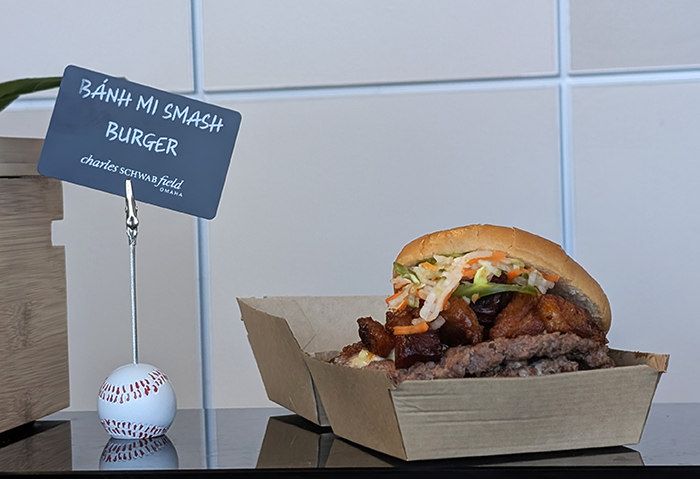
The Banh Mi Smash Burger is one of the newest burgers on the menu. For the smash burger portion, it features two beef patties topped with white American cheese. For the banh mi portion, there is fried pork belly tossed in gochujang sauce, along with pickled vegetables, cilantro, and Kewpie mayo. The flavors blended together well and complemented the burger. It was very good.
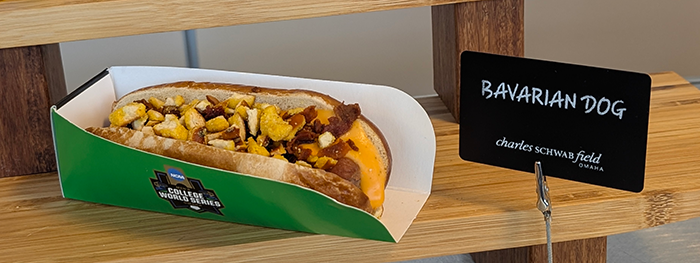
The Bavarian Dog is a beef hotdog covered with crisp bacon and honey mustard pretzel pieces nestled in a pretzel bun. Dripping in beer cheese sauce, it was a big hit and crowd-pleaser.
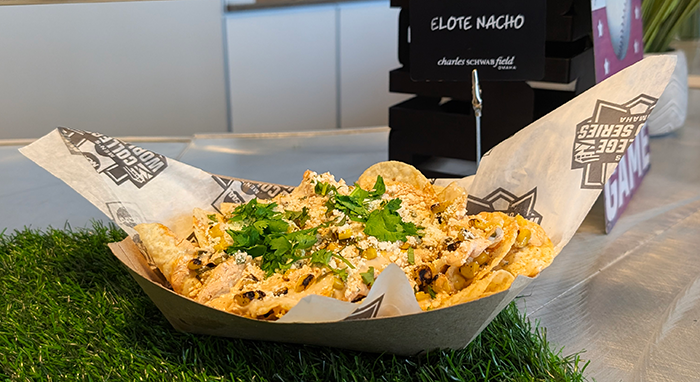
The Elote Nacho boat was my personal favorite. A gentle river of queso blanco and lime crema, topped with cotija cheese, cilantro, and fire-roasted corn, flows over a bed of tortilla chips. The combination of flavors was an outstanding winning combination for me. I’ve never had a sauce pair so perfectly with chips before.
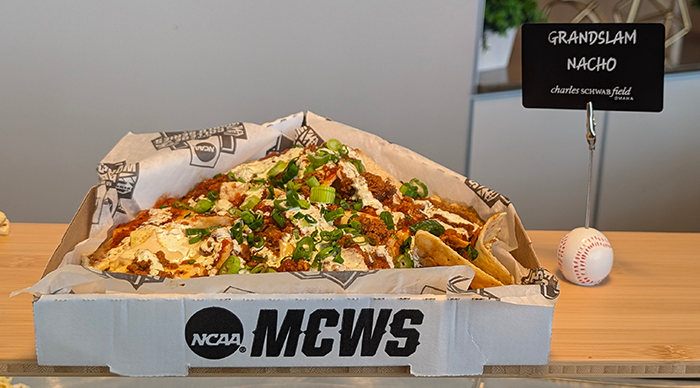
The Grand Slam Nacho is a returning and updated fan favorite. Its corn tortilla chip base is loaded with queso blanco, beef, and green onions. Bringing it all together for a home run of flavor are fire-roasted salsa and cilantro lime crema.
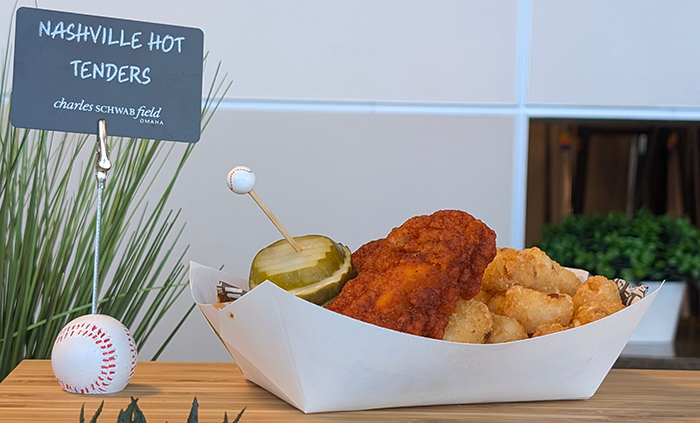
The Nashville Hot Tenders are large breaded chicken tenders covered in a spicy Nashville hot sauce that is sure to bring the heat. The lightly seasoned tater tots provide balance to the cayenne-heavy sauce with the tangy pickle slices as the perfect complement.
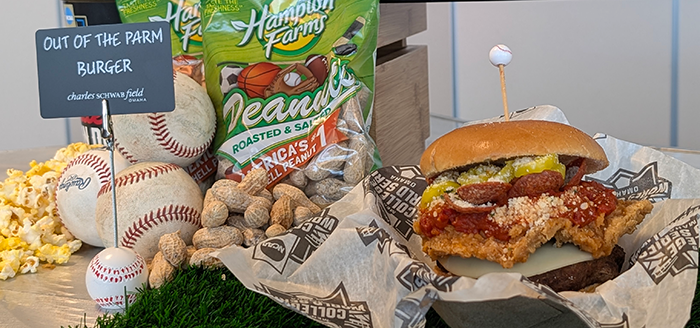
The Out of the Parm Burger was a surprise favorite for me. It is really two sandwiches in one. On the bottom is a traditional hamburger. Above it roosts the best chicken Parmesan I have ever had. It was tender and flavorful, with the right amount of cheese and a thin layer of sauce. A layer of banana peppers, along with the bun and a necessary skewer, helps tie everything together.
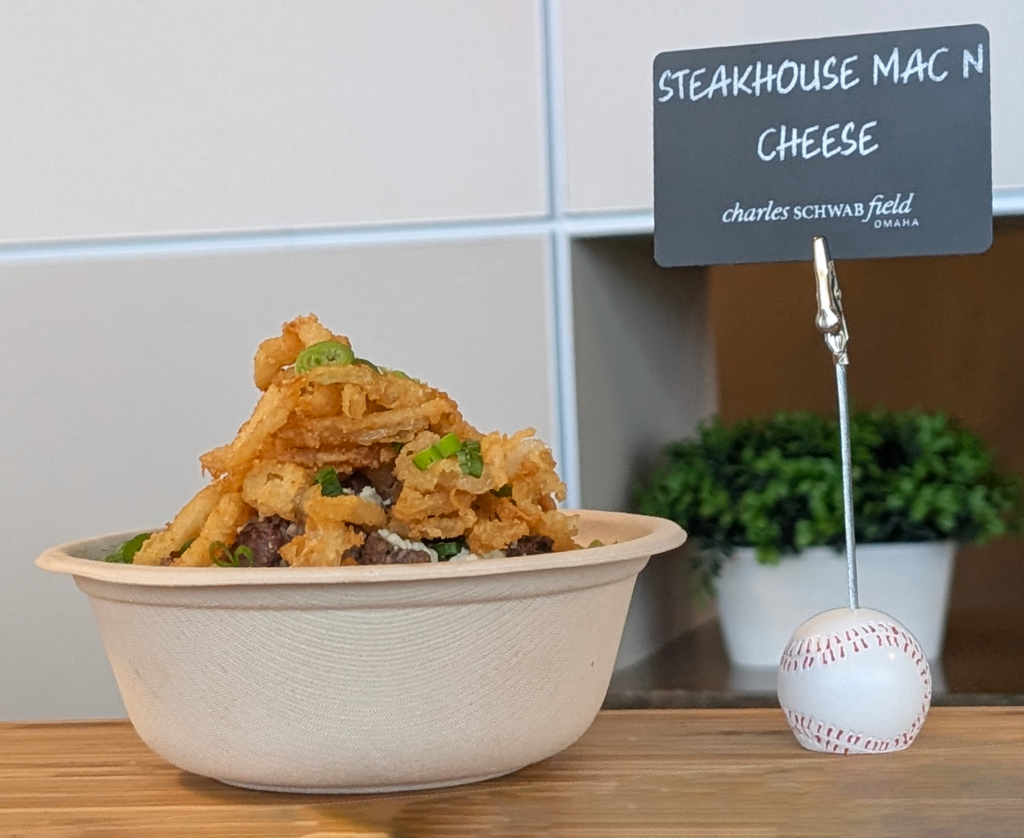
The Steakhouse Mac N Cheese is a three-cheese version with a surprise cheese-blue cheese. The steak bites go well with the blue cheese crumbles and fried onion. Green onions dot the creation.
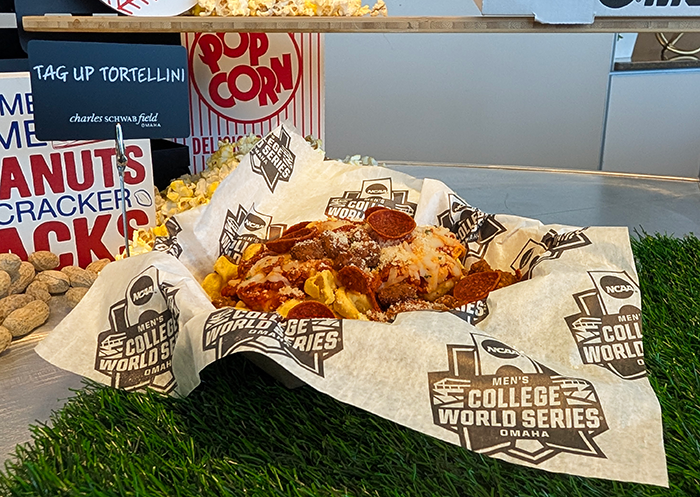
The Tag Up Tortellini is one of Chef Katie Cochran’s and my favorites. The base is fried cheese tortellini, and its teammates are Italian sausage bites, mozzarella, cupped pepperoni, and Parmesan cheese, all served with marinara sauce.
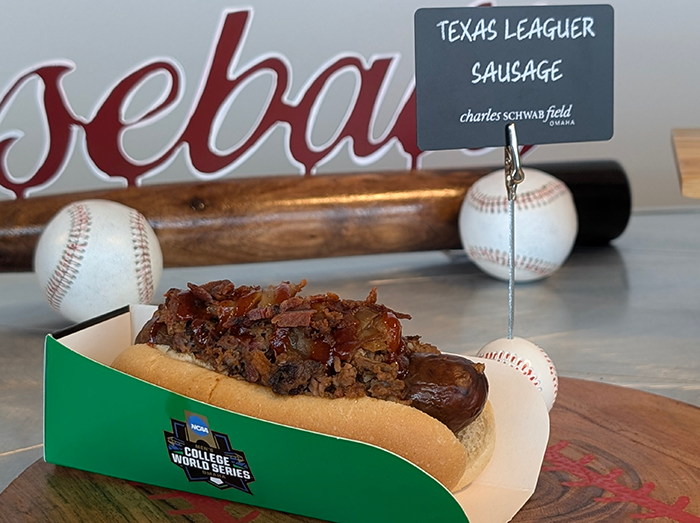
The Texas Leaguer Sausage is sure to become a new favorite. Tasty smoked barbecue brisket, barbecue sauce, and caramelized onions cover a Black Forest bacon sausage for an out-of-the-park flavor experience.
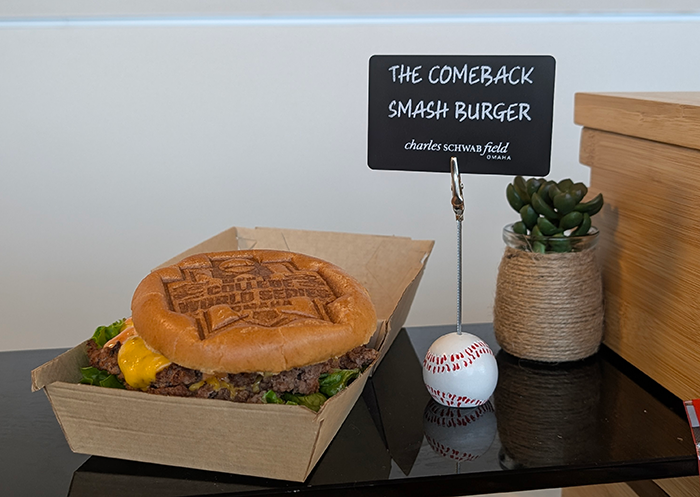
The Comeback Smash Burger is one of the newest smash burger offerings. It comes on a branded “College World Series Omaha” bun and features two beef patties, American cheese, lettuce, red onion, a thick slice of heirloom tomato, and comeback sauce. It’s a smash hit for sure and will make you want to come back for another.
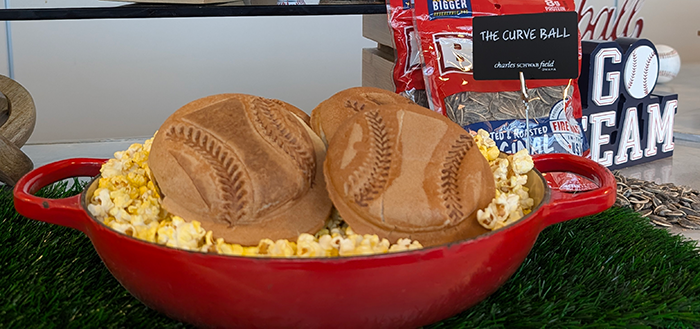
The Curve Ball is another burger served on one of the branded buns. The brioche bun is shaped and stamped to resemble a baseball. Enclosed inside are a grilled beef patty, two slices of American cheese, dill pickles, and house-made burger sauce. The closed bun keeps the burger and toppings safely tucked away until the first bite.
And now for dessert….
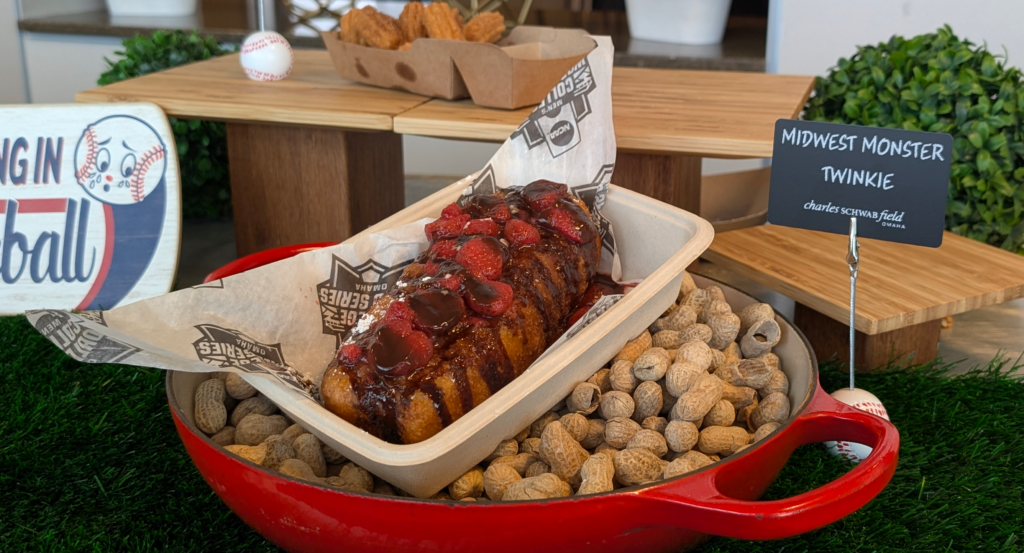
The Midwest Monster Twinkie is so massive you’ll need some friends to help you vanquish it. While it looks and is huge, the doughy part is incredibly light and airy. Dripped copiously with chocolate and heaping helpings of delicious strawberry compote, the toppings are the heaviest part of the confectionery creature. Oh yes, let’s not forget a light white fluffy expected surprise inside.
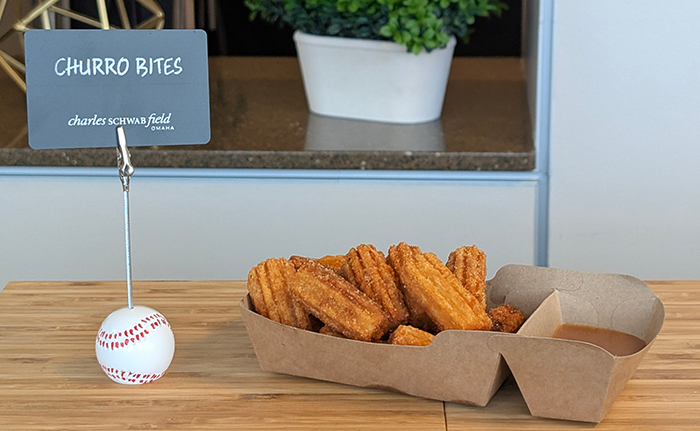
The Churro Bites were one of my favorites. Crispy-doughy ridges covered with cinnamon and sugar, these are sure to please. Don’t forget the dipping sauce. It goes perfectly with the mini churros.
OmahaNebraska.com’s Interview with Adam Straight, President and CEO of the Metropolitan Entertainment & Convention Authority (MECA)
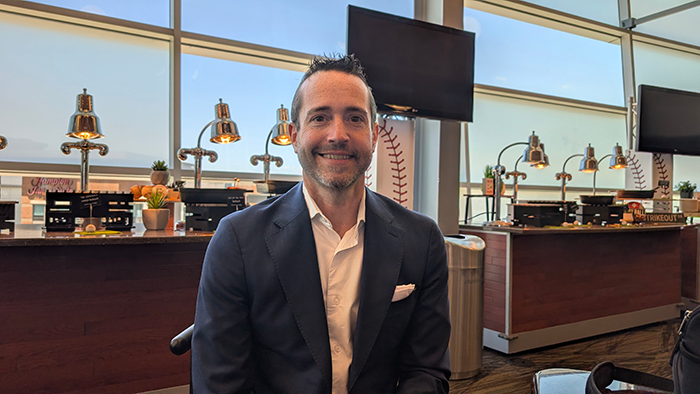
Adam Straight with CWS Media Food Tasting Offerings in background at Charles Schwab Field Park
OmahaNebraska.com here with…
Adam Straight, President and CEO of MECA.
Please tell me a little bit about yourself and what brought you here. I loved hearing all the wonderful things you said about Omaha earlier.
Oh yeah, great. Well, first and foremost, I love it. My last five and a half months have been some of the best of my career. And that’s from the genuine nature of the community and their welcoming of me, an outsider of sorts, into the community. So it’s been great.
I’ve been in the business for 25 years. I started actually as an electrician at the University of Maryland, working in the shop and providing support around campus. I was asked a couple of questions one evening, and one of those was “Do you like sports?” And I said “Yes.” And the next one was “Do you like overtime?” And I said “Absolutely. I’m your guy.” So that kind of really spawned into just me supporting the athletic department throughout all of their events and all of their sports… 27 sports. I got to be able to do a number of different things to learn the business, not just being a commercial electrician, but understanding audiovisual and scoreboard maintenance and scoreboard controls and electronics and everything it takes to put on an event just like this one. So that got me into the business, and I quickly moved up the ladder.
I spent 11 years at the University of Maryland. I started as an electrician and left as the director of all their athletic facilities. That took me to an opportunity in Georgia to run the Georgia Dome, the day-to-day operations. I did that for a few years. We realized that we wanted to decommission that building and build a new stadium, so my president at the time put me in charge of that project. I was the executive in charge of Mercedes-Benz Stadium literally from day one to day zero when we opened it in three and a half years. Again, I learned so much about the business: the different sides of the business that I wasn’t familiar with, like the project management side and the financial side, the stewardship to the community side—to engage them and to understand how it affects all the stakeholders. I spent eight years in Atlanta in various other roles.
After the stadium opened, I declined the offer to run that. I knew what it took, and I wanted to start a family, and it just wasn’t the right time. So my president then put me in another broader role in charge of the entire campus. I still had oversight of the stadium but not direct day-to-day operation oversight. I did that for eight years.
I got a call one day from a recruiter about a job in New Orleans, and it kind of checked all the boxes. It was a big risk. We had just started a family, had a one-year-old, so there was another opinion in the room. Maybe they couldn’t voice their opinion yet, but still, they were another opinion. So we respectfully declined that position several times, and then one day they flew my wife and I down, and I don’t know, it must have been something in the air, and we said, “Let’s go ahead and do this.” It turned out to be one of the best decisions of my life. The best decision of my life was to join the military right out of high school, and that’s what kind of put all this together and got me to Maryland. But this was probably the next best decision because it put me in a position of leadership to really prepare for what none of us knew was going to happen, and that was COVID.
I had reported to the COO in Atlanta, but then I was the COO in New Orleans. So I was able to take our organization and lead us through that pandemic effort and all of the things and all the nuances that changed daily, hourly, however you want to remember it, but it gave us a really good opportunity. And then on the development side, we had a lot of work to do in New Orleans to get back up to par level with our competitors. We saved a lot of money. The previous administration had saved a lot of money, but it was time for us to start spending that and start doing projects that made sense. So it allowed me to do that.
I oversaw basically a $2 billion capital strategy through my time in New Orleans, and that included $760 million renovations inside and some development outside. But again, at every stop, I just got to learn more and more and more. And when I got the call for this job last summer, I was literally sitting on a beach and I looked at it and said, “Omaha, Nebraska… I don’t know anything about Omaha, Nebraska.” I kind of put it down and picked it up later that night. And as I read through the job description, I knew it was fate. I gave it to my wife and said, “You got to tell me this job wasn’t written for me,” because it was college athletics again with our partnership with Creighton. It was stadium management, it was arena management, it was development, it was park management. It was all of these things that I’ve done in the last 25 years. The culmination of all, that to be able to lead such an effort, was just a no-brainer for me.
It must be so hard overseeing all of this. Are there things that were different maybe than other places? I’m sure with your background you were really ready to adapt and pivot.
Sure, yeah. I mean, as an operator, we don’t like to use the word hard. It may be a challenge sometimes, but that’s what we prepare for, right? It’s your separations and preparations is what I always like to say. It’s how you prepare for events like this. You know, this just doesn’t happen. We don’t start preparing for this yesterday. It’s an annual preparation to put on a show like this, but it’s chunks of everything that I’ve ever done that’s kind of set me up to be successful, and the team here is amazing. It’s not just me; it’s about all of us. We have a bunch of amazing people that are really dedicated to their job and dedicated to the brand and the reputation of MECA. And I’m just here to up that standard a little bit, maybe a lot bit. But again, it’s helping people understand what MECA does for not only our campus, but for the extended community.
What are you looking forward to for your first game?
Just the excitement around the event. Again, I’ve been part of multiple Super Bowls, Final Fours, college football, national championship, WrestleMania. It’s like all of these different events. Sitting back and capturing and just embracing the moment is what makes it all worth it. It’s the fan experience and the fan engagement. It’s seeing the little kids. play with their dads or their moms or whatever the case may be, but everyone really enjoying themselves. That’s what I’m built for. That’s what brought me to this hospitality profession and community. It’s just creating those compelling experiences and knowing that they’re going to last for decades.
MECA is more than a College World Series. Tell me a little bit about what you see going forward with MECA and Omaha in the area.
Yeah, absolutely. You hit it right on the head. It’s more than just two weeks in June. It’s an organization that encompasses so many things throughout the year, and it’s multiple layers of things, right? We have the arena asset, we have the convention center, we have the park, we have this facility.
And your staff at the park is amazing.
Oh, thank you. Yeah, it’s a great park. I couldn’t get my kids away from the park when we visited when they first got here, but it’s understanding how we need to program those assets to benefit the larger community, right? It’s not just about what MECA does to help MECA. It’s what MECA does to help Omaha. And that’s the importance of everything that we do: to bring people here, to have them sleep in our hotels and eat at our restaurants and drink at our pubs and just patronize everywhere they can around the city so they can go back to their communities where they’re from and tell them what a great experience Omaha was. Because nine out of 10 times, anyone I ask, have they been to Omaha, the response is, “It’s phenomenal, the best experience of my life.” You ask those that haven’t been, they just don’t know anything about it. I wouldn’t say it’s a negative reaction; it’s just not really a reaction at all. So the goal is to get more people, more eyes on it, so then that can organically grow a subset of fans, right? Raving fans that’ll come to our city just to visit. Not necessarily for an event or a convention, just to come visit for leisure.
One more question. Is there something you would have liked me to ask that I didn’t ask, or something you want to tell people?
I want people to know what MECA is and to understand our mission and our vision. It’s a newly created mission and vision. It’s not necessarily an adaptation of a mission and vision. We never really had one moving forward in written words, so my leadership team created that mission from a bunch of responses that we got from the entire team. And a lot of those adjectives that you see used in the mission and vision and the strategic goals and values, those all came from the staff by just having conversations. And you’ll see that those are very meaningful not only for what we do as an organization, but how we enhance everyone in the community. A rising tide floats all boats, right? What we’re doing here has a genuine impact and an elevated impact on what the city can be in total. If we have decided to expand the facility, that’s going to generate more business, which is going to, again, float all boats. If we decide to build a headquarter hotel in the future, that’s going to generate more opportunities to get more events of a higher scale, and again, float all boats. It’s what’s happening with the Union Omaha Stadium. It’s what’s happening with the growth of Creighton. It’s everything. This is going to turn into a thriving district. And one of the things I’ve said in the past is we have the Old Market, and everyone loves the Old Market. Why don’t we create a New Market and have this over here in northeast Omaha?
OmahaNebraska.com’s Interview with Jenny Peters, Marketing Director for the Omaha Baseball Village
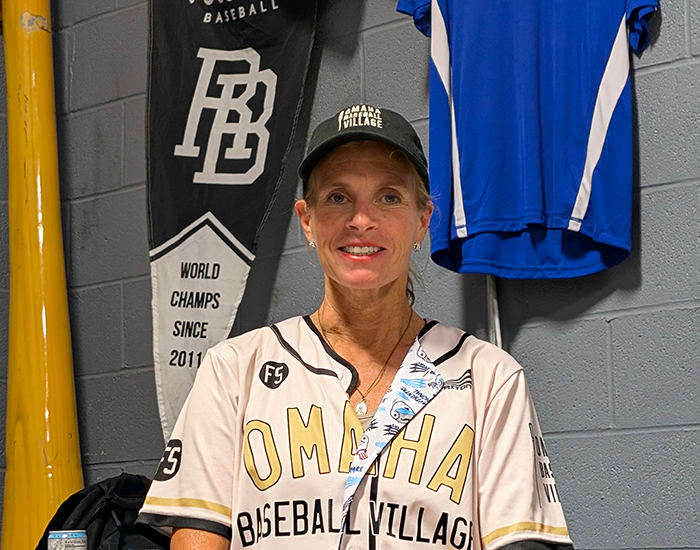
Jenny Peters,
OmahaNebraska.com, here with…
Jenny Peters, Marketing Director for the Omaha Baseball Village.
I have seen the Omaha Baseball Village for many years now, but I didn’t explore it until recently. I was impressed, so I would love to tell everybody about it.
Thank you for sharing the goodness that we have here at OBV. We are a fan event during the College World Series. We’re located directly across the street from Charles Schwab Field, and we host over 100 vendors. We have a shopping village. We have a beer garden area that’s family friendly all day and for age 21 and over after 9 p.m. We have a food court. We have a corporate tent where our anchor is the Old Mattress Factory, and we have a VIP experience there. Pretty much anything that anyone wants to do during the summer, that’s what we do. Our client base is from age 2 to 92. It’s open to the public. It’s free, other than at night when there’s a cover charge to get in for the music and everything. But it’s games and food and fun and video walls, and we cover the College World Series games on a video wall. A lot of shopping, a lot of competitions and interactive-type things to keep people busy, and that includes kids of all ages. It’s not just little kids. We see the adults playing a lot of our games. We’ve got golf, we’ve got soccer here, we’ve got a lot of baseball, and then we have a lot of spinning wheels with amazing prizes.
How long have you been doing this?
This is our 16th year. We initiated Omaha Baseball Village in 2011, the year the stadium was open downtown for the first CWS game to be played at this one, and it has been just a whirlwind. It started as an idea—a collaboration of the owners at the Old Mattress Factory—and became the new 13th Street. We really wanted to bring the fun that was happening down by Rosenblatt here to the downtown neighborhood and just welcome fans from all over the nation for some great baseball in Omaha.
What are some of the fun things for this year that you’d like people to not miss out on?
Well, we’ve got so much happening on our stage this year, even during the day. We welcome people to come down and enjoy. First of all, opening night, Thursday the 11th before the games even begin, we do our Flying Flags for Charity night, which is opening ceremonies. We’ve got First Responders Foundation coming with all kinds of their vehicles and mounted police and the dogs, the canine unit that do all the amazing things. That’s when we hoist the flags on the original eight flag poles from Rosenblatt. And we recognize eight local groups here in Omaha that are doing nonprofit work, so we’ve got some fabulous ones. This is our 15th year of doing Flying Flags for Charity. Outside of that, during the Village, everywhere you turn, there’s going to be obviously College World Series merchandise. There’s mini golf. We’ve got glow ball, which is a kind of glow-in-the-dark baseball this year that is going to be amazing. We have backyard baseball, which has made a comeback, and they are putting in a gaming studio and bringing their mascot, the infamous Pablo Sanchez. And we have of course the best food—all kinds of festival food and things like that. On opening Saturday we’ll have two very special guests. Jordan Larson will be here, and any volleyball player knows exactly who she is. We are hosting the College Baseball Foundation winners of the Buster Posey Award, the Skip Burton Coaching Award—all of those top NCAA award winners will be with us on our main stage. Every day there’s something exciting happening, but the shopping’s great, and the fun. We have a surprise happening in the center of our property that kids will come and see and be blown away by what’s happening there. I can’t give away the secret, but there’s going to be a treat.
What day will the surprise be revealed?
It will be revealed probably on opening day if it’s up and running, if not, on Friday the 12th for sure.
What nonprofits are being recognized? Is it too soon to say that?
No, we’re happy to promote them. The goal of Flying Flags for Charity really is to create and generate awareness for these nonprofit groups, large or small. We’ve worked with over 80 nonprofit groups over the years here in Omaha. We have one coming this year that’s not from Omaha, but their mission is so beautiful and aligns so well with baseball that we have them. We have the First Responders Foundation. We have League of Angels, which is out of Knoxville, Tennessee, and they take adults and children with developmental disabilities so that they can play baseball in major stadiums across the country. We’re hoping that they will bring a team here someday just to play and have a great experience. We’ve got Foster Heart and Hope. We have the Christopher Bremer Foundation. On Monday, we have Mosaic, which has been around since 1919. Who knew that?
I did not.
It’s amazing, and they’re a great organization. We have Season Heavenly Peace, we have Masons’ Day, and we have Bags of Fun, who create backpacks of all kinds of toys and things to keep kids busy when they’re in long-term hospital care. The best part about all of it is that our vendors are the contributors to this. So the fans come, and the goal is to help donate and raise funding for the organizations and create awareness, but our vendors are sponsoring them as our corporate sponsors, and they are also providing lots of prizes. So when we do these presentations on stage each day between games, we are allowing them to talk about their mission. They usually invite a family or someone that’s been affected in a good way to share just a couple-minute story about… it’s just goodness. It’s like you watch that happen. There’s tears, and you know, not a dry eye. And then we give away Oakley sunglasses and sliding mitts from Evo Shield and bats and you name it. We’re giving away prizes every single day, and it’s because of the generosity of these vendors, these over 100 vendors, that are here with us. It’s perfect.
How did you end up having this role, and what prepared you for it before?
That’s a great question, actually. I love that. I have been with the Old Mattress Factory since its opening in 2007 as the marketing person. And again, we are one of Omaha’s best event sites because we respond to large things happening at all times, whether it’s regional basketball happening at the CHI Center or big volleyball weekends. I can’t say enough about the staff at the Old Mattress Factory. They’re fantastic. And what they put on with Corporate Tent and the VIP experience and how they run a restaurant and run a beer garden the size of it all day and all night to the people that come to hear the DJs, it’s every single night. It’s insane.
So I have to give a shout out to The Mat. When we found out the stadium was being built, it was just a vision. We tried to learn a lot about Rosenblatt and what the crowds were like, and we did a two-year stint as a beer garden down there where we rented a little spot, set up shop, and learned about the fans and what they were. Not really how to sell beer, but how to sell beer and how to engage with everybody. And we just kind of created our own version of this, created our own mindset of what we thought people would want here in Omaha.
So we bought a lot of the Rosenblatt seats. You’ll see them around the property. We bought the flag poles and put them up. We do a lot of commemorative things along the way that kind of give the love back to the baseball tradition here that started so long ago back on South 13th Street. And then basically we decided we wanted to take care of corporate guests. We wanted to be able to host a team, alumni group, if they come.
We also want people to come here with their grandparents. We want the team members to come over when they’re not playing. We love the Little Leaguers that are in town. Everybody is welcome, and we try to cater. We’ve taken feedback from them, and we’ve learned what the people like best. And we’ve learned that once you’ve paid to park downtown, you might as well just stick around for a while, right? So you’re here, you’re going to a game, or you’re not going to a game. We really just want the experience.
We’re seeing our large check, so we donate. This is an example of what we do on stage each day is we will present. So this is from last year, but yeah. Last year, one of ours was Partnership for Kids. My job is to create an experience, and that isn’t just for the fans, it’s for the vendors who are here, it’s for our corporate sponsors, it’s for our staff. We have an amazing, very busy staff, as you can tell. And you see the energy and the electric—just overall, like, happiness. I think people just bring happiness to the College World Series. You just see it in the fans and in the people, and everyone’s so happy to be here. And it’s really a fun environment to be a part of. That’s why I welcome all of Omaha. I know a lot of Omaha, Nebraska, residents try to avoid this part of town this time of year because it’s congested and a lot going on. But in general, it is something you have to see. It’s a “seeing is believing” event for sure.
I’ve definitely enjoyed being here and catching games and covering the stories. And there’s just something special about the College World Series. There’s something special in everything, but I can’t really describe how special the experience is of just being here, even if you’re not seeing a game.
I agree. I agree, and we tell people all the time that if you can’t get a ticket, there are a number of places where you can catch a game. We obviously have huge video walls in our beer garden, and lots of people just, you’re there with your friends, you’re having a good time, you’re playing cornhole, trying your golf swing out at a simulator. I mean, what’s not to love? The beer is cold, the food’s good. But again, there’s nothing quite like what they do in the stadium. I can’t say enough again either about College World Series Inc and the NCAA, what a fine show they put on. The games are beautiful. The field is immaculate, and the teams are so happy. When you’re anywhere in this neighborhood, when something good happens, you hear it before it hits the TV anyway. So you know something big happened, and you’re like, what, what, what? Get me to a TV. So I think fans come down here just to enjoy the atmosphere that Omaha has created. We are a very welcoming community. And when you take a look, when you look outside this office building, a 360-degree view, it’s just beautiful, from the pedestrian bridge, and riverfront area to what’s happening with Creighton’s new stadium. You look downtown. The signage will go on the Mutual of Omaha building this weekend. It’s a little busy in the beginning, but after opening weekend I do get to visit with fans a little bit and it’s my favorite part. And they really do ask me every year, “Is Omaha really this nice?” And I’ve said, “Yes, yes it is. Omaha is this nice, and the people here are really good-natured.” So we’re a welcoming host site for this event, and I hope we get to keep it.
We moved here some years ago and it just was instantly home.
I agree. My husband and I came here for him to go to Creighton Law School. We had absolutely no intention of staying here because we’re from Illinois and we had a mindset to go back closer to family after three years, and we’ve been here over 30 years. And we say it, “We got Omaha.” I think it’s like a verb, you got Omaha. It’s a good place, and I think people are surprised. They’re not sure what to expect when they get here and when they do… as you know, the LSU fans come whether their team is here or not. When you see them, you know it’s their summer vacation. They come up because they love the series, they love the baseball, they love the city. They come back to say hello, and we’ve got a lot of favorites. And ours aren’t always favorite teams. It’s usually the fan bases. So we pick the ones that really want to be here.
What question would you like me to have asked that I didn’t, or what item would you like to promote or what activity?
I would love to promote for people to follow us on social media at Omaha Baseball Village and really just kind of engage in what’s going on. But don’t stop there. When you see something fun, come down. Probably that same kind of experience will happen to them. There are lots of people, and it is hot. Bring your water, and come on down and enjoy it, because what’s happening here, we don’t just put the best things on social media. Those are things that are just organically happening. And when we do something big, we don’t promote most of it. We like to let it just happen because the people are already here and so the ones who are here get to experience it. Oh my gosh, we’re giving away a full Cutco knife set because he’s one of our vendors and someone that’s in house that day is going to win it. I encourage people to just come and experience it and smile. Have fun.
What’s your website and social media where people should be following you?
You can follow the Old Mattress Factory, and you can also follow OmahaBaseballVillage.com. The nightly DJ schedule is on there. Our daily schedule for the most part is on there. And I should have probably also recommended that for people who maybe didn’t get a chance to come down and we’re almost to the end of it, we will be having a concert on the second Friday. So Friday the 19th we are having Pet Rock here. It’s a no-game day, kind of a day off. We change our stage out. Instead of being a DJ stage, we do a daytime concert with an opener and it becomes a music venue. And it’s so different because it’s not baseball, and tickets are inexpensive. It’s just a great time. So we really want to encourage people to come down. I think we’re calling it Friday Night Live. And Pet Rock is our entertainment. Should be great fun for everybody just to enjoy. Just come and do an outdoor concert. You don’t have to spend loads of money. Just come have fun.
The College World Series transforms Omaha into one of the most exciting sports destinations in the country each summer. Fans from across the United States and the world travel to Omaha for championship baseball, restaurants, nightlife, entertainment districts, arts venues, breweries, and local attractions throughout the city.
Whether you are visiting Omaha for the first time or returning for another year of the tournament, this guide will help you explore Omaha during the College World Series.
ABOUT THE COLLEGE WORLD SERIES IN OMAHA
The College World Series is one of the most recognized traditions in college baseball and one of the largest annual sporting events in Nebraska. Each summer, fans from across the country and the world travel to Omaha to watch the final teams compete for the national championship.
Omaha has hosted the College World Series since 1950 after local civic leaders worked to bring the tournament to the city. Over the decades, the event became deeply connected to Omaha’s identity and helped establish a national association between the city and college baseball.
Volunteer organizations, local businesses, civic leaders, and generations of fans helped shape the College World Series into one of Omaha’s most recognized annual traditions.
The tournament continues to draw visitors from across the country and world while helping shape Omaha’s national reputation as both a sports and tourism destination.
Midtown Omaha includes restaurants, coffee shops, international cuisine, and locally owned businesses located between downtown Omaha and west-central neighborhoods.
“There are no bad days in Omaha.”
— Anthony Holman
“The College World Series is just growing in national profile.”
— Amy Hornocker
“The College World Series is something that I think Omahans love and can’t wait for every year.”
— Mayor Jean Stothert
“You will fall in love with Omaha.”
— Mayor John Ewing Jr.
The College World Series offers visitors the opportunity to experience not only championship baseball, but also Omaha’s neighborhoods, restaurants, nightlife, attractions, arts venues, museums, breweries, and local culture.This guide will continue expanding with updated recommendations, interviews, local coverage, and Omaha visitor resources leading into the 2026 tournament.
Please visit back and learn more about Omaha and the fun things to do here!
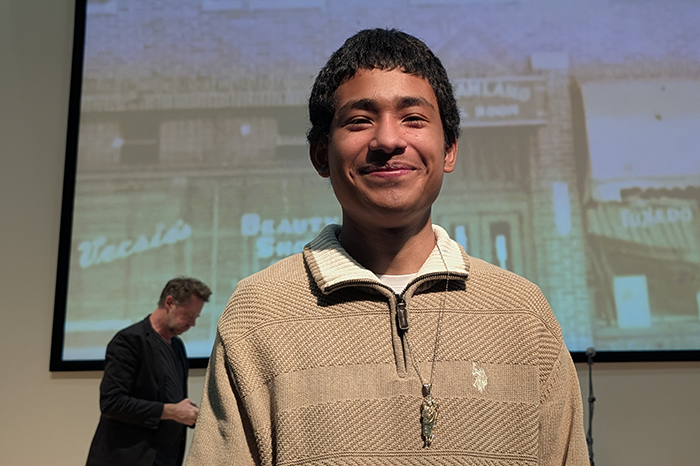
Rodrigo Ramirez Sanchez in the Stanley and Dorothy Truhlsen Lecture Hall at the Durham Museum
OmahaNebraska.com here with…
Rodrigo Ramirez Sanchez.
Tell me a little bit about yourself, how you came to work on the project, and your project.
So a little bit about myself: I’m a junior now. I worked on this project about three years ago. In middle school, certain people got chosen to be part of this program going into freshman year, and I was one of the lucky ones to get elected for this. My project was the Walker Hotel. That’s the one I researched about. Being a part of this program made me realize how much history Omaha has. And growing up in North Omaha, knowing all this stuff happened in my neighborhood, and now as a junior taking Omaha history, I see that all this history in Omaha is pretty interesting, more that I live in North Omaha. So I’m really fortunate to be able to be a part of this exhibit.
How did you do the research?
I didn’t really know a lot about the history of Omaha until this program. and we researched it on websites and stuff, and we went on a field trip to visit where the Blackburn is right now, where the Walker Hotel was, and we’ve seen different sites and all this. And after we finished our little project, and then, yeah, that’s pretty much how I finished the whole project.
You mentioned earlier that this changed your life and had an impact. What was that?
It really did, because now I know everything back then, it wasn’t easy for colored people and stuff. And North and South Omaha just have a lot of history, and that’s places I’m always around. So yes, and it made me realize there’s a lot of history in Omaha and there’s still more for me to learn about Omaha.
It’s amazing how much the history is in the city. I’ve been delving into it a little bit. But wow, you just keep going and keep going. What are you thinking of for maybe a future project to work on?
Future project? I would have to see and learn a little bit more about Omaha and maybe write a little something about another project or something.
What takeaway can you give people for the project that you worked on? And what would you like people to know or remember?
The Walker Hotel was one of the most popular in the Green Book traveling guide. It was one of the more popular ones. It was a motel and a restaurant, I believe. Downstairs it was a restaurant and then upstairs was the motel. I hope all this history keeps on going forward for other kids to learn about it and stuff.
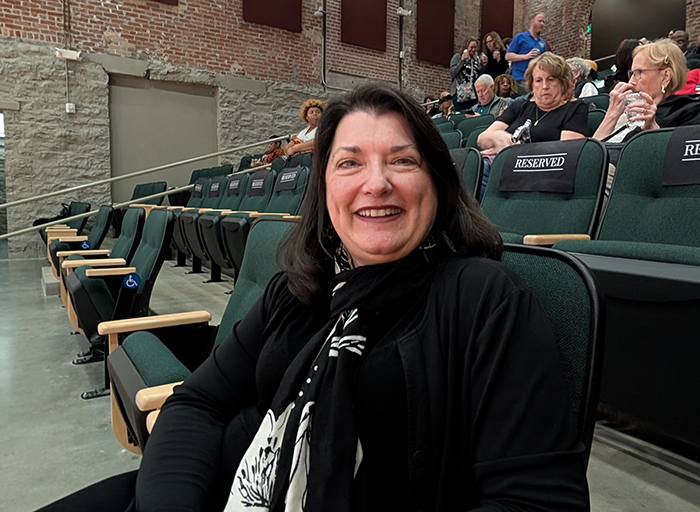
Kristine Gerber seated in auditorium before her talk in the Stanley and Dorothy Truhlsen Lecture Hall at the Durham Museum
OmahaNebraska.com here with…
Kristine Gerber.
Tell me a little bit about what you’ve done before and then about your involvement in the project.
I’m a local historian, so for the past 25 years, I have worked to tell Omaha’s stories. I’ve worked at the Omaha World Herald doing books. I’ve worked at Restoration Exchange Omaha, trying to save old buildings. And so now for the last five years, I’ve worked for Omaha Public Schools, helping students and teachers uncover and share Omaha’s diverse history.
Something I’ve been very interested and excited about is following the history of people here, the area, the buildings, what happened and then what’s going on and then where maybe the future is going. Tell me about your involvement in this project…how you got involved.
I’ve been working with ¨¨Making Invisible Histories Visible¨¨ for five years now, and every year we have a different subject or project and I get to pick it, which is always fun.
Wow.
So in 2023, I decided to do the Green Book project. And I picked that because I had seen the Green Book movie, but I also knew the Smithsonian had a Green Book exhibit going around and I had seen it and it was amazing. and I just was curious. I’m, like, well, I’m sure Omaha had some Green Book sites, but where were they and how many? And I thought this would be a good project for our kids and our teachers to do.
I understand Omaha’s Green Book sites had some unusual pieces to it compared to the rest of the country.
Candace C. Taylor, who’s a national scholar of the Green Book, will say that in most communities, 80% to 85% of the properties were African American owned. But in Omaha, only 60% of the properties were African American owned. And the reason for that is in North Omaha, where a majority of African Americans live, there was also a large Jewish community. These Jewish-owned businesses included delis and liquor stores that were open to African Americans. And so there was some Jewish, but then there were also just some also European immigrants, that knew that they should be open and welcoming to African Americans. And there were Green Book sites in North Omaha, but there also was an African-American community just across from the stockyards around the 30th and Q area, so there were three sites in that area.
Do you have a favorite section or exhibit or something that people should not miss when they go visit?
You know, what I really like is the trunk. So the trunk shows what an African American family had to pack for a trip. Unlike white Americans who could just go and not think about these things, African Americans had to think about “What if we can’t get something? We have to be prepared.” So in the trunk is a gas can filled with gas in case they couldn’t find a place to stop. They had things to cook with, like a big pot and some food. They had tents or sleeping bags in case they couldn’t find a place to stay. And they had a big cooler with food that they had made in case they couldn’t find a restaurant. So all of these things they had to think through. One of the lessons that we had our kids do is we gave them a Green Book, and we said, “You need to plan a two-day trip, but you can only stop at Green Book sites.” I had them start in New York because I wanted to give them a fair chance and have it so there would be lots of places. So they had to take a two-day trip starting from New York and going in any direction, okay? And they could only stay, gas up, go to Greenbook sites. Within like 5 to 10 minutes, they’re, like, “Oh, my God, Mrs. Gerber, this is really hard.” I’m, like, “I know.” They’re, like, “I’m going to run out of gas.” I’m, like, “Well, you have to think ahead. And when you can find gas, you’ve got to fill up your gas can, you know?” I think I could just see the light bulbs going off. And it just was a key moment for my students to realize how unfair it was and how hard it was. It shouldn’t have been so hard.
It’s important that history becomes something more than just you read.
Yeah.
That however it is, you can try to experience it, that you can.
Yeah.
And this is a very clever idea.
Yeah, exactly.
Is there a question you would have liked me to ask that I haven’t asked?
Let’s see.
Because I feel like I’m missing…
Well, no, no, no. So one really fun thing is when we found out the Smithsonian had an exhibit, as part of my programming, the Smithsonian actually was involved. I got to know their education person, and she gave us some lessons, and they have the exhibit online because they developed it during COVID so you could look at it online. And I kept saying, “You need to bring the exhibit to Omaha.” And I am really involved in the Durham…have been forever. I’m, like, “You need to bring it to the Durham.” And they’re, like, “No, no, it’s already full. And we’re retiring it, and blah, blah, blah.” So after we were done with the project, I sent all the kids’ projects to the Smithsonian. And they were like, “We have never known someone so persistent,” and they decided to send their exhibit to Omaha, and this is the last place it’s going to be shown, and then it is going to be retired.
And then there’s a whole Omaha section.
Yeah.
So more livable moments connecting with the actual area we live in.
Yeah, because we were able to share all this great information with them.
Please tell me a little bit about things that you’ve done before in your life and then how this project started.
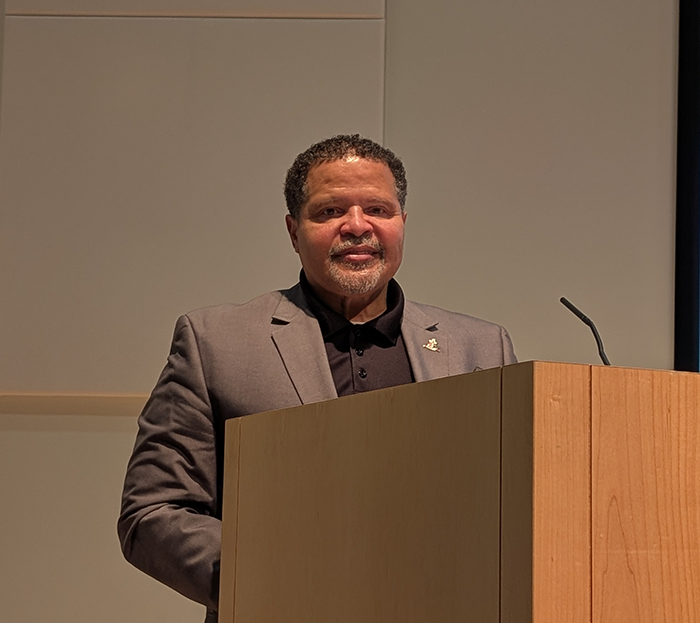
Well, I’ve been having the honor of serving as the executive director for the Great Plains Black History Museum for the last nine years. I come from a health care background, having served in the military for 20 years where I worked in healthcare. I currently still teach health care management. I’ve been having the fortunate opportunity to work here for the Great Plains Black History Museum and serving as its executive director where we’ve had an opportunity to tell some stories that may have either never been told or have been undertold through others. And so we’ve been having an opportunity to bring more awareness to the rich history of African Americans and what it brings not only to the city of Omaha, but throughout the Great Plains and throughout America.
Thank you. Tell me a little bit about how this project got started and then your involvement here.
Well, Ms. Kristine Gerber worked for “Making Invisible History Visible” a few years ago. That project works with high school students. Back in 2023, she had a group of students who did some research to locate the Green Book sites that were here in Omaha. There were a total of 30 Green Book sites here in Omaha. The students found those spots and researched them, and they found old pictures of the buildings and then newer pictures of those buildings that were still standing. The interesting thing about it is that with other Green Book sites throughout America, maybe 20% of the buildings are still standing. But here in Omaha, it’s unique, where 36% of the buildings that served as Green Book sites are still standing. And also, not all the Green Book sites were located in North Omaha. There were three Green Book sites in South Omaha on Q Street.
I know you’re going to talk some more about those later, but tell me some of your favorite ones for the area.
My favorite two, as far as hotels, is the Broadview Hotel, also referred to as the castle, because it does look like a castle. It was in the Green Book a few years. It’s one of the more noticeable places in North Omaha. And also, even though it’s no longer standing, the other place that was really intriguing was the Patton Hotel, because the Patton Hotel served as a place where the black porters could stay, musicians would stay as they were traveling throughout America and had any time to spend overnight, as well as the chefs that worked for Union Pacific. So those are my two favorites.
Your involvement in the project here… tell us a little bit about that.
When the Durham got an opportunity to get the Smithsonian’s Green Book story, we collaborated with them to be able to tell the Omaha story. That way, Omaha folks could see that while all these things were happening throughout history, they also got a chance to see that Omaha wasn’t just on the sidelines: Omaha was a part of that history.
So, you brought Omaha to life within this exhibit.
Yes.
Please tell us a little bit about why this is so important and everyone should come see the exhibit or learn more about the Green Book.
Well, I think it’s important because it’s a part of history. Again, it’s a part of history that a lot of times goes untold, and it’s an opportunity for folks to see, as I mentioned earlier, as things were happening throughout America, they were also happening here. So it’s important for folks to know these things because it helps them see their role, in particular, in history.
Is there a question you would have liked me to ask that I didn’t ask?
“How can folks learn more about the Great Plains Black History Museum?”
I was going to ask you a separate one on that later, but yes, go for it. Tell me more about the…
Well, the Great Plains Black History Museum has been in existence…this year we’re celebrating our 50th anniversary. It was started by Mrs. Bertha Callaway, and it started in the old historic Webster Building. We’re now currently operating out of the historic Jewel Building, which was the home of the Dreamland Ballroom and other venues. We currently occupy part of the first floor, and we’ve had the fortunate opportunity to be there for almost nine years. We’re open Wednesdays through Saturdays from 1 to 5 pm.