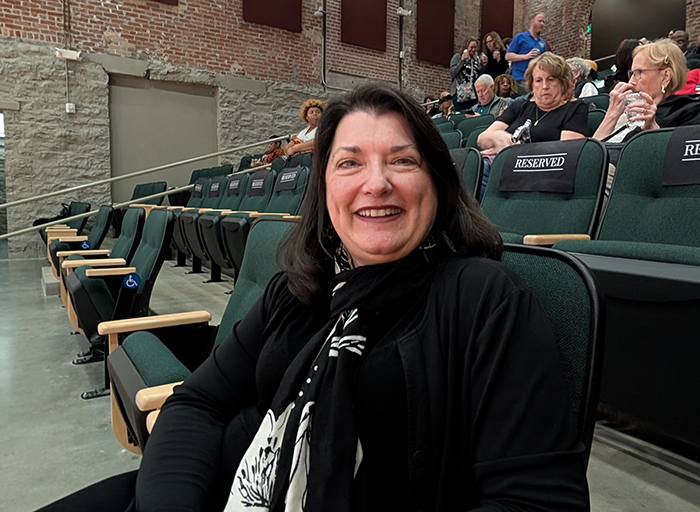
OmahaNebraska.com here with…
Kristine Gerber.
Tell me a little bit about what you’ve done before and then about your involvement in the project.
I’m a local historian, so for the past 25 years, I have worked to tell Omaha’s stories. I’ve worked at the Omaha World Herald doing books. I’ve worked at Restoration Exchange Omaha, trying to save old buildings. And so now for the last five years, I’ve worked for Omaha Public Schools, helping students and teachers uncover and share Omaha’s diverse history.
Something I’ve been very interested and excited about is following the history of people here, the area, the buildings, what happened and then what’s going on and then where maybe the future is going. Tell me about your involvement in this project…how you got involved.
I’ve been working with ¨¨Making Invisible Histories Visible¨¨ for five years now, and every year we have a different subject or project and I get to pick it, which is always fun.
Wow.
So in 2023, I decided to do the Green Book project. And I picked that because I had seen the Green Book movie, but I also knew the Smithsonian had a Green Book exhibit going around and I had seen it and it was amazing. and I just was curious. I’m, like, well, I’m sure Omaha had some Green Book sites, but where were they and how many? And I thought this would be a good project for our kids and our teachers to do.
I understand Omaha’s Green Book sites had some unusual pieces to it compared to the rest of the country.
Candace C. Taylor, who’s a national scholar of the Green Book, will say that in most communities, 80% to 85% of the properties were African American owned. But in Omaha, only 60% of the properties were African American owned. And the reason for that is in North Omaha, where a majority of African Americans live, there was also a large Jewish community. These Jewish-owned businesses included delis and liquor stores that were open to African Americans. And so there was some Jewish, but then there were also just some also European immigrants, that knew that they should be open and welcoming to African Americans. And there were Green Book sites in North Omaha, but there also was an African-American community just across from the stockyards around the 30th and Q area, so there were three sites in that area.
Do you have a favorite section or exhibit or something that people should not miss when they go visit?
You know, what I really like is the trunk. So the trunk shows what an African American family had to pack for a trip. Unlike white Americans who could just go and not think about these things, African Americans had to think about “What if we can’t get something? We have to be prepared.” So in the trunk is a gas can filled with gas in case they couldn’t find a place to stop. They had things to cook with, like a big pot and some food. They had tents or sleeping bags in case they couldn’t find a place to stay. And they had a big cooler with food that they had made in case they couldn’t find a restaurant. So all of these things they had to think through. One of the lessons that we had our kids do is we gave them a Green Book, and we said, “You need to plan a two-day trip, but you can only stop at Green Book sites.” I had them start in New York because I wanted to give them a fair chance and have it so there would be lots of places. So they had to take a two-day trip starting from New York and going in any direction, okay? And they could only stay, gas up, go to Greenbook sites. Within like 5 to 10 minutes, they’re, like, “Oh, my God, Mrs. Gerber, this is really hard.” I’m, like, “I know.” They’re, like, “I’m going to run out of gas.” I’m, like, “Well, you have to think ahead. And when you can find gas, you’ve got to fill up your gas can, you know?” I think I could just see the light bulbs going off. And it just was a key moment for my students to realize how unfair it was and how hard it was. It shouldn’t have been so hard.
It’s important that history becomes something more than just you read.
Yeah.
That however it is, you can try to experience it, that you can.
Yeah.
And this is a very clever idea.
Yeah, exactly.
Is there a question you would have liked me to ask that I haven’t asked?
Let’s see.
Because I feel like I’m missing…
Well, no, no, no. So one really fun thing is when we found out the Smithsonian had an exhibit, as part of my programming, the Smithsonian actually was involved. I got to know their education person, and she gave us some lessons, and they have the exhibit online because they developed it during COVID so you could look at it online. And I kept saying, “You need to bring the exhibit to Omaha.” And I am really involved in the Durham…have been forever. I’m, like, “You need to bring it to the Durham.” And they’re, like, “No, no, it’s already full. And we’re retiring it, and blah, blah, blah.” So after we were done with the project, I sent all the kids’ projects to the Smithsonian. And they were like, “We have never known someone so persistent,” and they decided to send their exhibit to Omaha, and this is the last place it’s going to be shown, and then it is going to be retired.
And then there’s a whole Omaha section.
Yeah.
So more livable moments connecting with the actual area we live in.
Yeah, because we were able to share all this great information with them.
Thank you.
