OmahaNebraska.com here with…
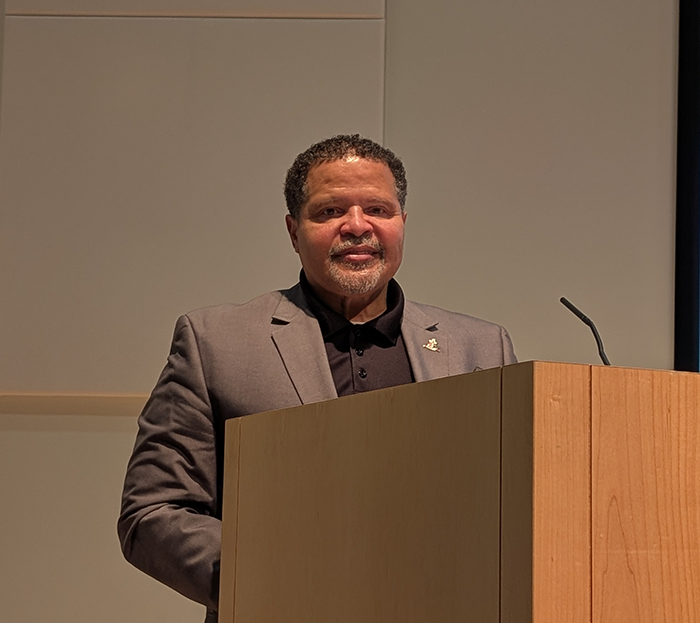
Eric L. Ewing.
Please tell me a little bit about things that you’ve done before in your life and then how this project started.
Well, I’ve been having the honor of serving as the executive director for the Great Plains Black History Museum for the last nine years. I come from a health care background, having served in the military for 20 years where I worked in healthcare. I currently still teach health care management. I’ve been having the fortunate opportunity to work here for the Great Plains Black History Museum and serving as its executive director where we’ve had an opportunity to tell some stories that may have either never been told or have been undertold through others. And so we’ve been having an opportunity to bring more awareness to the rich history of African Americans and what it brings not only to the city of Omaha, but throughout the Great Plains and throughout America.
Thank you. Tell me a little bit about how this project got started and then your involvement here.
Well, Ms. Kristine Gerber worked for “Making Invisible History Visible” a few years ago. That project works with high school students. Back in 2023, she had a group of students who did some research to locate the Green Book sites that were here in Omaha. There were a total of 30 Green Book sites here in Omaha. The students found those spots and researched them, and they found old pictures of the buildings and then newer pictures of those buildings that were still standing. The interesting thing about it is that with other Green Book sites throughout America, maybe 20% of the buildings are still standing. But here in Omaha, it’s unique, where 36% of the buildings that served as Green Book sites are still standing. And also, not all the Green Book sites were located in North Omaha. There were three Green Book sites in South Omaha on Q Street.
I know you’re going to talk some more about those later, but tell me some of your favorite ones for the area.
My favorite two, as far as hotels, is the Broadview Hotel, also referred to as the castle, because it does look like a castle. It was in the Green Book a few years. It’s one of the more noticeable places in North Omaha. And also, even though it’s no longer standing, the other place that was really intriguing was the Patton Hotel, because the Patton Hotel served as a place where the black porters could stay, musicians would stay as they were traveling throughout America and had any time to spend overnight, as well as the chefs that worked for Union Pacific. So those are my two favorites.
Your involvement in the project here… tell us a little bit about that.
When the Durham got an opportunity to get the Smithsonian’s Green Book story, we collaborated with them to be able to tell the Omaha story. That way, Omaha folks could see that while all these things were happening throughout history, they also got a chance to see that Omaha wasn’t just on the sidelines: Omaha was a part of that history.
So, you brought Omaha to life within this exhibit.
Yes.
Please tell us a little bit about why this is so important and everyone should come see the exhibit or learn more about the Green Book.
Well, I think it’s important because it’s a part of history. Again, it’s a part of history that a lot of times goes untold, and it’s an opportunity for folks to see, as I mentioned earlier, as things were happening throughout America, they were also happening here. So it’s important for folks to know these things because it helps them see their role, in particular, in history.
Is there a question you would have liked me to ask that I didn’t ask?
“How can folks learn more about the Great Plains Black History Museum?”
I was going to ask you a separate one on that later, but yes, go for it. Tell me more about the…
Well, the Great Plains Black History Museum has been in existence…this year we’re celebrating our 50th anniversary. It was started by Mrs. Bertha Callaway, and it started in the old historic Webster Building. We’re now currently operating out of the historic Jewel Building, which was the home of the Dreamland Ballroom and other venues. We currently occupy part of the first floor, and we’ve had the fortunate opportunity to be there for almost nine years. We’re open Wednesdays through Saturdays from 1 to 5 pm.
And that website and phone number?
The website is GPBlackhistorymuseum.org. Our phone number is 402-932-7077.
Thank you.
You’re welcome.
