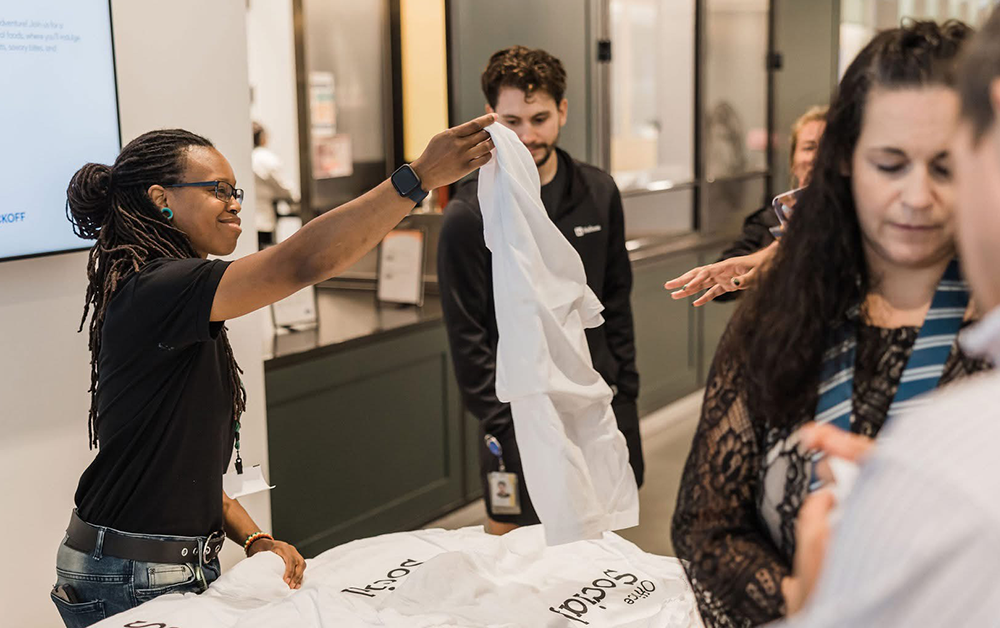
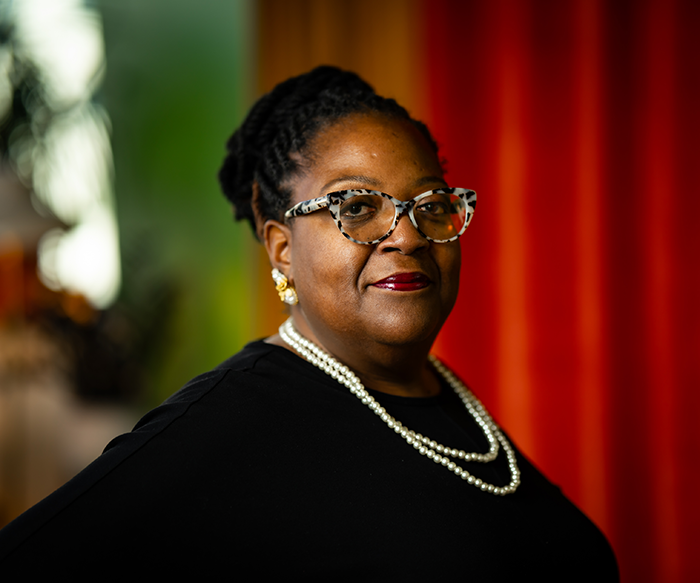
La Kesha Johnson with Omaha printing equipment in the background
La Kesha Johnson.
Please tell me a little bit about yourself and how you came to own your business.
I discovered that I was a creative person back when I was working in the corporate world. I worked at Bank of the West corporate building and as a creative person, that was something that was just like, no, I can’t do this.
So in 2019, I started to explore YouTube for business ideas. One morning, Youtube suggested a video of a guy screen printing T-shirts in his garage. I watched that video at least 20 times, and I was like,”Man, all I wear is T-shirts and hoodies!”
In late 2019, I bought my first piece of equipment: a heat press. Then a few months later, COVID happened and the bank sent us home to work. So from 2020 to 2023, I spent a lot of time just trying to teach myself the entirety of the screen printing process. Everything was closed, so I couldn’t take classes or anything. But in 2023, I decided it was time to invest in some in-person training with my mentor in Texas.
I ended up landing my first big order in August of 2023. So I decided to jump ship because at the time the bank was in the middle of a transition.
I ended up quitting the corporate job September 6, 2023.
What kind of things do you print?
I specialize in screen printing. T-shirts, hoodies, anything you can wear.
I also do what’s called digital printing. Some people may know that as DTF (Direct to Film). So that’s basically just me doing a transfer. I offer embroidery as well.
I also specialize in signage: tablecloths, backdrops, retractable banners.
So a lot of people tend to come to me to get both as a package in one place.
What kind of kind of companies have you worked with before?
I do a lot of nonprofit work. At least 50% of the jobs I get are from local nonprofits.
The other portion of my work comes from a combination of small businesses like coffee shops. I also get a lot from contractors.
What types of apparel have you printed?
The bulk of my work is T-shirts but I also do a lot of hoodies when it gets cold.
I do a lot of zip hoodies and jackets. I occasionally get hats.
Is there a question you wished I would have asked?
My most favorite thing about what I do has nothing to do with the printing.
I love when I get to meet people in person, walk into their establishment, and see
the excitement on their face. It makes me so happy to see people get so excited to see their new apparel!
Another one of my favorite parts about the process is doing the test print. That moment where I get to see that image coming together for the first time, it’s just so great, and I love it.
I get to give back. I get to directly see the impact that I’m making on these businesses and the people that get to wear this apparel. So, that makes me excited!
Call Imperial Custom Printing in Omaha at (402) 290-5538 today for your custom apparel printing needs!
Dawn Myron with holiday sweater in front of the Durham Christmas Tree
OmahaNebraska.com here with…
Dawn Myron. My title is the Senior Manager of Marketing and Brand.
Please tell me a little bit about yourself and how you came to be in your position.
I have been working in the non-profit world for quite some time, and in 2016 I came to the Durham Museum from the Salvation Army Kroc Center here in Omaha. I started as a graphic artist here, and I’ve held a few different roles in my time in the marketing area. One of the things that I love about this place is how generations connect. I think that the traditions that the museum helps to cultivate just are so heartwarming, and of course, the history that we tell. It’s so important to share that history and to get all generations excited. It’s work that I really love doing, and I love how there’s always something new at the museum, whether it be a new exhibit, a new event, or a new education program. I’m just really excited to be here.
Tell us a little bit about the lighting event today.
Okay. So tonight is the kickoff to our Christmas at Union Station, presented by FNBO. It’s an annual event. This will be the 50th year that the Durham Museum is doing Christmas at Union Station, but it is an event that predates the museum. The museum opened in 1975, but our home, Union Station, Union Pacific has been bringing in a tree to be the centerpiece of the Suzanne and Walter Scott Great Hall—that’s what it’s called now—a live tree has been brought in to be the centerpiece of the Christmas festivities since Union Station was a train depot in the 1930s, so it’s pretty special. Union Pacific, when they started the tradition, they would actually go to the Pacific Northwest and they would get a tree from the Pacific Northwest, bring it by rail here to Omaha. But today we don’t go as far to find our tree. We actually search for nominations here in the metro area. We usually have about 30 to 40 families who nominate their tree, and we go out and we look at them. We find the one that is the perfect tree.
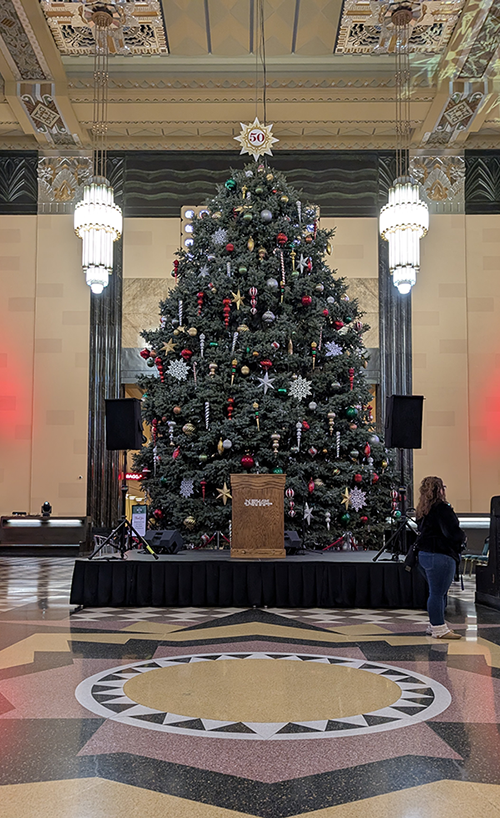
A full view of the Durham Christmas Tree bedecked with ornaments, snowflakes and lights
We really got a special one this year for the museum’s 50th anniversary. It’s big, beautiful tree, and tonight we are actually going to light it up with over 1,000 feet of LED lights, and it’s got a beautiful tree topper on it with a big 50 on it to celebrate our anniversary. And at 7:00 we are going to light the tree, and that will be the start of Christmas at Union Station.
A box of sugar cookies waiting to be decorated
This season we have a lot going on. We’ve got cookie decorating.
Side view of Jordi and the Jitterbugs performing in front of the Durham Christmas Tree
We’ve got Jordi and the Jitterbugs, who are going to entertain us and help us rock around the Christmas tree tonight.
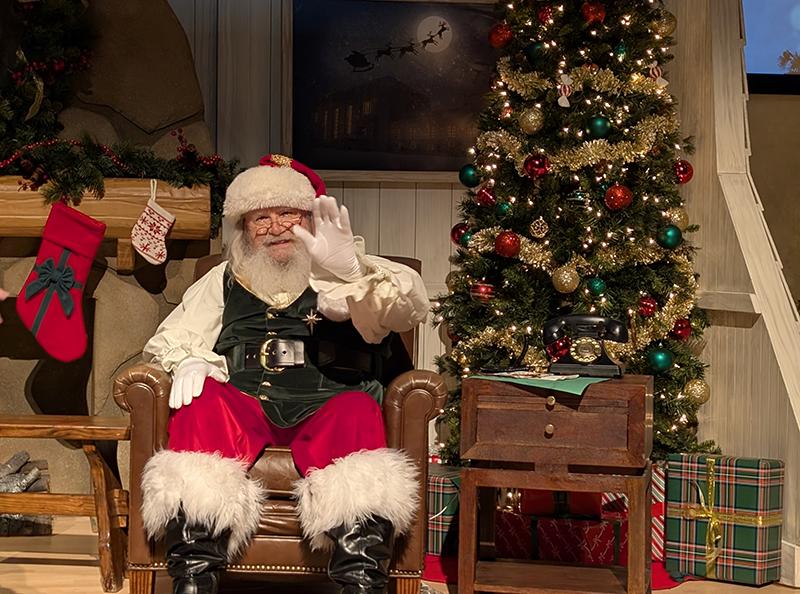
A Christmas Elf poses for us by the Durham Switchboard. She helps Santa and takes calls from visitors.The Jolly Old Elf himself, Santa, waves at the photographer for a great picture. Thank you Santa!
And we’ve got Santa. So if kids want to share their wish list with Santa, they can meet him down in Santa’s cabin and share everything that they’re looking forward to this Christmas. Also, new for our 50th, we have a brand new activity, and that is a sock skating pond.
I am quite curious about that.
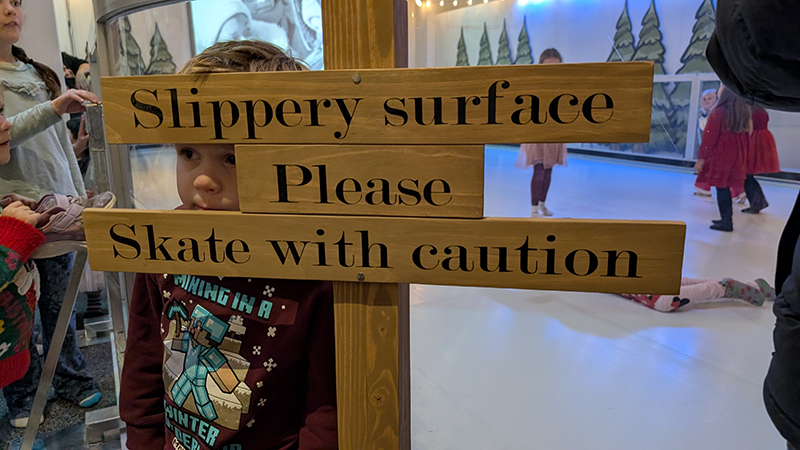
People of all ages wait in line for the Sock Skating PondChildren sock skate happily on the treated floor piece amongst pictures of Christmas trees with parents photographing this special moment.A child peeps out of the slippery surface warning sign with the reason for its placement to the right (fallen skater)
Yeah, so it’s pretty fun, and it’s kind of a new twist on an old tradition, and we’re all about tradition here at the Durham Museum. We’re super excited about that. And then throughout the season, we’re going to have Santa every day. You can slide and glide on the sock skate pond all season long.
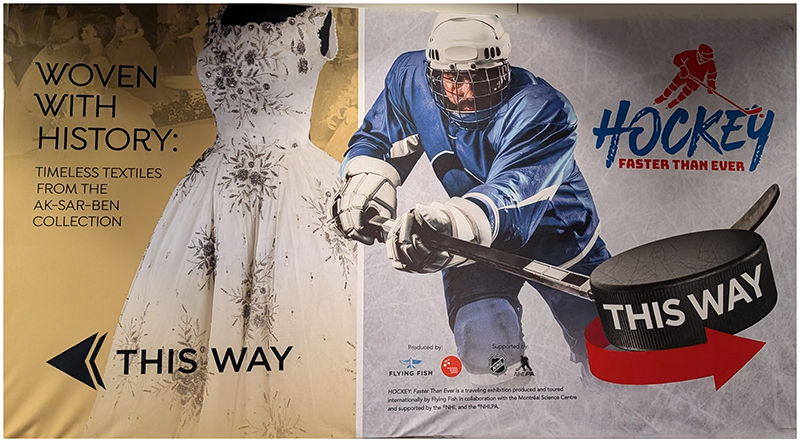
A split poster style sign with the white gown and text (WOVEN WITH HISTORY: TIMELESS TEXTILES FROM THE AK-SAR-BEN COLLECTION, THIS WAY ) for the Aksarben gown exhibit and the image of a hockey player wit text (HOCKEY FASTER THAN EVER, THIS WAY ) on the right
We’ve got some really fun exhibits too, some really interesting exhibits. A traveling exhibit, we have a hockey exhibit. It’s really interactive. And then we have a local exhibit that we curated that talks about Omaha’s history with hockey and kind of our trifecta of the Mavericks, the Lancers, and the Knights. And if sports is not your thing, we also have a beautiful exhibit that features the Aksarben gowns. It’s gorgeous, yeah. So a little something for everyone this season at the Durham Museum.
Thank you. A little bit about the tree and the family?
Yeah, so this year’s tree was donated by C.J. and Stephen Carr. They are from La Vista and just a really fun nugget at their home, which they are new homeowners. They just moved in a couple months ago, and when we had selected the tree, the previous owner had nominated it for Christmas at Union Station. When we selected it and found out that the home was being sold, we weren’t sure that we were going to get the tree, but when they heard about the tradition and what it means to be a Christmas at Union Station tree, they were completely enamored and wanted to participate as well. Plus, the tree was gigantic and just dwarfed their house. They didn’t have any space in between really their front door and the tree. It had totally overgrown its space in the yard and was starting to become problematic for the homeowners, so it was kind of a win-win for both of us. But we talk about history, and one of the really cool things about their home is that it was one of the first houses built in La Vista. A lot of tradition and history there too, which of course we love, being a history museum.
La Vista has a very interesting history all to its own, too.
Let’s see what else there is at the Durham. What’s coming up next?
After Christmas?
After Christmas.
Okay. So we are going to be announcing our 2026 exhibition lineup very, very soon. I’ll give you a little sneak peek as to some of the things. One of them that we’ve already announced is the Negro Motorist Green Book. And so that delves into the history of blacks traveling in America and kind of using the Green Book and the stories there. And we also are tying that in locally and talking about the locations here in Omaha that were part of that. We’re actually partnering with a few other entities to tell that story here in Omaha. In addition to that, we’re going to have some exhibits that, like the Green Book exhibit, are very history-focused, one related to the 250th anniversary of the United States. And then we’re going to also delve into some pop culture and the history related to pop culture. We’ve got a Disney exhibit we’re bringing in. We’re going to be doing something with Legos this year. And then we’re also planning on bringing back the White Christmas exhibit that was so popular, but we’re going to expand that. So quite a few fun things and interesting things we’re bringing into the new year.
Thank you very much. And are there any questions you wish I would have asked that I didn’t yet?
Let’s see… You know what? I would love to tell you a little bit about a few more activities that we’re going to be having in December. So this December, one of the things, if someone’s interested in stories like how Christmas at Union Station came to be, or how the museum kind of renewed this tradition, I really encourage people to check out our new “behind the scenes” tours. One of our museum educators will walk people through the hidden history behind that activity so you can get to learn a little bit more about it. So that’s a great thing if you want to come and sign up for that. In addition to that, we’ve got great winter camps for kids. I also would highly recommend that folks check out the Holiday Cultural Festival, which is December 5th. That is a tradition that in some form or another has been going on for 34 years, and it’s an opportunity to celebrate all the different cultures that make up the people of Omaha and the region. We have 35 cultural groups who are going to be joining us for that. There will be music, there will be gifts, there will be food. It’s just a really special event.
That’s one of my favorite events.
Oh, have you been to that?
I love that event.
Yeah, so very cool. I’m glad you have enjoyed that.
So many things here too. I was glad that I finally became a member.
Thank you for being a member. We really appreciate that.
Feeding Community, Preserving Legacy: An Interview with Gladys Harrison of Big Mama’s Kitchen & Catering
Few restaurants in Omaha carry a legacy as rich—or as rooted in love—as Big Mama’s Kitchen & Catering. Since opening its doors in 2007, Big Mama’s has become a destination for soul food, community connection, and generational entrepreneurship. We sat down with Gladys Harrison, owner of Big Mama’s Kitchen, to talk about her family’s history, the evolution of the business, and the vision driving its future.
Gladys Harrison
Growing Up in Big Mama’s Kitchen
My name is Gladys Harrison, and I’m the owner of Big Mama’s Kitchen and Catering.
Gladys laughs when she says she “started working at the restaurant basically at birth.” Before Big Mama’s was a brick-and-mortar restaurant, it was an in-home catering service run by her mother, Patricia “Big Mama” Barron, for over 40 years. Everyone in the family had a job—including the little ones.
As a child, Gladys washed dishes, helped fill piping bags, traced wax-paper liners for cakes, and even learned to make icing roses by hand. “I was licking the cake batter off the spoon too,” she adds. “Food and family were always intertwined.”
When Big Mama began catering outside the home, the whole family pitched in—prepping, loading, delivering, and setting up events. Later, when weekend food sales began out of Big Mama’s home kitchen, Gladys became the designated emailer, flyer-maker, and menu creator.
“I was born into Big Mama’s Kitchen,” she says.
And by the time the family opened their first official restaurant in 2007, Gladys and her sisters were already seasoned veterans.
Finding Their First Location: A Leap of Faith
In the mid-2000s, conversations about revitalizing North Omaha were gaining momentum. Gladys and her mother attended community meetings hosted by organizations like the Empowerment Network, eager to be part of rebuilding the neighborhood Big Mama had grown up in.
During one meeting, they met Gail Ross, director of Turning Point, an organization housed on the former campus of the Nebraska School for the Deaf. Gail heard they were looking for a restaurant space and repeatedly encouraged them to consider a cafeteria space on the campus.
Big Mama refused—three times.
The fenced-in campus looked too much like an old school, and the dining room still smelled like 1960s cafeteria food. But after prayer, reflection, and much persistence from Gail, Big Mama agreed to take a look. Once they stepped into the enormous, fully equipped production kitchen—complete with walk-ins, a tilt skillet, ovens, and the beloved pellet-ice machine—the vision finally clicked.
Gladys remembers: “My sisters and I said, ‘Mom, this is it.’”
They stripped out the cafeteria furniture, repainted, brought décor from Big Mama’s home, and created a warm, kitchen-table atmosphere. Big Mama’s love of yellow and leopard print made its way into the dining room, because—as she always said—“leopard is not just a print, it’s an attitude.”
They opened on December 4, 2007, and held their grand opening on February 4, 2008—Big Mama’s birthday.
Overcoming Challenges and Gaining National Attention
Financing the restaurant was a battle. Banks told Big Mama she was “too old” and that her daughters didn’t know enough to run a restaurant. But with help from the Omaha Small Business Network, a small loan, retirement funds, and credit cards, the family opened their doors.
Then came the surprise that changed everything:
“Diners, Drive-Ins and Dives”.
“Had it not been for that show, we wouldn’t be here today,” Gladys says. “It brought people then, and it still brings people now. Every single day, someone walks in because they saw us on Triple D.”
In 2016, Big Mama’s was invited to join the new 75 North development, a mixed-income, community-focused neighborhood on 30th Street. The new restaurant—a bright, modern, window-lined space—was designed to be part of a food-hall environment. Big Mama participated in the design, though she passed away before the new space opened in January 2020.
A few months later, COVID-19 arrived.
Everything changed. Large gatherings vanished. Full-service catering disappeared overnight. Customers wanted individually boxed meals. The team had to reinvent processes—again and again.
“We’ve pivoted more in the last five years than at any point in our history,” Gladys says. “But we’re still here. The food is still made the way Big Mama taught us.”
A Vision for the Future: Feeding the World, Creating Opportunity
Big Mama’s dream was clear:
Feed people all over the world.
Gladys doesn’t envision franchising—not when the food is real, hand-seasoned, and handcrafted. Instead, she and her sisters expanded in a different direction:
The Seasoning Line
The signature fried chicken seasoning—passed down from Gladys’s great-grandmother—was once blended in-house by hand. Now it’s professionally produced, labeled, and ready for retail nationwide.
The line includes:
Fried Chicken Seasoning
No-Salt Seasoning (a family favorite)
“Pitmaster in a Bottle” Dry Rub
“On Anything” Seasoning
Cornbread Mix (over 100 years old)
Golden Fry Mix
This expansion opens the door to grocery stores, specialty markets, and online national shipping.
Prepared Meals & SNAP Accessibility
Gladys also envisions heat-and-eat meals—healthy, low-sodium, home-style dishes that families, seniors, and caregivers can easily warm at home. She hopes to see them available in local markets, nursing homes, assisted living facilities, and eventually via SNAP benefits.
“This can create living-wage jobs and real economic opportunity,” she says. “Food can lift families out of poverty.”
The Heart of North Omaha
Beyond the restaurant, Gladys speaks passionately about the cultural and economic importance of North Omaha.
“North Omaha has always been vibrant,” she says. “There’s immense talent, deep history, beautiful culture. We’ve contributed so much to the city’s growth.”
Events like Native Omaha Days and Christmas in the Village showcase the community’s strength and draw people from across the country. Big Mama’s, thanks to its national exposure, has long been a quiet tourism engine—bringing visitors, hotel stays, and local spending into the city.
“We once had a couple fly here from England just to eat at Big Mama’s,” Gladys recalls.
Encouraging the Next Generation
When asked what advice she has for aspiring entrepreneurs, Gladys offers a simple truth:
“Whatever you love to do—find a way to monetize it. When you enjoy the work, it doesn’t just create income. It brings joy.”
Holiday Offerings
Big Mama’s is preparing for a busy holiday season with a full heat-and-eat Thanksgiving catering menu, including:
Smoked, roasted, or deep-fried turkeys
Cornbread dressing
Macaroni and cheese
Sweet potato pudding
Red beans and rice
Sweet potato pie
And more family favorites
All dishes are prepackaged in oven-ready containers with heating instructions.
The team will close Thanksgiving Day through the following Saturday for a much-needed rest and reopen December 1.
Black Friday Seasoning Sale
All seasonings make excellent holiday gifts, and several items—including recipes from Gladys’s upcoming digital cookbook—will be available at special Black Friday pricing.
A Legacy of Love
As we wrapped up our conversation, Gladys reflected on her mother’s mission:
“My mother was adamant about making the world better than she found it. That’s what my family and I are trying to do—use our gifts to make Omaha better for everyone.”
Big Mama’s Kitchen continues to honor that legacy—feeding the community, creating opportunity, and proving that soul food is more than a meal. It’s connection. It’s culture. It’s love served hot.
Big Mama’s Kitchen
2112 North 30th Street Highlander Accelerator, Suite 201
Omaha, NE 68111
(402) 455-6262
My name is Sibhat Gebre Michael. Currently, I’m the owner of Lalibela Restaurant.
So, you were talking to me a little bit about the history of the restaurant…
Yeah, the restaurant has been open the last 15 years, since 2010. Since then, it has been a family business. Nothing changed, everybody’s the same. The only difference is the owner’s name. Everybody’s still doing the same thing.
The menu has changed a little bit. Can you tell us about the menu?
Do you think it’s changed? I don’t think it’s changed. We got a new print and a new picture we took, but we kept the same menu ever since the restaurant opened.
So everything is the same?
Everything is the same.
We might take out some items, but for now, everything is the same. In the future, we’re trying to expand more. We’re trying to add more desserts. That’s in the future, and we’ll see.
You have some very classic Ethiopian foods, and I’ve tried many of the dishes, and I just love them. My favorite, as everybody here knows, is Gored Gored.
Gored Gored, a cubed beef dish with salad and pepper mixture is shown on injera (flat circular bread made from teff)
Yes, we do, we do.
Please tell me a little bit about your food.
The only thing I would say is Ethiopian food is different than any other food. It’s like, even the spice we make, the Berbere or the Doro Wot, it’s different. It tastes different. We cook it for longer, and we have more spices in it. And yeah, my favorite one is combination. For the first-time people, I recommend a combination, which is every Ethiopian food, and you get it in a smaller portion, so on one plate pretty much you can try literally Ethiopia.
What kind of spices do you use?
The spice we use is called Berbere. Berbere has over 17 kinds of spices in it to make that different, distinguished taste.
I love that.
Yeah.
And tell us a little bit about the bread.
We call it injera bread. It’s made out of Teff flour, and it’s gluten-free, so it’s pretty much a healthy food to have.
I really enjoy that…the bread and all the spices and all of that. It’s probably good I don’t live nearby, because if I did live nearby I’d be here all the time because the food is so good here.
Yes, it is.
And the people are so good here. Both mean a lot to me.
All right, thank you.
Please tell us a little bit about your journey here as owner. What did you do before? How did you become the owner?
It’s a family business. My uncle is the one who started Lalibela. The opportunity came, and I just jumped in. And now I’m the owner, and we’re running it as a family. Even though I’m the owner, it’s just a family business.
The family touch is really evident in everything.
Yes.
Special low table for coffee preparation and serving, includes cups, sugar and incense
Like you see right here, this is pretty much a display of how Ethiopians drink coffee. This is for a ceremony, a holiday ceremony. People gather…family, friends, they come together like me and you right now.
And somebody sits down right there, you see, like the lady, pretty much somebody sits right there and makes coffee from scratch. They brew, they grind it, and what you see is they understand coffee. The smell puts you in a good mood, good spirit. That’s how people start their morning. They drink coffee with the family, and they go about their day, and they come home at night.
Any foods or dishes that you would like to talk about a little bit more? Or anything you want people to come here to try?
I would say the vegetarian is really good food. I recommend the vegetarian and the combination because it’s really different. I don’t know how to explain it, but like so many flavors in one big plate, so the experience is something you never had before.
I haven’t had the vegetarian one since you became owner, but there’s this cabbage…
Yeah.
I love that.
It’s the same thing …
Family recipe?
Yes, family recipe is passed down, so yeah.
I think those are always the best.
Yes, they are.
You have tea and do you have coffee now?
Yes, we have Ethiopian spice tea, and we have Ethiopian coffee, too. So the coffee is a little bit strong, but it’s really good. The originator of coffee… really, coffee comes from the region of Kaffa. That’s the original coffee. That really came from the Ethiopian word Kaffa. So we’re known as coffee drinkers. Yes.
Thank you very much.
All right, thank you, thank you.
Exterior of Lalibela Ethiopian Restaurant
Visit for yourself and enjoy the great food and hospitality of this Omaha restaurant.
Lalibela Ethiopian Restaurant 4422 Cass St, Omaha, NE 68131
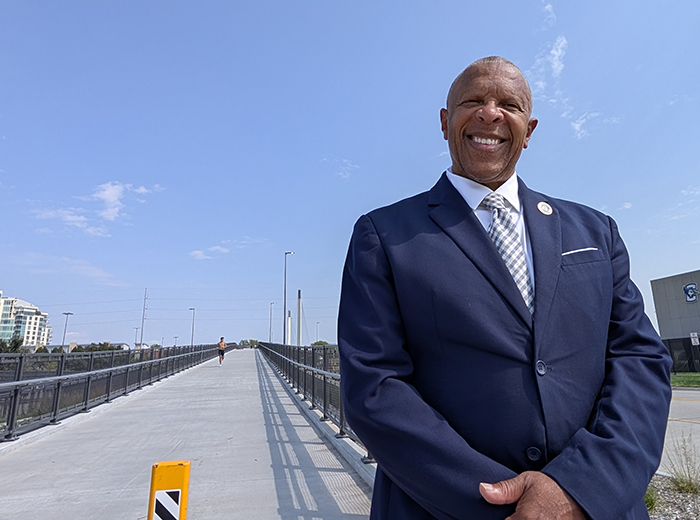
Omaha Mayor John Ewing on the “Baby Bob” Bridge with the Bob Kerrey Pedestrian Bridge in the background
Hi, this is OmahaNebraska.com here with…
Mayor John Ewing.
This Baby Bob Bridge is pretty exciting on the connection. Can you tell us a little bit more about it?
Yeah, sure. I think it’s a critical piece of our infrastructure.
What it allows us to do is have the ability to connect to the trails that are in this area, the trails that are in Council Bluffs, and also connect the two cities.
One of the things I’m working diligently on is building a metro area economic development plan.
And these type of things, these type of relationships allow us to be able to build that trust. And when you have trust, then you can work faster and more effectively. And so this is just one example of being able to do that when we can build a bridge to each other’s cities.
What would you like to tell the people on the Iowa side to come see?
Well, I would love for them to come on over and check out the College World Series or other events we might have. At Charles Schwab Field, we have the CHI Center directly across the street from the bridge.
We would love for them to come over and frequent events there.
Also we have the Hilton Hotel, very close by, that if they want to just do a staycation and just take a few days away, come on over, enjoy Omaha and be able to enjoy the amenities that we have like the Old Market, the Zoo and other things like that.
This is one of the events that we all look forward to, La Festa Italiana.
Please tell me a little bit about how it started and what you’re offering this year.
Okay. Well, this is the 41st year of our festival. It has become probably the most widely attended festival in the city.
We used to have to compete against September Fest because they always had the Labor Day weekend, but that was discontinued last year. So now everybody in the city comes here over Labor Day weekend. Last night, there was no place to sit, inside or outside. It was absolutely packed, even with this rain. We thought people wouldn’t come, but they’re here.
It’s all about the food. We have 31 homemade Italian dishes. They can’t get that anywhere else in this city, so I think that’s why people come. That’s what they tell us, anyway. They come for the music, the food, and the wine.
I noticed you have quite a few of the most popular bands in the area, too.
Yeah, those three bands have been coming here for years. And every year when they finish, they immediately ask us to put them on the calendar for next year. So we rarely have to call to find entertainment because they want to come back.
What are some of your favorite foods?
That’s a tough one. You know, everything is homemade. Probably the thing that we are most famous for is our meatballs. I think three years ago we made 3,000, and this year we made 7,500. We used almost 4,000 last night. People just can’t get enough. And it sounds weird over a meatball, but it’s a meatball you cannot get anywhere else. It is a true, original Sicilian recipe that no other restaurant in this city makes. So that’s why people come here.
I guess that’s going to be on my list to try here.
Yeah, absolutely. And we have another Italian dish that you can’t get anywhere else in the city. It’s called Farsu Magru. It’s kind of a braciole. It’s basically Italian meatloaf, and inside are hard-boiled eggs and provolone cheese, pepperoni, onions, and peppers. And then you roll it all up, bake it, and the cheese melts inside. It’s delicious. Then they put marinara over the top of it.
Fried ravioli is another real popular item. Our friends at Pasta Amore made 5,000 raviolis for us this year. We have to boil them, and then we have to bread them, and then we have to fry them.
Chicken Sicilian is very popular. It’s basically a little drummette that’s deep fried and then herb butter is poured over it and tossed.
Our pizza is a true Sicilian pizza. We make it inside and outside. We have pizza ovens all the way along the back of the property so people can get it right out of the oven if they want it.
Calamari, shrimp scampi. You name it, it’s here.
What makes a Sicilian pizza different from other pizzas?
Some people say, “Well, is it like New York pizza?” No, it’s not thin, it’s thick. Our friends at Rotella make the dough for us, and then we let it rise a little bit. We make a cheese and tomato pizza. We also make a sausage pizza that’s very, very popular.
How many years have you been doing this?
Well, I’ve served as the chairman of the board of the society [American Italian Heritage Society] for many years. I am the co-chairman of the festival, and I have been for the last five years. We start planning three to four months in advance. And then we do all the cooking pretty much here [at the Palazzo].
Really?
Yeah. We prep all the food. Anything that can be frozen, we prep months in advance, put in the freezer, and then we thaw it out for the festival. Some stuff we can’t freeze, so we have to make it fresh. But a lot of the things we serve, we can freeze them. Otherwise, we couldn’t cook enough food in one weekend because we couldn’t do the kind of volume we do. Like, the night before Festa starts, we had to boil 500 pounds of pasta.
Wow.
People say, “There’s no way you’ll use that,” but I tell them, “We’ll run out of pasta by Sunday.” One of our favorite items is mostaccioli and meatballs. That’s what people come for. That’s what we’re known for, anyway.
Can you think of anything surprising that maybe people don’t know that you’d want them to try or to experience?
Yeah. Sometimes people come to the festival, and they only come inside. They think that’s the only place they can get food. They don’t realize that there are five booths in the back.
One of the most popular booths out there is called fried dough. In Italian, it’s zeppole. Rotella gives us the dough, and we let it rise. We cut it in pieces about this big, drop it in a hot fryer, cover it with cinnamon and sugar. The line will be long until 11:00 at night. People can’t get enough of it.
If people don’t go outside and experience some of the things that are in the booths, they’ll think they have to stand in this obnoxious line and wait an hour to get food. They don’t. They can go anywhere on the festival grounds and find food. We make homemade lemon and chocolate gelato, and that’s popular. There’s a lot of stuff out there.
Thank you very much.
You’re welcome.
American Italian Heritage Society
5110 N 132nd St.
Omaha, NE 68164
Amy Hornocker at College World Series at Omaha, Inc.
Omaha, Nebraska.com here with …
Amy Hornocker, Executive Director, College World Series Inc.
You’ve been now doing this for a couple years.
Yes.
And you have the one for the 75th year of hosting it.
Yes.
Tell us about it, please.
It’s the 75th anniversary of the College World Series in Omaha. The event has been running longer. So we just want to make sure that people know that it’s just the one that…for the city. But it is still very important.
Obviously, 75 years in a city is significant. So we’re just doing some things to celebrate. I think our biggest one that we’re doing is the 75th at the Riverfront. [https://theriverfrontomaha.com/events/?&eventid=7971]
Thursday, June 12th at Gene Leahy Mall, we have three bands, food trucks, and then capping it off with fireworks. And it’s free, open to the public. We want to celebrate with the community that’s given so much to this event.
We’ll also just have some other general celebrations throughout.
We have Ashley Spitsnogle. She’s a painter. She started a painting, which is basically Rosenblatt fading into Charles Schwab Field, and then she’s going to finish it on Finals Game 1. She’s going to finish the field piece of today, and then that will be available for purchase when she completes the whole painting, following the Series.
So that’s kind of a cool thing. Yes, that’s about it for celebrating.
I know you celebrate different groups of people too.
Yes.
First responders, teachers…
Yes. Heroes in the Heartland is Tuesday, June 17th. Game 10. We’ll honor heroes within the community. So that’s police, fire, doctors, nurses, military. So that’s a cool night.
Teacher Appreciation is game 11. That’s Wednesday afternoon. The first 250 teachers that show their ID get a Levy concession gift card.
We have a partnership with Omaha Public Schools on a reading initiative. We’ll celebrate some of the top readers that came out of their competition at that game too.
Is that the Readers Are Leaders?
Yes, Readers Become Leaders. We worked with Omaha Public Schools district-wide this year. Before this year, we just worked with one whole school to see if that would be like more intentional. We worked with Skinner Elementary in North Omaha. We did a couple pep rallies there, and it was fun to see the kids excited about reading.
Saturday, Game 4, we have the All Star Award. It’s usually been coaches, former coaches basically for their contribution to the game. But with the anniversary, we’re actually honoring Jack Diesing Sr. and Jr. Obviously, Jack Jr. is the chairman of our board, and his father was instrumental in keeping this event in Omaha and growing it. They’re going to be honored on Saturday night.
And then the very famous Rawlings keychain giveaway is on Monday afternoon at 1, game 7.
I have one of those and enjoy it very much.
They are very popular. People like to collect every year.
Anything the fans should know about this year? I know there’s a clear bag policy …
Yes. So clear bag. And then it will be the same metal detector walk-through. So it should be the same process to enter the stadium.
We actually do have some enhanced security in the way of road closures. This is for fan pedestrian safety mostly. Two hours before each game and one hour after, 13th Street will be closed completely from Cass to Cuming. The only way you can get down here is if you’re escorted by the Omaha Police Department … And we have rerouted the ADA drop off to over by Rocco’s.
All that is available on our website. The information is at cwsomaha.com, and we have updated maps and everything like that.
You’ve been doing this for many years now. What kind of things have you decided to add to the fan experience? And then I know you’re very active in the community as well as the CWS. It’s not just a couple weeks of the year…
Yes. So I think this year, besides all the stuff for the anniversary, we also have our normal Fan Fest that’s presented by Capital One.
The Ferris wheel will be back, which was popular, and they’re actually extending the hours of its operation on that first Saturday because they usually close with Fan Fest at 6:30, but they’re going to leave it open until the final until the game 2 is over and just see how that goes and then we’ll kind of see if there’s a lot of ridership.
The Air Force also is bringing one of their national assets, which is pretty cool. It’s a VR, it’s called the Hangar. So it is going to be like a pretty big footprint, and you’ll be able to go in and they have some virtual reality simulator.
So those are some new fan enhancements. And you know, Fan Fest is open to the public. So even if you don’t have a ticket to the game inside, you can come down and go to Fan Fest.
Some of the other things that we do besides the Readers Become Leaders program that we talked about is we have a grant program. Since the ’70s, we’ve given over $8 million to community fields and baseball and softball programs in the community.
So again, we’re trying to leave a legacy at home.
What do people need to know besides the clear bags, the scooters, the cashless…Is there anything new?
I think the biggest thing as far as access is definitely those road closures that will take place during the game days because there still is obviously the ride share programs to get down here.
Metro has adjusted some of their normal routes to come down here at more frequent times.
So that stuff’s all on our website. But also if you go to Metro’s, the scooters are around, the bikes, those E bikes and everything. So there’s plenty of different ways to get around down here.
What do you envision for the College World Series going forward?
Because there has to be this balance of the dynamics of the love of the sport, the rich history of the sport and then still going forward into the future.
How do you balance that?
Yes, and we have the contract here in Omaha until 2036.
But our organization did a strategic plan this year looking at what do we talk about next?
Like, when do we go look for an extension to this agreement, and what do we need to do to ensure that it doesn’t look to go somewhere else?
We’ve seen that happen with the Olympic Swim Trials, that there are communities that are willing to get these things.
So that’s still a work in progress. We definitely are looking at fan experience and even student athlete experience upgrades so that we can basically make sure there’s no doubt that people don’t want to leave here.
I remember many years ago I was fortunate to be able to tour the facilities here when things were changing. And it was amazing…the use of technology that hadn’t been even considered before.
Yes. So we have and we’re looking at a technology upgrade next year. It’ll actually start in the fall when the CWS ends, and we’ll have new video boards. The original one is kind of at its end of life… that technology.
Yes.
And we are going to get the long-awaited secondary board that is in left field that people have wanted and then some ribbon panels on the fascia. So being able to do a lot more stuff in the game, a lot of more sponsorship activities. We’re hoping and we’re always just trying to find the best way to make it accessible.
And we actually just had a media availability this morning. This is the first year we’ve worked with Autism Action Partnership. We will have bags at our guest services. So if you have a need, they have the noise canceling headphones, fidget spinners, those kinds of things for anybody neurodivergent, because we want to make it accessible for everyone knowing that the stadium is a big, loud, scary place. We’re trying to help families feel like they can bring everybody,
That’s fantastic.
Yes, it’s great. We’ve been talking to them for about two years, and we were able to bring that to fruition. We’re interested to see how well it does.
OmahaNebraska.com Interview: Emily Brewer, Community Development Manager at Millwork Commons
Emily Brewer with red brick background at the Ashton Building in Millwork Commons
Omahanebraska.com is here with…
Emily Brewer.
Tell me a little bit about yourself and how you came to be at Millwork Commons.
I am an army brat, so moved around a lot growing up… kind of fostered a love for people and new spaces early, early on. I grew up in Colorado, went to school out in Bozeman, Montana, did a year abroad my junior year, so I studied in Spain. Love to travel, love to be in new places and spaces, and ended up moving to Omaha in 2010 because my dad had taken a government job out here.
I moved to Omaha after just having visited once, ended up really liking it. Learned quickly that if I didn’t only want to hang out with my dad, that I needed to make friends and form a community. And so naturally, the best way to do that for me was by volunteering. I found some great nonprofits in the area. I joined Big Brothers Big Sisters. So I was a Big for about 6 years.
I guess I would say I cut my teeth on the Omaha scene by working in restaurants, so I feel very fortunate to have worked in some really incredible restaurants with some wonderful people over…I’d say the last decade plus. But what got me out of the service industry and into maybe a different kind of service industry was the pandemic. Like many of us, when things were shut down and there was so much uncertainty, certain jobs either had to really pivot to being remote or to change how they operated. With restaurants, it’s pretty hard to wait tables remote.
I was unfortunately laid off from both of my restaurant jobs, and I spent the next however many months trying to figure out what I could be doing, because although I have three college degrees and a minor, I hadn’t really used them since graduating. I always just thought I would figure things out. I joke that they are dinner party degrees, so they’re good for conversation. Very liberal arts focused, but I just didn’t want to teach and wasn’t sure how to use them. I just knew I wanted to go to college and I did, and then afterwards I was like, “Okay, now what?”
Aside from traveling, which again the pandemic really shut that down for a while, I was feeling pretty restless. I ended up getting a job at a medical staffing agency here in Omaha and fortunately or unfortunately, during the pandemic, those were really booming. Travel nursing was a big thing. The pay was great for those wonderful nurses and doctors at the time, and so I took a job and eventually was doing… initially my role was community outreach, because that just kind of fell in line with things I already valued and was plugged into, but I was doing it on behalf of the agency I worked for. That then pivoted to a more internal role, being very employee facing, and so I did employee onboarding, I did events planning, I helped run some of our groups, certain DEI initiatives, all sorts of things, but I really loved interacting with and being face-to-face with employees. That was important to me. I love people. Also, I called it the three C’s—internal communications, culture, and community outreach were the main hats I wore.
And then… gosh, I’ve done some copywriting, just freelance for some agencies and companies around town. I’m not sure if I should name them or not. I don’t think it’s a secret. Is that—? Well, Omaha Performing Arts was a client. Yeah, there’s just some great people I’ve met through being out there in the community.
I love networking. It’s got such a dry term, but I really just enjoyed meeting new people, and so I was very lucky when I was approached about this role here at Millwork Commons. My title is community development manager, and I’m still fairly new in this role and I am still learning. I had some really incredible predecessors. I’m actually friends with both of these gals, and so it’s been really neat to see how the role is kind of evolving as Millwork Commons and the neighborhood itself grows… as businesses and tenants start to move in and they get their footing. It’s been really cool to see how people choose to activate the space, whether it is kind of an organic, natural flow where they’re coming in and working archetype with a coworker or a friend, or if it’s a planned meeting. There are just a lot of great things happening around the neighborhood. And so my role is to find new ways to activate the space, but also, to make sure that our current tenants are happy and are able to utilize it in a way that best suits their needs, whether it’s personal or professional.
Millwork Commons was thought of and planned and took a long time to develop. Do you know a little bit of the history of that, and why this particular space?
Not as much of the concrete history as some of my colleagues would, but a big mission and goal of the neighborhood and the folks who are actively developing Millwork Commons is to really push arts, music, tech innovation, and entrepreneurship, which I know are some exciting buzzwords, but really what Millwork Commons is hoping to do is to give community members, artists, creatives, whomever a space and a platform to—I hate to keep using the same words, but to innovate and to be creative.
As far as the overall vision for Millwork, it’s hard to be future-thinking without reflecting on how we got here. I’m learning that it takes a lot. You see the sausage, but learning how the sausage gets made is a completely different process. It’s trying to think broadly, as far as what does Omaha as a community want? And what do they maybe need that they themselves might not even recognize? And so with the dock, which is located in the Ashton Building within the Miller Commons neighborhood, that’s a space with a state-of-the-art video wall, a great sound system, and so we allow people to use that to show art, or we partner with “KIOS at the Movies” to show documentaries and things like that. We’ve used it for our One Million Cups presentations, all kinds of things. It’s one of those things where when you get people in a room or a space together, often they are greater than the sum of their parts. By creating a vibrant hub as a way to activate a space and bring people to a neighborhood, we hope that it can exist as a legacy neighborhood, as something that you see in other cities, where there are interesting and creative things happening, but not just arts and music…where it can be a tech-focused thing.
We are so lucky to have the Nebraska Startup Academy housed here as well, in the Mastercraft Building. There are some brilliant minds at work over there, and the fact that we have a space for tech-minded folks and those who exist more in the arts and creative world is amazing. We are neighbors with Hot Shops, and that is a slew of… a community in of itself, of some really, really wonderful artists here in Omaha and they are just across the street from us right here in Millwork Commons. It’s exciting to see who are our neighbors and who is visiting this space. My goal is to be a good steward of this neighborhood and a liaison between people …
Oh, another thing that’s great to mention is Millwork Commons is working to be a very sustainable neighborhood. We have native prairie grasses out in our space that we call The Prairie. So a lot of the design of the building, it being a historic site, that meant we weren’t leveling it and rebuilding it with cheap and also very costly materials. We were working with a structure that was here, to renovate it in a way that created less of a footprint, but also paid homage to what the structures were like beforehand. So the beams you’ll see when you walk around, or the exposed brick that we’re looking at right now, it was all very deliberate, but in an effort to lessen any sort of footprint and have a more gentle environmental effect. There are very smart people who are overseeing those measures, and I’m just grateful to be in a space that prioritizes composting and recycling and leaving a smaller footprint.
Three buildings: Hello Apartments (Left), Ashton (Center) and Mastercraft (Right)
There’s a number of buildings here, and it’s grown slowly. Please tell me a little bit about each building that’s part of Millwork.
Well, there’s a teammate I would love to loop in, Jeff Slobotski and Steven Ausberg… they’ve both been with PGSA for a number of years and have feet firmly entrenched in the city planning world.
We’ve got the Hello Apartments that are just such a delight to visit. I love the branding that they’ve chosen. It’s a whimsical apartment building to live in, and I just think it’s a very cool space.
Dizzy Mule Apartments are open, and there will be retail there.
One of the things I’m always curious about and that we’ve been working on the blog is understanding how neighborhoods thrive. What helps them thrive? What helps them not thrive? And then how do they have a resurgence?
And so one of the things we learned over time was in this area Hot Shops that you mentioned earlier really had an impact on helping develop this area. And it’s interesting that you’re putting an emphasis on artists, and so were they. From what I’ve noticed with other places in other cities is that the artists take a chance, and obviously they can’t afford the fanciest place in town. They take a chance on the area and start to develop it, it starts to thrive. And then people get encouraged and excited by this, and then more development comes in.
So while in a lot of places, arts and science, arts and music and all of that are one of the first things to go, it’s one of the first things to help develop an area, which I find really fascinating.
Well said. I mean, truly, that’s a perfect way to phrase it. I think if you don’t give creatives—and you don’t just have to be an artist to be a creative, right?
Right.
You can just be someone who is passionate about something niche or something broad community wide, but I say “creatives” as kind of a broad categorization, but…
It’s innovators and entrepreneurs…they’re all creatives in some way.
Yes, exactly.
Even programmers. Yes, your language can be zeros and ones, or it can be watercolors or anything in between, but we want to give people a space. I think neighborhoods that folks are drawn to often have a center in creative arts because it scratches a lot of itches as far as aesthetics: you know, sight, smell, sound, touch, just an overall feeling, and not to get too hippy dippy, but I do think there’s kind of a palpable sense when, like, the energy of a space is more active. I mean, think about someone playing a show to a room of five versus a room of 200… even if it’s so silent in either scenario you could hear pin drop, there’s still this kind of electric shared energy.
And so neighborhoods that thrive. There’s some really cool ones in St. Louis, and there’s art-heavy districts in other cities…Denver. There’s tons of great pockets of neighborhoods, and I want to learn from them and emulate certain programming to give artists and creatives… entrepreneurs… a chance here. I think that there is also some grace in that there is room for things to fail first time around or maybe not get off the ground in the way we would have hoped or anticipated, but it’s just pilot programming, some of it, seeing, “Do people respond better to events at this time of day or that time of day? What about doing something over the lunch hour versus what about doing something after work?” You know, unfortunately, based on different work schedules, personal demands, family responsibilities, things like that, we can never find the perfect thing at the perfect time, but hopefully as I settle more into this role I can get creative myself and offer sort of a diverse range of things at different times, so that there are accessible programs for people who are interested.
And I’m very open and I very much encourage ideas from the community. For example, I met with someone who wanted to potentially host a bonsai workshop… the art of these trees. The Japanese art of pruning and growing and shaping these plants. But we talked about “Would that be something better suited to do in the dock for visibility?” And you know, it’s exciting to have people walk through and kind of be like, “Oh, what are you doing there?” Or I met with someone at Kross Strain, Sarah, who runs their programming… we talked about doing a Beers and Bonsai event. So people who sign up for this workshop, they get the materials, and then they can hang out and socialize and have a beverage if they’d like, but really, is that another fun way to activate a space within Millwork in partnership with one of our tenants? So yeah, I’m constantly floored by the really cool requests or ideas that people have shared. And again, if I had an unlimited budget, I would just say yes to everything, but until, you know… we’re a society that just trades in services and goods, I do have to keep in mind that I can’t say yes to everything.
The Dock at the Ashton
I know that there’s the dock here at the Ashton, and … Hello Apartments. Dizzy Mule is relatively new.
We have incredible tenants here [Ashton] , and I hope shining a light on them and supporting them just makes room for other really great tenants, too. You’re not going to see a chain restaurant or anything like that. There’s a reason we have Archetype Coffee here instead of Starbucks, or, Dolomiti for pizza or Heirloom and Clean Slate… Kros Strain, a local brewery. We want to support local businesses, and having them in Millwork Commons is really a treat and I’d say a benefit to those who live in the area or who are visiting. We’re so close to the airport. When I do airport runs, I always …love making a stop and coming in and sitting down at Dolomiti and grabbing pizza with whoever I just picked up and kind of making that a welcome to the neighborhood.
Entrance to Coneflower Creamery in the Ashton building
Coneflower Ice Cream … Oh my gosh. Amazing. They have the nicest staff, they give you as many samples as you want, and they never make you feel guilty about asking for a seventh, but I love bringing people by here to grab a coffee at Archetype or take a spin through Heirloom and just grab … hostess gifts over at Heirloom because they have just great little local products: candles, honey, things like that, in addition to really good food. They just have … cards or chocolates, something I can just take a lap through and be like, “Okay, I didn’t know I needed this, but it’s coming with me.”
Painting in the background, center with the side of the large screen on the right and white modern table in the foreground
There’s great artwork inside and outside here.
Yes. And one we’re currently working with Amplify Arts to do…it hasn’t been posted yet, but we’ll be doing a call for art and so on. Our video wall in the dock, that, you know we’ve got unless it’s being utilized for something else, we’ve got… and I wish I knew how many artists we had featured in there, but before I started here, they had done a call for art with local artists, and they either created new work, or could submit something existing that they had, and it was selected by a team of people. Again, we are very lucky to be working with Amplify Arts because they’ve got a wonderful pipeline for all of this. But again, we have just different visuals on display, just all the time on that video wall. And so we just thought it would be nice to refresh it. It’s been there for over a year now and just to give other artists a chance to submit some of their work and have it be seen by fresh eyes, and so as far as how they’ll do a call for art for those outside public spaces, we’ve worked with some other great local artists. I personally don’t know how folks are tapped or how that’s curated. Typically we will work with an unbiased organization so that they can help us with an art selection. But so it doesn’t fall to Paul and Annette [Smith], who are art collectors and very generous philanthropists in their own right, but so that everyone has a chance to have their art get seen.
Sounds like another good story there.
And again, not just artists and creatives in that sense, but the Nebraska Startup Academy, housed in the Mastercraft building. Charlie Cuddy and John Grange and Alyssa Cave. They are movers and shakers in that world, and they are so giving of their time and energy and just advice. They hold VC, venture capitalist, office hours after the weekly Wednesday One Million Cups meeting for people who just want to talk through things or ask questions. So they’re helping develop young entrepreneurs and those in the tech world just as much as an arts grant from Nebraska Arts Council or Amplify Arts, is doing. It’s really amazing that Millwork Commons is kind of a space where those worlds are intersecting and supporting each other, and hopefully thriving and just creating pathways for more.
That’s what I was thinking, too. How cool that is.
… Was there a question you would have liked me to ask?
How can we support our tenants? How can community members support our tenants? And the nonprofits housed here.
Heartland Bike Share is another tenant that comes to mind. And they are just doing such great work to make E-bikes accessible to anyone in the community. You don’t need a special license, anything like that. We want to make public transportation as accessible as possible. We’ve got United Way housed here, Habitat for Humanity.
So ways to support the goings on in Millwork Commons: to follow us on our socials. Even to engage with some of those posts helps generate more eyes on the happenings, which in turn helps bring more attention to what is going on, and it’s just got a ripple effect. Coming down to Miller Commons, maybe carpooling with friends or family and just visiting some of our restaurants and shops or popping by the Hot Shops and seeing what they’re doing and asking if you can have a tour. Engaging with the people. In our surrounding neighborhood is a wonderful way to support us, and that’s what I want to emphasize to anyone listening to or reading this: that we want to build a neighborhood that is good for Omaha and that gives back to the community as much as possible. And so by folks who visit Omaha or who live here and come to see us and spend some time here, that’s the very best way you in turn can support us and then we can just continue this way of giving back and giving a platform to folks down the road.
Thank you.
Yeah. Thank you. I really, really appreciate it. So yeah, even you being so flexible with time this morning was… you’re a gracious interviewer and a lovely person.
Thank you.
I’ve seen you roll with quite a few punches. And shout out to, on the record, to our wonderful property management team, Mark with Colliers, and Bluestone Group. We’re grateful for them, too. Mark keeps the wheels on and then some, so I don’t know what I would do without some of these folks who operate behind the scenes. I think the takeaway is that I am lucky and grateful to be here.
OmahaNebraska.com Interview with Kari Kawa Harding of Johnny’s Cafe
Omaha, Nebraska.com here with …
Kari Kawa Harding stands in front of the doors of Johnny’s Cafe
Please tell me a little bit about what you did before you became owner and your earlier days here.
Yes. My grandfather started the restaurant in 1922, and then my father and my Uncle Jack took it over in the early ’60s.
So I did grow up being here. Not as much as people think I was, but I do remember driving up to the back and hearing all the mooing, and flies would be everywhere. It smelled awful, but they always said it was the smell of money. I do remember all of that.
I went to a hotel and restaurant management school at the University of Nevada, Las Vegas. Then I worked for Marriott Corporation in California for a couple years, and then I decided to come back and work for the family. My sister Sally also came back, so we both have taken it over now. My uncle has passed away and my father is semi-retired, so Sally and I are both running it now.
The restaurant industry is really hard, and there was a whole lot that happened with COVID. Tell me how you kept going and things you learned that might be good advice to other people.
To be honest, COVID was very, very difficult. We had never seen anything like it. We had gone through recessions. Closing of the interstate. People always wanting to go to the new place. But this was something we’d never seen. We’d never had the government tell us, “You have to close.”
And you still have bills to pay. This is a very big building, so you still have power, water, everything that you just have to keep paying.
We just really put our heads down. And as soon as we were able to open, we did three weeks later. While we were closed, we did “Easter to go” for people and stuff like that, so we did a couple of things here and there. But on the other side of it, we’re known for steaks and prime rib, and that isn’t really what people think of “to go.” And I think also at the time people were so nervous that they didn’t want to pay for high-priced items compared to places that were doing pizza and fast food.
We were very fortunate in that we did receive federal grants that helped us stay open, even though it was a long time coming. We really worked hard and got lean and mean because it was very slow for a very long time, and I think it was a mixture of people being nervous and everything else that was going on.
We did try to think outside the box. We would do huge holiday meals to go for people, like packages for 4, 8, or 12.
We did TV dinners on Friday nights that were chop steak with gravy or chicken fried chicken with chicken gravy which was a big seller.
I think it taught us a lot about how to get lean and mean to sustain, because it took quite a while until things got back to normal. And I think we kind of felt at the time that we’d never seen anything like that, so we thought once we opened, people would be dying to go out. People were very scared, but I think it helped us that we’re a well-known name. We have high ceilings here, and we really spread out tables. We did everything we could to make people feel comfortable. We’re both happy and proud that we survived it.
We’re glad you’re still here. You’re one of my favorite restaurants.
Wonderful.
Interior of Johnny’s Cafe looking out to open front doors with plaques and images showing decade by decade the history of Johnny’s CafePlaque hangs on the wall at Johnny’s Cafe showing historical images of the Cafe and people
I enjoy coming here. The staff is great, the food is great, and I love all the history.
It is fun to see.
Tell me a little bit about your grandpa and how he started it.
He was an immigrant from Poland, so really our last name is Kawalowski. And when he came over, he was around 12 years old. He came with an aunt, and he was just happy to be here. They shortened his last name to Kawa. When I was growing up, people used to think I was Japanese or something, but I was like, “No, I’m from Nebraska.”
My grandfather came to Omaha and he worked a little. During World War I he had a job in a kitchen. Then when he came back to Omaha, he bought a little bar. The name on the bar was “Johnny’s,” and my grandfather’s name was Frank Kawa. The story goes that he didn’t have enough money to change the paint on the building. We’re not even talking neon, we’re talking paint. So he would answer to the name of Johnny and he would sign things “Frank Johnny Kawa.”
It was just a little bar with eight tables. The old pictures show people who have guns on them, and oil lamps are on the walls. It was in South Omaha, which was kind of the Wild West in the ’20s. We didn’t find out until much later that he was a beer runner. He was well known and making a lot of money, and they were after him. Once Prohibition was over, I think he decided to go legit. He decided to really seriously get into food and drink.
As the story goes, Johnny’s just grew. As the stockyards grew, there were so many people around all the time. They were open for breakfast, lunch, and dinner. And they just kept adding on rooms every which way they could.
They talk about in the ’50s when there was sawdust on the floors and they’d have to hose it out every night because of everything on everyone’s boots. They were open from 6 am to 1 am every day, and they just grew with the stockyards.
My grandfather died in the early ’60s. I never met him, and my mother never met him either. And then my uncle and my father took over the restaurant. And then Sally and I were proud to be part of the next generation, and we took over in the late ’90s.
So this started out as a bar and then it came to this location?
It’s always been on this corner of 27th and L. Probably the really oldest part of it is the corner of 27th and L. There used to be a door right there. If you walked out now you would probably get hit by the cars going by.
I don’t even really know the old walls or anything. I mean, they’ve really changed it around. In the ’70s they changed it to what it is now. And they really did change it a lot. It used to be a lot of little dining rooms and all this stuff. The original part, though, would be the corner of 27th and L, and they just added on.
What’s your capacity here?
For the dining room, full capacity would be 175. The party rooms are 125. And the bar is about 75.
So you can hold anything from date night or just coming here to enjoy the food like I do, to really larger events.
Yes, yes, we do parties. We can do private parties up to 120. We have closed down for private weddings that are over 300. But we also have the booths which everyone loves, so it’s great for date night. And we have the old-school bar, which a lot of people love. They just like to go in there and have a cocktail and pretend they’re in the past.
Right now I’m looking at this beautiful wine area with the stained glass. Could you tell me a little bit about it and the wine that you offer?
This was built in 1971 when they redid the whole restaurant. They really wanted the restaurant to have what they called a “handsome feel” with the red walls, the dark wood, the red leatherback chairs, the wine cellar. They were very much into promoting wine, because they felt it was a good match with beef and prime rib. So they had it built. I believe the person who did the stained glass was from Omaha. They did all the J’s and the grapes. We have wines in there. Our wines range anywhere from $20 to… I think we go up to $180 bottles, but most of it is affordable. We’re here to sell wine and to match. And we want your dinner to be a wonderful experience.
And so we don’t age wine. That’s not our goal. Our goal is to match it with our food. But we do sell wines by the bottle, in the glass, at lunch and dinner.
We do wine tastings twice a month, which are $30 a person. We have different wine people that come in and you taste five wines. Then we do hot and cold appetizers with it.
T-bone shaped arches and forest mural in the background, wide viewT-bone shaped arches and forest mural in the background, closer view of aches
What are some of your favorite foods here and some of the most popular dishes?
I think what got us on the map definitely was our steak and prime rib. Everything is corn-fed beef from the Midwest. We age and hand cut it all here, so we have our own butchers. All of our soups, dressings, gravies, they’re all homemade from scratch, which I think tastes much better. AndI think that puts us on the map because I don’t think a lot of people still do that.
But the menu is well rounded. There are other things. If you don’t want beef, there is seafood, fish, chicken items.
We do a lot of old-school specials at lunch, which we’re kind of known for because a lot of people don’t do that.
We have oxtails on Tuesday. Thursday they do actual roast turkey and dressing, where they’re actually cooking whole turkeys.
Every Thursday?
Every Thursday at lunch.
Wow.
Turkey and dressing. And then I think my favorite is the tenderloins. I do like petite filet or chateaubriand. I think the prime rib is always wonderful. We slow roast it.
We do fresh salmon. We do a sea bass at night with a lemon piccata sauce, which is wonderful.
And we also do old-school four-piece fried chicken, which you’d be surprised how much we sell, because people like that. We also do chicken that is more heart healthy, like a ginger chicken, which is a chicken breast marinated in ginger and soy sauce and grilled.
So we try to have a little bit for everyone.
And then also our desserts are homemade, too. I forgot to say that.
Oh, wow. Tell me a little about your desserts.
We have a pretty large dessert menu. We have creme brulee. We have bread pudding served warm with a Jack Daniel cream sauce.
We have a warm apple crisp served with a scoop of ice cream.
We have apple, cherry, and pecan pie at all times. We also have plain cheesecake or Oreo cheesecake. So there’s quite an array of desserts, and they’re all homemade.
And then we don’t always have it, but once in a while he does make homemade carrot cake, which people go crazy for.
Any favorite memory stories from when you were little or now?
I do always remember that when I was little, like, we would drive up, and being girls, I think we would always tell our dad, “Oh, my gosh, it smells terrible. And all these cows are mooing, and there’s flies everywhere.” And he would always tell us it was a smell of money, which I think is what every cowboy and rancher in Nebraska would say.
I do remember in the ’80s, the stockyards were still open, but barely, and a cow got loose and was running down L Street. No one could decide exactly what to do. So the police are out there, the Humane Society is out there.
Door
Door
The cow started coming toward Johnny’s, and they were afraid it was going to hit the big front doors, and they didn’t want it to ruin anything. The police and the Humane Society couldn’t decide what to do. So my uncle took serving trays and threw them as Frisbees to the cow to get it away from Johnny’s. The story actually made USA Today.
Oh, wow. I was thinking, this is a bad direction for the cow to run.
It is. It is. It might be served.
How did the stockyards change everything when they went away?
The amount of people in this neighborhood had slowly been dwindling for quite a while after they decided to get rid of the stockyards.
They really thought seriously about moving Johnny’s, like, maybe out west. And I think they just decided it was a historical place and they should stay where they are.
We’ve seen a lot of transitioning in south Omaha, both bad and good, but we’re proud to always be, like, one of the footholds that was always here. So that was very hard.
The stock yards were dwindling, and by the time they closed, they had been gone for quite a few years because there was hardly anything going on there, and there were not many people going through. And right around the same time, the Interstate was closed for a couple years as they redid everything around us.
So it was a hard time in that you really had to know Omaha, how to get into here, because you had to come the back way. This was before GPS and before you could talk to your phone about how to get here. After they finished the Interstate, they did make us a cement island. People are very scared to take the frontage road because they’re afraid they’re getting on the interstate. We used to spend so much time on the phone telling people how to get in here.
That was my concern the first time I came here, and the second and the third time, and then I got used to it.
We would be on the phone all the time telling people, “You’re not gonna get on the Interstate. It’ll take you in.” So that did make it easier when there was GPS and people understood that. But still to this day, on big weekends like Berkshire when there’s a lot of people out of town, there’s people who ask, “How do I get in there?”
But you don’t really have a choice when you’re dealing with Nebraska roads: they do what they want to do.
Today, GPS took me because I was in a different location. It was like a historical journey almost to get here. And it’s a real testimony to your resilience and being able to pivot but still keep the core value and the core wonderfulness of what’s Johnny’s.
South Omaha has always been where the immigrants go. And really, the packing plant jobs pay great money, so there’s always been a melting pot around us. It has changed over the years but it works to our benefit, too, because those are people that want to work and want a job.
Is there a question you wish I would have asked that I didn’t or something people don’t know about Johnny’s that you’d like them to know?
Steak for lunch with scalloped potatoes, salad and broccoli and cauliflower
I don’t think a lot of people realize that we’re open for lunches Tuesday through Friday. Our lunches range from $11 to $24, but you can get a soup, a meal, a roll, a potato for $15, and it’s cooked to order. It’s homemade. That’s almost the same price as fast food. I don’t think people realize that and that we do have more than just beef at lunch.
Something for people to keep in mind is that we will be open for both Easter and Mother’s Day. We do a limited menu from 11:30 to 2:30 on both days, even though usually we’re closed on Sundays. I think we’re a nice choice for Easter or Mother’s Day if you don’t want to cook.
OmahaNebraska.com Interview with Dale Gubbels, Director of Business Development for Firstar Fiber
Dale Gubbels holding cleaned material to be melted
OmahaNebraska.com is here today with …
Dale Gubbels and I am the business development director at Firstar Fiber.
How long have you been here?
Firstar was formed in 1998 and we moved into this property in 2005 and we’ve been here ever since.
What part of town were you in before?
Actually, we started out in Fremont. We went through a couple growth spurts. So when we moved to … grew out of Omaha. That was actually pretty quickly because we had a customer based here in Omaha and they asked if we would move in and share a building with them. They were a document destruction company and it was a pretty good fit.
And then we outgrew that building, then we outgrew another building.
And then this building is just right.
What did you do before?
I have been involved in recycling since the early 1980s and I worked at one point for the Nebraska Department of Environmental Control, which has also gone through several name changes.
I was the public information officer and one of my assignments when I worked for the agency was to help the division that was just starting up in recycling to help with their education programs and so forth.
So I got involved more and more in recycling. And then in 1982? … I think it was … the Nebraska Recycling Association was formed. It was a non-profit group to advocate for recycling. I became its first executive director and ran that for probably about eight years or so.
Then I was recruited by a Canadian company that was opening an office for a consulting operation back East. I took a job with them, moved the family to Connecticut and we lived in Connecticut for about 10 years.
Then the group that I ran in Nebraska, the Nebraska Recycling Association, got a grant. They asked if I would be willing to do a study on how to bring about an in-state recycling market. And long story short, that the idea was to try to build a paper mill.
We found a Italian company that claimed that they could sell us a paper mill and it would only be about $10 to $15 million, which is a lot of money. It would turn out 10 to 15 tons a day of toilet paper.
We said that’s what we’ll bring to Nebraska. And long story short, by the time we got through the last engineering study, the last marketing study (where you look at, okay, you have to make enough in order to justify your investment) you have to meet environmental standards that apparently that operation wasn’t having to meet in selling into Africa and other developing countries.
The last quote was for a much larger facility. It was going to be, I want to say, about 100 tons a day, but it ramped up to about $90 million. So we pivoted it to just concentrate on the initial stage of collecting it and processing it. And by that I meant we would sort it, bale it, and ship it off to paper mills.
So Firstar has kind of grown from those early days.
Glass recycling, I know, is been a difficult thing and I wish there’d be some great new technology that came up, but I don’t know, has there been? I haven’t researched it in several years.
Yeah, the biggest challenge with glass is that it’s made from sand. So you’re always using the lowest, you know, it’s sand.
So you’re always going to be fighting that cost issue between you and …
Exactly.
Okay, I was really hoping like some thing would have appeared to solve this.
The closest that I ever came across and unfortunately it’s never really panned out because again, sand. They were using it in some forms of drywall as a way to mitigate against mold. It didn’t really go anywhere either.
Tell me a little bit about what you do here.
Well, I turned over my responsibilities as CEO to Patrick about – well, he started October two years ago this past year, and I stayed on to hand off more and more of my responsibilities. But he actually learned them pretty quickly. And we started this plastic operation. And so my role as business development director is to try to find new ways to market the plastics like the sheeting. I found that company out in Wyoming that is making plastic sheeting and boats … I managed to get an organization that is funded by the various brands who want to see their packaging recycled.
I got Firstar a grant to trial the use of these pellets that you saw tonight.
Is this the initiatives they have at the different schools for some of the materials project?
Project School Board was one that I started … we got a donation from Reynolds and we gave the high schools that have shop classes some boards and they made a variety of things.
So the school sent you materials, you turn them into boards and gave them back to the schools.
That is really cool.
Yeah. So that’s pretty much what I do. So let’s try to find those connections.
That’s pretty amazing. How did you end up with the Hawaiian fishnets?
They learned of us through an industry group that we had worked with to develop a lot of this out here.
They were looking for ideas and how to do something with the nets other than to send it to a waste to energy plant, a burn plant.
They didn’t like that. So they’ve been looking for some time to try to find what’s an alternative that could be actually turned into something that the Hawaiians could use as well. They’d rather keep everything in Hawaii rather than add the extra cost and the carbon footprint shipping it.
This effort is not a long term effort to do in Nebraska by any stretch … Well, they reached out to us because they wanted to learn more about the lumber and they hired me to do some consulting for them.
I’ve been advising Dr. [Jennifer] Lynch and Mafalda [Gentil Martins Seiz de Freitas] , … She was doing some of the fishnet recovery in Portugal and the Hawaiians managed to snap her up. She’s running that program for Dr. Lynch. I’m not sure if it’s going to be plastic lumber, plastic sheeting … But the idea that they need more than anything is just to get the Hawaiians excited about doing this.
So the idea behind the boards, I said, let’s make some boards for you. You can take those around dog and pony show. And you can tell this is one thing that’s been done with it.
But Hawaii has some huge problems in terms of it’s an island state. “Islands” state is a better way to say it because there’s seven islands. When you get right down to it, transportation between them is tough. It’s no more populated than Nebraska. In fact, it’s harder in many ways because they’re stretched out. It makes it very difficult for any economic answer to any of their problems.
And tourism is their lifeblood, that and the Navy and Army. But with the tourism industry you’re bringing in, and I have no idea, but I’m just going to venture, probably millions of people a year. And that’s waste. That’s waste. That’s waste as well.
So the tourists come in and now we have a new source of waste.
Not just everyday waste, because people don’t take it home with them.
What do you think will be in the direction of solutions for Hawaii and other places? Because your facility is amazing and it’s huge.
But it’s a drop in the bucket. It can’t be everywhere. No, no. And I believe the solution is anything that’s made from plastic, like this table, that table, probably parts of your chair, all these things should be utilizing some form of recycled plastics.
I know there are a lot of people who rather see it go back into a bottle or into a sandwich bag or into potato bag, all those things. Wonderful. That’d be great, but people don’t realize just how problematic that is because we can never get it clean enough. On top of that, you’re introducing so many different types of resin and all the…
Yes, the toxicity would be hard to…
That’s why it’s – There is legislation that they’re trying to force the brands to make packaging with at least 30% recycled plastic in it and they’re struggling. Struggling mightily because it is such a challenge.
How did they come up with 30%?Even knowing nothing- it’s a big number.
Oh, it’s a huge number.
And so there needs to be technological solutions on the horizon or an incentive for a technological solution…
… Why they came up with 30%, I couldn’t tell you … It’s state by state. California, Washington state, New York. A lot of places have it.
What do you think would be good legislation here [ in Nebraska] ?
Well, I believe we have to get the brands excited about helping Nebraskans solve their problem. Instead of mandating that, you got to put it back in your package.
No, we’re okay with that [not requiring it go into packages]. Anything that it isn’t going to cause a problem for you, such as, maybe a pallet, or maybe boards, or things that can tolerate a lot of different levels of contamination and heterogeneous mixes and all that, that’s what we want you to do.
What would you like to see anything more for the legislation and then going forward for your company for legislation?
These other states, Colorado, now Minnesota, have passed what’s called extended producer responsibility. The producers that they’re referring to are the brands themselves. And the responsibility is help us develop the infrastructure to collect, process and turn this material back into a product that we can have a sustainable program. So, that’s my aim right now.
Right now there is legislation that has got four parts to it. It’s just a beginning part where the expectation would be. Colorado and Minnesota and California, Portland, they have required that the brands form non-profit organizations that take responsibility.
If you’re General Mills, if you’re Nestle, if you’re Heinz, whomever, if you’re selling into that state packaging, you pay into this nonprofit. That nonprofit will help the municipalities develop a coherent program to get it collected.
That nonprofit will also invest in businesses to process it into new materials and that is something that is going to take a while for Nebraska to do. This bill that’s down there right now is requiring the battery industry to take the first leap into this because batteries are such a safety issue, for not just us, but for everyone. I mean, if your cell phone was attacked by a dog and start chewing on it. It could start a fire. Just about everything that is electronic anymore has a battery in it, a lithium battery.
And I’m sure you sitting on one right now.
So if it passes in the Legislature, they will be required to develop a recovery system here in Nebraska for our lithium batteries. But because people can’t tell the difference between lithium batteries and any other batteries, they’re to be responsible for collecting and disposing of, or recycling, all forms of batteries.
So, the batteries would be separated at some point because …
… the onus will fall off on the industry itself to figure out how to make it convenient for people. You can’t put a battery in your recycling bin because we have no way of getting it out. They’re going to have to come up with some pretty ingenious ways to incentivize people.
This bill is one element that hopefully will come about first, and as people learn more about it. Why should we, as the consumer, be responsible for everything? The people selling it – we need them to be thinking, you know, from …
… cradle to grave, so to speakand that would hopefully spur some innovation on the front side of things. So there’s less left on the waste side …
Exactly, yeah. And to answer the second part of your question, my hope is that innovation companies like Firstar can be part of the solution, too, but someone else has to help us with that because they have far more R and D available to them than what we do.