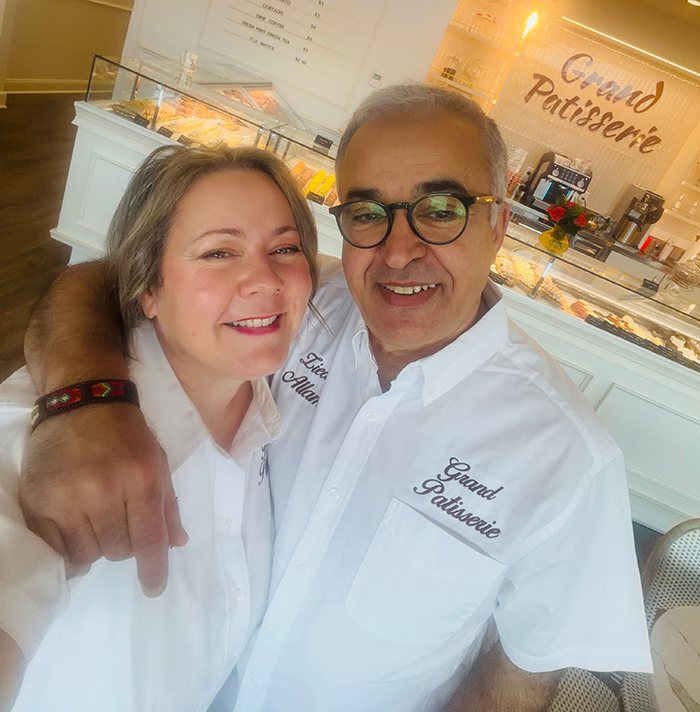
OmahaNebraska.com here with…
My name is Zied Allam.
This is Rafika Oudelha.
Thank you. Please tell me a little bit about what has prepared you to open up this bakery here and why you picked this location.
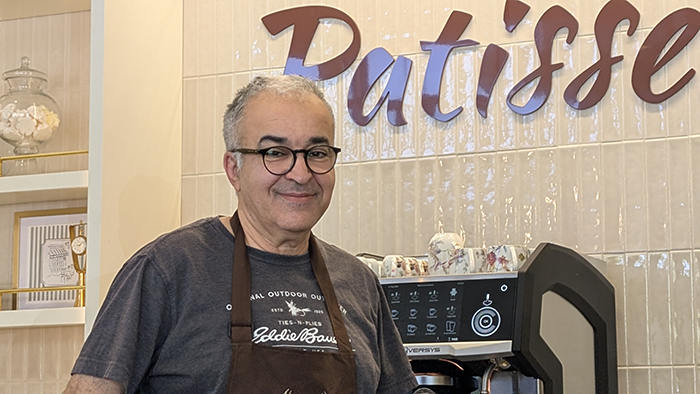
Zied Allam: Well, I would say almost 20 years ago I had this vision of opening a pastry shop where we can, me and my wife, serve the Omaha community with a good pastry. I remember each time I go either to New York City or Paris, when we come back to Omaha we always wondered why we could not have similar quality to what they have there. And I found out that a lot of times it has to do with cost, location, and being prepared for your audience to consume your product. Then what we did is, me and my wife, we started at a place called Roast Coffee at Aksarben, and we did a few pop-ups there. And we started making a few product items, mainly small items like macarons, like petit fours, which are small, two-bite pastries. And then once we started getting some traction and some interest from many people there, we decided to go ahead and rent a commissary kitchen where we could bake our stuff and start selling it to some other like small parties and small, tiny companies. Later on, I found out there was a shop down on 144th and West Center Road. The person who owned that shop wanted us to move there because she wanted to move out of town. So we decided to take over the lease and rent it the way it was, and we started making and baking our French product. Then after that we got hit with COVID. It’s unfortunate that it started like that. So we did have a very rough time. Then later on, we got a big boost from the social media people, especially Omaha Food Lover. They were great in terms of support and encouragement. And that really helped us and kept us alive, if I can say that. And then as we started to grow, people were wondering why we didn’t move to a more central spot here in Omaha where it’s closer to everything else. We were looking, and unfortunately, we did not get a chance to find something decent. Then later on, we found a spot in Aksarben, and we thought it would be the best place for us in terms of location and proximity to everybody. And that’s how we ended up in Aksarben. We wanted to put in a really nice shop that fits the location.
Thank you.
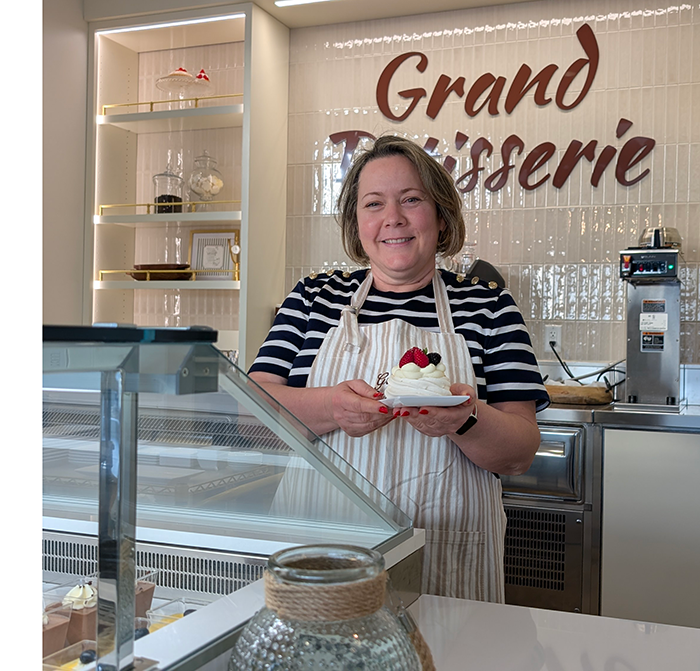
Rafika Oudelha: Well, I always had a passion to make desserts. When I came here 23 years ago, I was pregnant with my first baby. I was craving something called millefeuille, which we have in every bakery in North Africa or France, and I couldn’t find it here in Omaha. We had to travel all the way to DC to get the millefeuille which was equal to what we have here. We traveled all the way there, and I was craving: Baby wants this, too. So we got the millefeuille. We couldn’t find slices of millefeuille, but we found the whole cake millefeuille there. I was telling my husband, “Oh, gosh, they have it here.” So we went there. The price for that millefeuille 23 years ago was like $75 for that small piece of cake. And he goes, “You traveled all the way to D.C. to buy a millefeuille for $75.” I said, “Yes,” and I said, “In Omaha, we need like more French bakeries here.” Like I said, I always had a passion for making desserts. I have four kids, and when my kids were little, I stayed home. But when they started school, I was teaching kids’ cooking classes. I started from my home and did it for five years. Then I went to Montessori schools, and I did this for another six years with Montessori schools. When we opened our shop at 144, my husband said, “You need to stop teaching all those kids. We need help here.” I quit the job at Montessori and I joined my lovely husband and started making all those beautiful desserts.
Are you the primary baker then, or the only baker?
Rafika Oudelha: No, we have a lot of chefs. I’m not the only one. He’s the main chef, but he’s a specialist in some areas, like the macaron, he’s the only one who does it. Like other things, we share the job. Milk chocolate mousse, tarts, those are my things to make. But we share things together.
It’s unusual when both partners in a couple can bake.
Zied Allam: Without my wife, I would never have been able to start this business because even if you are the smartest and the best chef, you still have to have a partner who can help you and complement you in terms of what you fall short of sometimes, like getting organized, see what’s trending, and know your best spot when it comes to production. Those things are extremely important. So without my wife, honestly, I couldn’t even imagine getting to this point. Basically it kept me alive, and it couldn’t have happened without her.
Rafika Oudelha: I guess we complete each other.
That’s beautiful.
Rafika Oudelha: Yeah, we complete each other. It’s the same thing for me. I can’t do that by myself. He’s my partner, so we do it together.
Zied Allam: It’s like the parts of a coin here. You have the heads and you have the tails. Basically, it’s the same part, but they complement each other.
What are some of the items that you would like people to know about and to try?
Zied Allam: Well…
There are so many. We’ll be here for two more days, I think, but what are some things that people shouldn’t miss or maybe try the first time?
Zied Allam: I think our story has to begin with the macaron.
Rafika Oudelha: That’s the first thing we started.
Zied Allam: I was probably one of the first people to pioneer when it comes to this product. It took me so many, many, many, many years to develop it and to get it to the point where it comes to almost complete perfection. When I was in Paris, I noticed that the macaron is too sweet, and that was okay. It may suit the French palate. But here in Nebraska or the Midwest, I find that it’s a little bit too sweet. So taking the sweetness out of it or reducing the sweetness out of it required me to change the structure of the cookie itself, and it took me almost two years to come up with a good, perfect structure for that. And once I started it and people start trying it, they fell in love with it. So the macaron is basically our most important signature here. It’s not overly sweet. It’s made with very, very high-quality ingredients and made from scratch. No synthetic liquid of any sort or any artificial flavoring or anything like that. So if you buy a pistachio macaron, guess what? You’re going to get pure pistachio. Same thing with vanilla, orange, strawberry, raspberry, you name it. So, yeah, that’s an extremely important product that really offset and lifted our bakery. Then we have other products like chocolate mousse, millefeuille, the tarts, the petit fours, the chocolate mousse cakes. We’re getting better and better. Our product is basically driven by imagination, by being creative. So when we see or observe something that’s trending in Europe, like, say France or Italy, we try to accommodate that and make it fit the palate for the people in Omaha or in the Midwest in general.
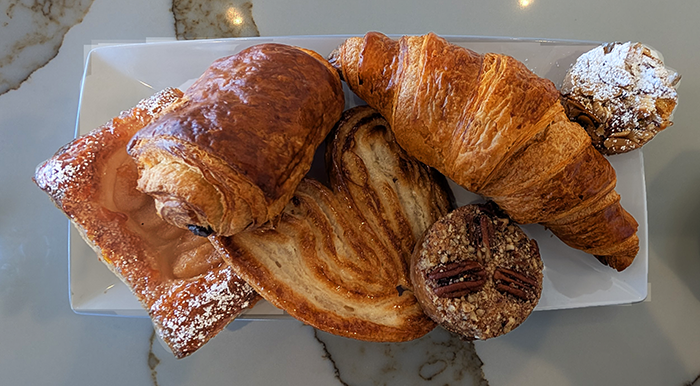
Please tell me a little bit about what’s on each plate?
Rafika Oudelha: So in this plate here, those basically, we call them viennoiserie. The viennoiserie means like the item you can have with your coffee in the morning, which is a pain au chocolat. And we have a plain croissant. We do have pear tarts. The pecan almond tart is very popular here. We noticed that in Aksarben, a lot of people like it. And we have the almond tarts.
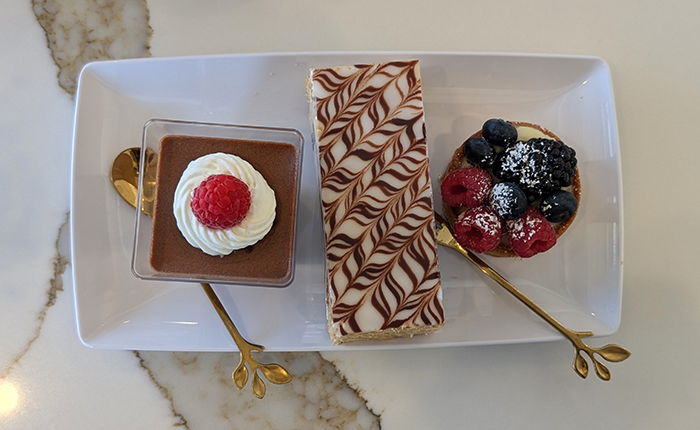
For the other tray we have here, we have the mille-feuille, the fruit tarts, and the chocolate mousse cup.
There are different things in different countries. Like, flour is not the same everywhere. How do you adapt for being here?
Rafika Oudelha: I guess that’s why it took us forever to find the right texture.
We don’t have to get into anything secret, but just the idea.
Zied Allam: Actually, that’s a great, great, great question. So basically, we know the flour that exists in Europe, specifically France, is extremely difficult to find here in Omaha, Nebraska. To go around that, we will sample seven or eight flours. And then we look at the region where it produces a flour that is similar to the one in France. So, for example, when it comes to croissants, most of the time I buy my flour from this French company out of Washington, D.C. It’s called Moulin Rouge. For the cakes, we use another type of flour that we buy from Texas. It’s very similar to the French flour. It has a good protein, but not high gluten ratio, and has a very low ashes. Ashes is basically sort of like an ingredient that is mixed with the flour. And then sometimes we may use King Arthur flour. Sometimes we may use a different type of flour that can suit that particular product, like pastries. And there’s a lot of times where basically we try to come up with our own recipe. Honestly, it’s not something like if there’s no French flour, we can’t substitute something else similar. It’s not going to be 100 percent like a French flour, but it’s very, very close.
Thank you. Is there a question you would have liked me to ask that I didn’t yet? Or anything else to tell people about?
Zied Allam: Well, we want to mention that this pastry was created and born out of vision, out of passion for what we want to do.
Rafika Oudelha: We love what we do.
Zied Allam: Yeah, we did not create this because we heard of people making tons of money doing this. No. Our idea was driven by the fact that we really need something outstanding here in the Midwest. We want to basically, at least in our modest way, change the pastry culture, because we felt that we are lagging when it comes to this. We want to bring something more of a different style, but then we want to also enrich the diversity when it comes to selections. So, people, you don’t have to be stuck with only muffins and cupcakes and donuts and things like that. Those are great too, but in the meantime, I think we, as consumers, also need to be exposed to different other pastries, and that’s what has basically driven us.
It shows so much, the love. And the love of creating and sharing when I come to visit and today in both your eyes, it’s so beautiful.
Rafika Oudelha: Thank you.
Zied Allam: Thank you.
Rafika Oudelha: I want to share this too. I feel so happy and so grateful when customers come here and they go, “Oh my gosh, this reminds me of my country,” like Australia, Italy, France, North Africa, South Africa. Every customer is different, but I just feel so happy when I hear them saying, “Oh my gosh, the pavlova .” When we started making pavlova, a lot of people were like, “Thank you so much for making this here.” They said, “We couldn’t find Pavlova here in Omaha.” And other people, they go, “Oh my gosh, that remind me of my grandma who used to make the Italian amaretti ” Those comments make me so happy, and I try to make everyone happy. It’s not like, because I’m from North Africa, I just make North African desserts. No, I want to make a variety, because people here, they like variety. They are not just American or African. So when I try to make a variety of desserts, that makes me so happy. And we have some customers who go, “Please, do not move from Omaha. Stay in Omaha.” These customers, every time they show up, they say, “We are so thankful you are in Omaha. We are so thankful you have these desserts here.” These things make me so happy and make me want to work harder and bring more new items here.
Thank you.
Rafika Oudelha: You’re welcome.
Zied Allam: If I may add to this, before we started, some people were like, “Oh, man, you’re going to start pastries? There’s no chance. There are so many stores here.” I said, “Yeah, but I’m not doing similar items. I’m bringing something different.” This is designed for that 10% niche of the population who want to try on something different, something unique, people who are tired of the same pastries every single day. I’m not expecting people to come to our store every single day, but once in a while, if a person craves good quality chocolate or a good quality butter croissant or whatever that is, they can come over here and enjoy it.
I’m very happy you’re here. I’ve missed things like this, having lived other places, and I was telling your wife I was seeking them out. And then I was just going down the street, and I’m like, “No, this can’t be here! This is wonderful!” Then I tried it, and it was so good. And the people here, especially your wife…it’s just so lovely that you want to come again and again, not just for fantastic pastries, but for the experience of coming here.
Rafika Oudelha: We have a lot of gluten-free items here as well, like the amarati, the Italian cookie, the petit fours, the French macaron, the pavlova, the chocolate mousse cup, the mango.
Zied Allam: We have a specific kitchen station designed for preparing gluten-free items. We also want to bring artisanal types of pastry to Omaha restaurants. I’m hoping we can catch up with other cities like New York City or Los Angeles.
(A customer named Gina walks into the store and speaks French.)
Zied Allam: So this is a French testimony. It’s a French lady.
GINA: I was just saying that I felt like I was in France. We sat at a little corner table drinking delicious coffee and eating delicious pastries and talking about ideas. And that’s very French, and the coffee’s delicious. For someone who’s lived in France, they are 100% authentic French pastries. And the coffee is magnifique...delicious. I felt like I was in France in a little bit.
This is a perfect ending to the interview.
GINA: I was in France in February, and I when I came in here, I felt like I was back in France. I will be back. Thank you.
Rafika Oudelha: Yeah, that’s what I told you earlier. Every customer who comes here will say, “Thank you. I am so happy.” The most popular bakeries in France for the macaron are called La Duret or Pierre Armee. We have some customers who say, “We tried the macaron in France, but this macaron is better than theirs.” We have people from here who buy it and take it from here to Saudi Arabia.
Zied Allam: Remember that guy from Offutt Air Force Base?
Rafika Oudelha: Yeah.
Zied Allam: He came in and bought a lot of pastries. And I said, “What are you going to do with all these pastries?” He said, “We’re going to take them to Seoul.” I thought Seoul must be a city in the United States. He said, “No, no, my friend, this is going to South Korea.” Then later on I find out there are planes that fly from a base in Bellevue straight to Seoul. During Christmas they sent us a picture of them celebrating with our pastries. I told my wife, “Here we go! Our pastry made it all the way to South Korea.” The guy who came in here was a colonel or something like that.
Rafika Oudelha: Yesterday 10 or 12 Japanese people showed up. The farmer’s market was yesterday. It was the first one of the season. We thought they might have come from the farmer’s market. No, they came to Omaha for the Berkshire event.
Zied Allam: And when I asked them how they found out about us, they said they heard about us on TikTok. Berkshire brings thousands of people to Omaha. We did not even know there was something going on like that. We just knew about the farmer’s market.
Thank you.
Grand Patisserie
2283 S 67th St.
Omaha, NE 68106
(402) 509-9233
Grand Patisserie
14451 W Center Rd.
Omaha, NE 68144
(402) 509-9233
