Happy Fourth of July Omaha!
Friday, July 4
Ralston Independence Day Parade
1 PM Parade
Main Street, Ralston
https://www.cityofralston.com/community/pages/ralston%E2%80%99s-65th-annual-independence-day-celebration
Werner Park Independence Day Fireworks
4 – 7:05 PM Omaha Storm Chasers vs. Iowa Cubs
After the game fireworks
Werner Park
12356 Ballpark Way
Papillion, NE 68046
RiverFront Fourth of July Celebration
8:30 PM Concert
Around 10 PM Fireworks
Gene Leahy Mall, Downtown Omaha
https://theriverfrontomaha.com/visit-the-riverfront/gene-leahy-mall
Our OmahaNebraska.com Line Up of CWS Food Offerings at the College World Series
https://www.omahanebraska.com/blog/our-line-up-of-cws-food-offerings-at-the-college-world-series
CWS Media Tasting Presentation: Katie Smith, Executive Chef – Levy Foods
https://www.omahanebraska.com/blog/cws-media-tasting-presentation-katie-smith-executive-chef-levy-foods
CWS Interview: Katie Smith, Executive Chef – Levy Foods
https://www.omahanebraska.com/blog/cws-interview-katie-smith-executive-chef-levy-foods
CWS Media Tasting, 11 June 2025
https://www.omahanebraska.com/blog/cws-media-tasting-11-june-2025
CWS Pre-Game Press Conference, 11 June 2025
CWS Interview: Amy Hornocker, Executive Director – College World Series
https://www.omahanebraska.com/blog/cws-interview-amy-hornocker-executive-director-college-world-series/
Omaha Interview: Roger Dixon, President and CEO- MECA
https://www.omahanebraska.com/blog/omaha-interview-roger-dixon-president-and-ceo-meca/
There are a lot of tasty food options at the College World Series.
OmahaNebraska.com tried them all and we have some o-pun-ions, I mean opinions.


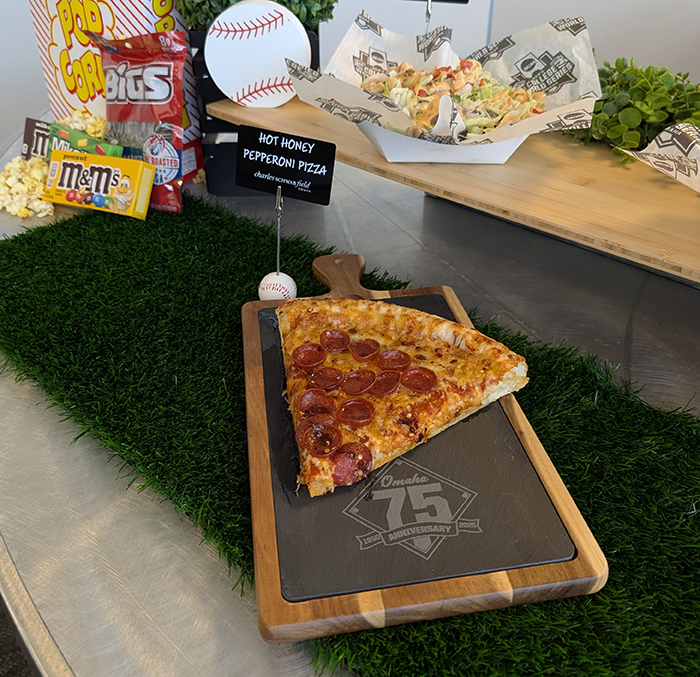
#5: Hot Pepperoni Pizza
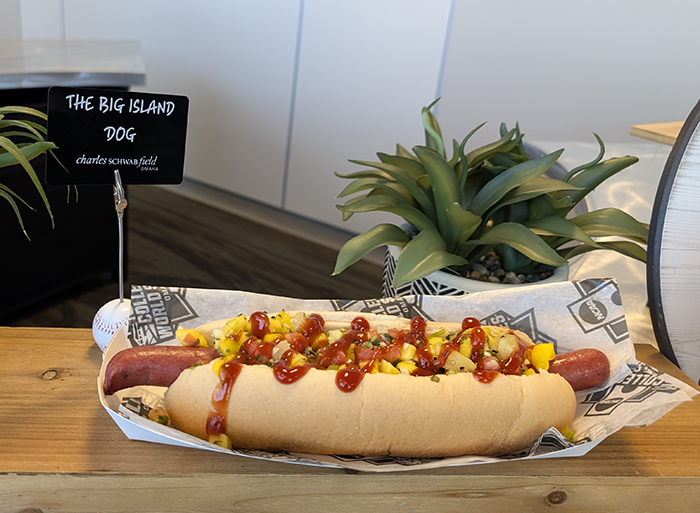
#4: The Big Island Dog
#3 The Flyover Frank

#2: You’re Killing Me Smores

What do you think? What did you try and what was your favorite?
The presentation was given by Katie Smith, Executive Chef of Levy Foods at the College Word Series Media Tasting Event to the media.

All right, so I’m going to go over all of the offerings that we have this year for you, for our College World Series. Obviously, we have kept all of our fan favorites, but these are all the new items that we have this year.
This year we have two different burgers of our specials. We have the Big Dill, which is right here. We’ve got a grilled Omaha Steaks burger, and then it has provolone cheese, fresh red onions, our dill aioli, and fried dill pickle chips on it.
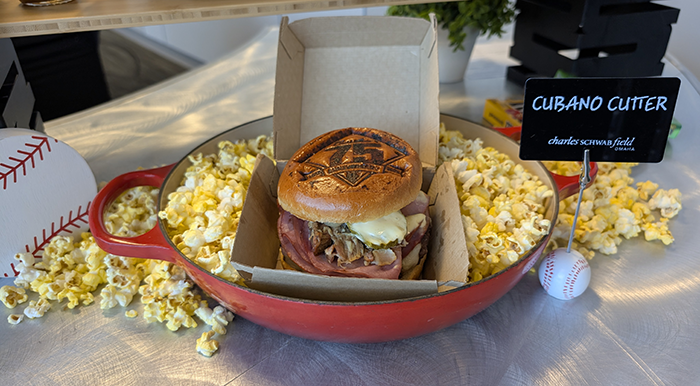
And then our next burger is our branded 75th burger, the Cubano Cutter. We have our Omaha Steaks grilled burger, and we have ham, smoked pork, dijonnaise, and pickles on top of that, so your classic Cubano in a burger. And then it is branded with our 75th logo right on top.
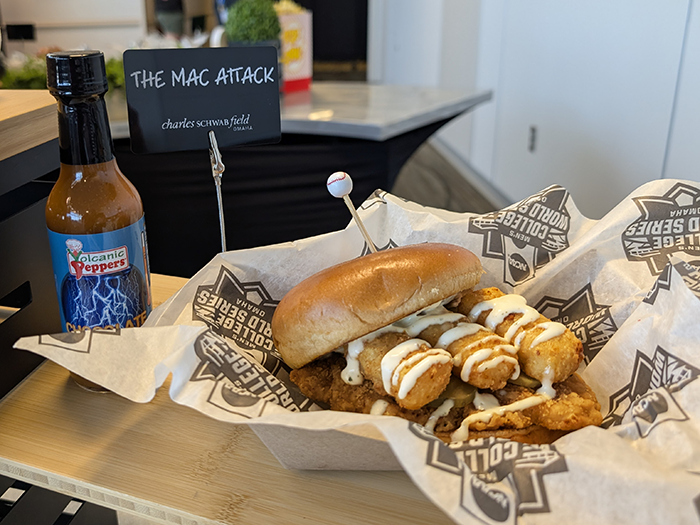
And our last sandwich on this display is our Mac Attack. It is a chicken sandwich—a fried chicken patty on a brioche bun with pepper jack, fried mac and cheese bites, our spicy ranch that is made with our chocolate habanero sauce from Volcanic Peppers, and then it is topped with pickles as well.

We’ll move on to our dog selection. So this year we have three new loaded dogs. You have three options, but our Big Island Dog is our footlong, but we also have an Island Dog is just our normal hot dog with the same toppings on it. So we have a larger version and then we also have a smaller version. Our Big Island dog is our Omaha Steaks footlong hot dog topped with a mango pineapple pico, and then it is drizzled with teriyaki ketchup.
For our next dog, we tried to take a spin on a classic Chicago dog and we made a Midwest dog. We named it The Flyover Frank. It is a classic Omaha Steaks dog topped with red pickle relish, diced onions, sliced tomatoes, and a pickle spear.

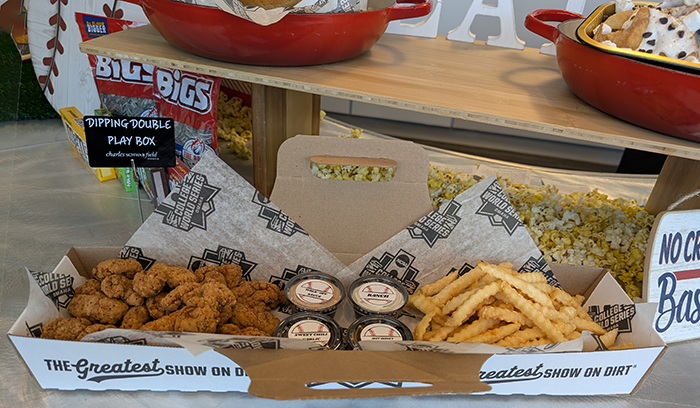
We’ll come over here. These are more of the items we really want to show you. We have two shareable items. Our first shareable item that I’m gonna talk about is our Double Dipper box. Our Double Dipper box is boneless chicken meat and crinkle cut fries. And then it comes with four of our signature sauces. We have our house made buttermilk ranch, a sweet chili sauce, a hot honey BBQ, and our house tender sauce, which is called our Walk-Off Sauce. This all comes in that beautiful big box that are NachOmaha comes in… very easy to share, very sit on your lap, at your feet.
Our next one that we’re showcasing this year for our 75th anniversary of the College World Series in Omaha which is our pork tenderloin. We decided to go back to some Midwestern classics with this one. You can’t get any more Midwestern than a pork chop. So we’ve branded the bun as well with that 75th logo. So you have a beautiful golden fried large pork tenderloin with our branded bun.
Our next shareable item, and something that I am really super excited about this year, is our You’re Killing Me S’mores. Not only do I love the name, I love everything that’s in it. And we have churro chips, creamy marshmallow, chocolate chips, and toasted marshmallows.

And then over here for our last section, we have some loaded fries and tots and then we’re showcasing a new pepperoni pizza that we’re doing this year. We switched out all of our pepperoni to a cupped pepperoni. It’s a beautiful, crispy, cupped pepperoni on all of our pizzas, and you can put hot honey on top of it. So we’ll have regular pepperoni pizzas, and then we’ll also have an option to have a hot honey pepperoni pizza.
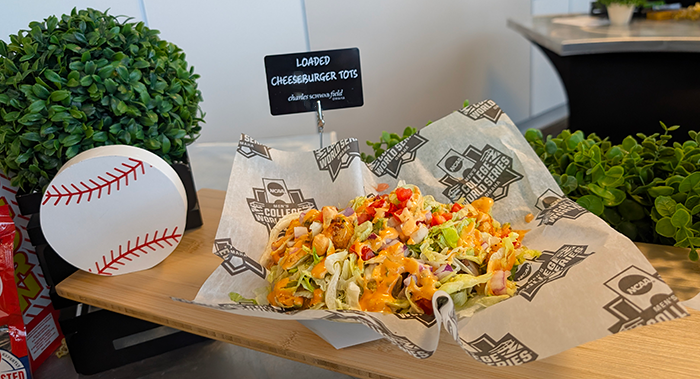
For our loaded tots for this year, we tried to go back to a classic once again. We have a classic cheeseburger tot—our crispy golden brown tot topped with seasoned Omaha Steaks ground beef. Then you have lettuce, tomato, onion, and then topped with our burger sauce. So everything that you would find on a burger right here with our spicy nacho cheese.
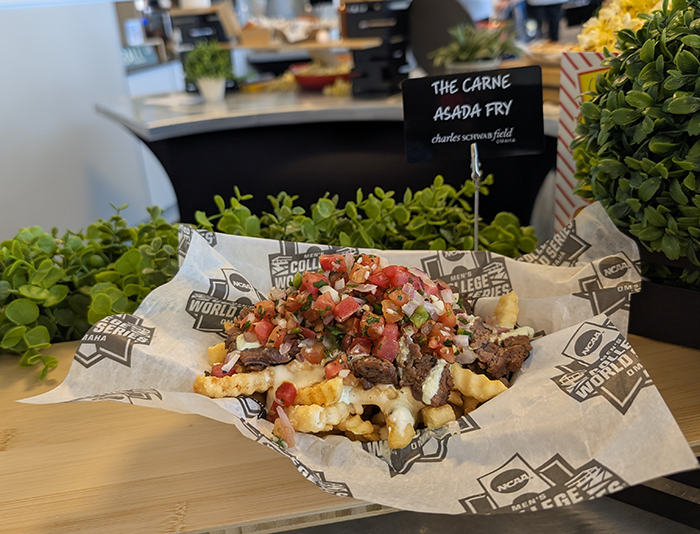
Our last loaded fry that we are doing this year is our Carne Asada fries. You have crinkle cut fries, our queso blanco, and then it is topped with a fajita-style beef and fresh pico.
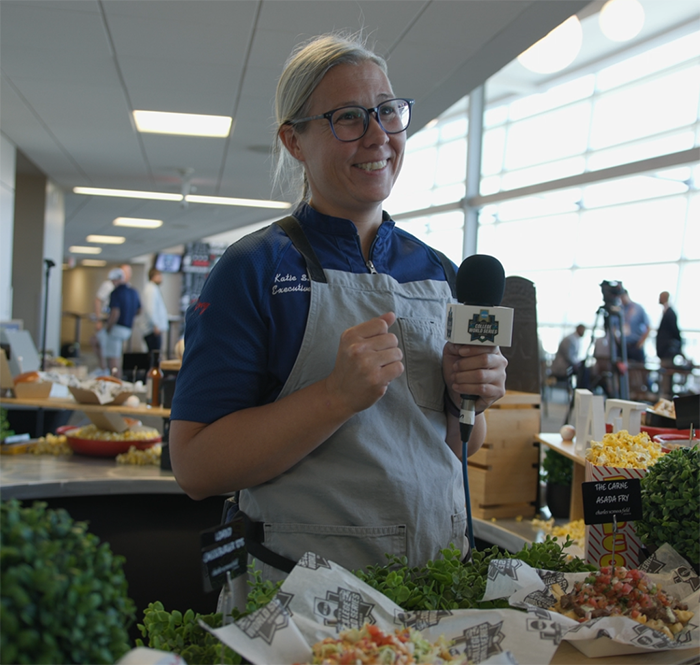
And that is our offerings for this year.
(Applause)
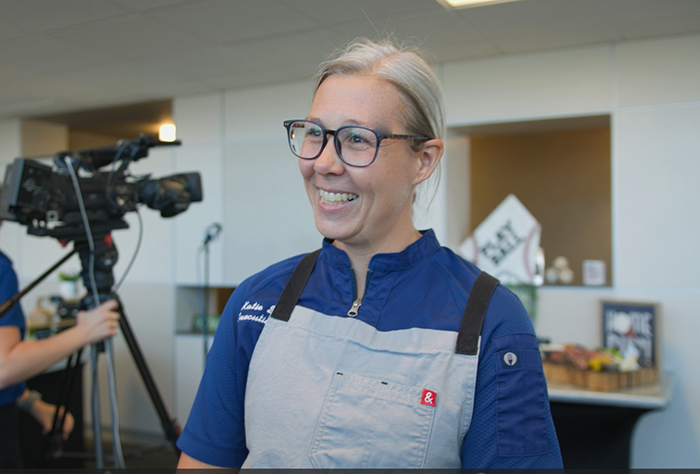
OmahaNebraska,com here with…
Katie Smith
So this is your first time in this position …
It’s my second year as the executive chef. I usually focus on the catering aspect at the CHI Health Center. That’s been transported here that I’ve focused on for the last seven years. I gave that responsibility to Alec [Woockman ], who you guys have all met before, and he is now the Executive Sous Chef of the CHI Health Center. So this is my second year doing it as a whole, but having more of a focus over here, it is the first.
I was wondering how you were able to do this, because I didn’t know whether the inside of the facility [had this capacity], so that makes a lot of sense.
Yeah. Look, there’s a lot of logistics. There’s a lot of working parts, and it’s something that we just have to work through every single year. We get better every single time. We are, I like to say, just a well-oiled machine because we’ve done this so many years, and we have the history of how we can do it, better and better. And I feel like we get better.
What are some of your new offerings this year and some stories on how it was devolped?
So this year I really started. After the last College World Series, I went to a Cub’s game for 4th of July and I was sitting and eating, and I realized how difficult it kind of was to eat in your seat. So my biggest focus this year was finding more items that are easier to eat and have a better guest experience while they’re sitting down in the bleachers.
But I do have quite a few different fan favorite foods, this year. We also did more of a focus on the 75th year of it being in Omaha. We have things that are focused around that right now and that is our Cuban burger. So a Cubano Cutter. It’s a specialty burger. And on the bun we branded it, so it has the 75 year logo branded on it. And then we also are doing that pork tenderloin. That was another one I kind of wanted to bring back. I wanted to bring back the midwest classic for the 75th year, kind of anniversary to showcase all the wonderful foodsin the midwest. I feel that the pork tenderloin is one of those that we do best. We are branding that bun too. So those would be in two separate locations. And then another item that I am super excited about this year is our “You are Killing e S’mores”.
That was something else I really wanted to try to focus on was finding more dessert options for the stands. It was something we kinda lacked each year. So, we’re taking more of a focus on the things that we can do better on: guest experience, creating new items that haven’t been able to execute before in the stands, so…We landed on a S’mores nacho. It is a churro chip loaded with marshmallow toppings, chocolate chips, toasted marshmallows and then graham cracker crumbs on the top of it.
It sounds wonderful.
Oh, I am so excited for everyone to try that one.
I’ve noticed a lot of items that are spicier this year. Can you tell us about that please?
Some of our themes you will see this year are a lot of ranch and a lot of pickles, too. This is kind of how the menu developed this year.
We do have a few different, spicier options, so we have the Heat Streak Brat. So that is sriracha aioli and fresh jalapenos on top of that. You have The Mac Attack, and that’s a chicken sandwich with a spicy pepper jack and mac and cheese bite right on top with a spicy ranch. We use the Chocolate Lightning from Volcanic Peppers’.
I was going to ask you about that. I’ve noticed that the store in Bellevue, Volcanic Peppers …
We use them. We work with them a lot. We use a lot of their different products. We have Dia De Sol. That is one of their best-sellers, and that’s on our NachOmaha, which is one of our best-sellers. We always try to showcase some of their new items. I always go and talk to them and then find out what’s new that year and then try to make something special.
Is there a question I haven’t asked you or something else you’d like to say?
Just come and try out our wonderful options that we have this year.
Thank you.
You are welcome
The College Word Series Media Tasting was held today.
Here is the line up:


PDF version is here:
2025-Special-Menu-Flyer-MCWS
If you use a screen reader and are having trouble with the PDF, please email us or give us a call. info@omahanebraska.com 402.932.7243
Our descriptions are up next! Please visit back later for those.
The College Word Series Pre-Game Press Conference was held this morning at the
In attendance were:
Jim Pillen, Governor, State of Nebraska
John Ewing, Mayor, City of Omaha
John “Jack” Diesing Jr., Chairman and President of College World Series of Omaha, Inc.
Anthony Holman, NCAA Vice President of Championships
Roger Dixon, President and CEO of MECA
The format this year was different with each speaker taking a turn to speak and then receive questions from the press.
Here is the transcript:
2025 College World Series Pregame Press Conference
JOEY = Joey Gardner, Marketing and Creative Manager at College World Series of Omaha, Inc.
GOV = Jim Pillen, Governor of Nebraska
MAYOR = Mayor John Ewing, Jr., Mayor of Omaha
JACK = Jack Diesing, Jr., College World Series of Omaha
ROGER = Roger Dixon, MECA
ANTHONY = Anthony Holman, NCAA
FATHER = Father Hendrickson (Rev. Daniel S. Henderson), president of Creighton University
MT: Michel Thornhill, OmahaNebraska.com
MP: Mike Patterson, Omaha World Herald
Transcript
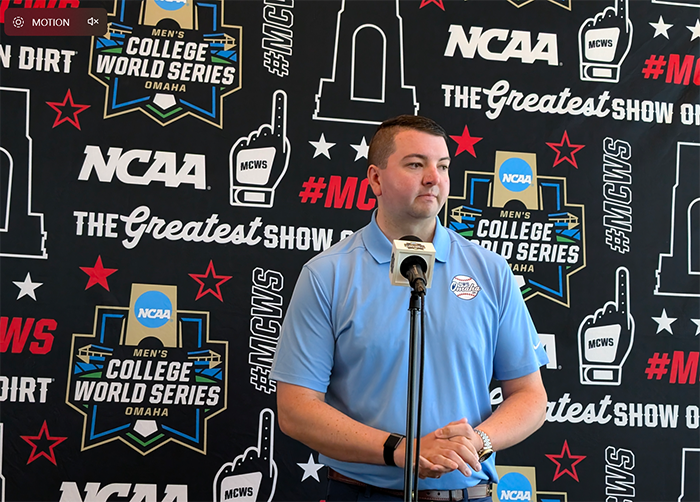
JOEY: Thank you, everyone, for joining us today. I’d like to welcome our distinguished guests. We have Governor Jim Pillen, Mayor John Ewing, Jack Diesing Jr. from the College World Series of Omaha, Roger Dixon from MECA, Anthony Holman from the NCAA, and Father Hendrickson from Creighton University. I would like to start by welcoming up Governor Pillen for some remarks and questions.

GOV: Well, good morning, everybody. I think the most important thing to say is “Welcome to Omaha,” and “Welcome to Nebraska.” As I was meeting some young ladies who are working with the College World Series, I said, “Do you know what’s going to happen to you in the next two weeks?” And they said, “We’re not sure.” I said, “You are falling in love with the people in Nebraska, and you’re going to stay here. You’re not going to go back home. So you’ll be welcome.” You know, let me say, on a very, very serious note, this is an extraordinary celebration. Seeing people here like Jack that have been working their whole lifetimes for the College World Series, in the 75th year. And from my viewpoint, as I said earlier, you know, I’m fighting this aging stuff. I’m working out and lifting weights and doing all this stuff because I want to be here 25 years from now when we hit 100 years and have an incredible celebration. And maybe lastly, I think the thing that’s so extraordinary that we in Nebraska gotta brag about a lot… Just think about it: Any little boy in the United States of America that grows up swinging a bat… his dream isn’t talking about Major League Baseball. The dream is Omaha: “How do I get to Omaha?” And every kid that’s playing college baseball…my guess would be if I was a coach, I’d be breaking… from the time we start to the end of every day: “Omaha, Omaha, Omaha.” It’s really, really a big deal, and we’re incredibly proud of all the work that everybody’s doing. It’s gigantic for Omaha, it’s gigantic for the State of Nebraska, and it’s extraordinary for the youth across the country that we have an event that is unrivaled to anything any of these kids are gonna experience in the coming weeks, to compete and play here. And then think about Murray State. Holy cow, I can’t wait to meet the coach of Murray State because he cuts the grass on his field. And I’m gonna get him over, and we’re going to cut the grass in the county. By the way, I love to cut grass. Any questions? I’m happy to take…
JOEY: Governor, can you start by talking about the economic impact in the state of Nebraska and what it means?
GOV: Well, the economic impact’s gigantic. What’s really incredible is people that come here, right? I have friends in a number of states, and they say, “You know, once we came, we got hooked.” So people come here more than we even know besides the World Series. The hotels are filled up, and it ends up being millions and millions of dollars, several hundred million dollars of economic activity. But it’s even far greater than that, because there’s lots of people that come here whether their team makes it or not, and then they find out how extraordinary this city is. Think about this city. We are the safest place of any city over 500,000 people in the United States of America. And we have the best people. Who doesn’t want to come here? We have people coming here all the time, so it’s kind of immeasurable.
JOEY: Now we can open it up for questions.
PRESS: Will you come cut my grass? Just asking.
GOV: I wish. I tell this talk all the time. When we’re young people… and if we all ask ourselves who are the three most important people in our life, 100% of the time—I’ll bet the farm on it—one of the three is a teacher or acoach. So I’ll come and coach you how to cut your grass. I wish I’d been a coach. I’ll coach you how to cut your grass.
JOEY: Any other questions for the governor?
PRESS: Governor Pillen, I know we’re here for the CWS, but I also feel like you can’t ignore what happened yesterday. Would you be able to comment on what the state controlled involvement is in what happened yesterday in Omaha?
GOV: We’re here to celebrate the College World Series, so I think we ought to keep it focused on that. I’ll be happy to talk to you offline. Anything else? Yes, dear.
MT: Michel Thornhill with OmahaNebraska.com. What’s your favorite baseball or sport or team memory?
GOV: I didn’t get the chance to play baseball when I was a kid in Platte Center in the summer. A couple little times, but I didn’t really get to play baseball, so I got extraordinary team memories from my high school days. And then I had the privilege to play for Coach Osborne, and a cool memory. Because when I was a kid growing up, we would play Alabama and there was this guy named Bear Bryant. And I’ll never forget…in my junior year we’re playing Alabama in Lincoln and before the game we’re going through calisthenics and doing stuff and I look over and the Bear is leaning against the uprights, leaning against the pole with his fedora hat on, smoking a cigarette. And I’m saying, “Holy cow, I’m playing against the Bear today.” It’s something I’ll never forget. It was really cool.
MT: Thank you.
JOEY: All right. Thank you, governor. So, next up will be Mayor John Ewing.
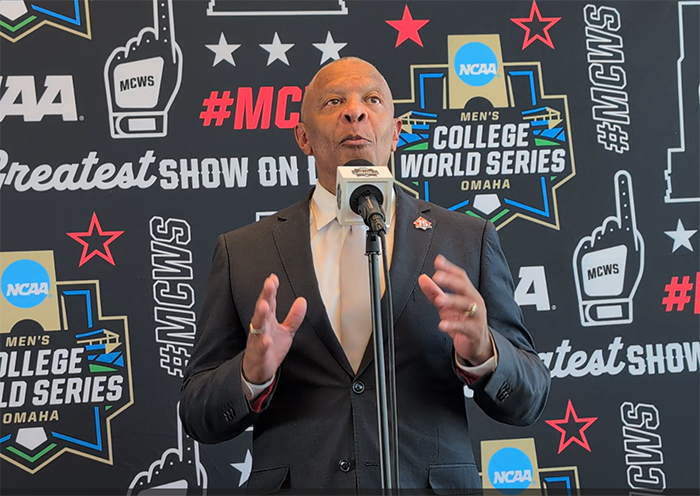
MAYOR: Good morning, everyone, and welcome to Omaha. And as the governor said, you will fall in love with Omaha, and you will want to stay. If you would like to know more information about staying in Omaha, I have some cards that I can share. But this is the road to Omaha, the greatest show on dirt, and we’re always excited about being able to celebrate the College World Series here in Omaha 75 years… and I know the governor talked about 25 more years, but what I’ve been talking about is laying the foundation so we can be here another 75 years. This is where the College World Series belongs. We’re excited that you’re here. We’re excited for the eight teams that will be here, and this will be an amazing two weeks of baseball and also great activities for the people that come to Omaha and get to experience Omaha. So thank you all for being here.
JOEY: Mayor Ewing, can you start by talking about the economic impact on the city of Omaha and what it means?
MAYOR: Absolutely. We know last year just from the College World Series—and we can’t talk about second visits or anything like that because we don’t know—but we know this was $115 million of economic impact, 75,000 hotel rooms filled, and $3.5 million of sales tax revenue. And as a former county treasurer, I pay attention to things like that, because that tells us how well we’re doing as a city when it comes to bringing people here and sharing the good life with you.
JOEY: Any questions for Mayor Ewing?
PRESS: Mayor?
MAYOR: Yes.
MP: Mike Patterson, World Herald. Do you love baseball? Have you gone to the College World Series very often in the past?
MAYOR: I’ve come to the College World Series almost every year since I was a 21-year-old rookie police officer, and so I’d usually come down two or three times a year. This year I’ll probably be down every day, but I get this new, exciting opportunity to be the ambassador for the city of Omaha, and I am absolutely thrilled.
PRESS: You mentioned, Mayor Ewing, that you wanted this to stay here over the next 75 years. I know it’s a little early in your tenure. What plans do you kind of have in place to ensure that that happens and that contract does get renewed in 2026?
MAYOR: Sure. Well, one of the things I think we have to do is we have to be great hosts as I said. We have to build the right partnerships and continue those partnerships with the College World Series, with Creighton University, with the NCAA and other people who come here to this city, just letting them experience the greatness of this opportunity and the greatness of this event.
JOEY: Yes.
MT: I enjoy learning about economic development and how things change over time. With the College World Series right here and Hot Shops spurring a lot of growth in the area, what other types of things do you see are going forward? And I also know that’s a little early.
MAYOR: Well, one of the things I want to see is more venues for people when they come to Omaha to be able to enjoy it, but also for the people of this community…as well as looking at expanding, as I’ve talked about quite a bit, the urban core further north and south to increase opportunities for businesses there, shopping, retail, those type of things so that people can have a fuller experience when they’re here in Omaha.
MT: Thank you.
JOEY: Any other questions for Mayor Ewing? All right. Thank you, Mayor.
MAYOR: Thank you.
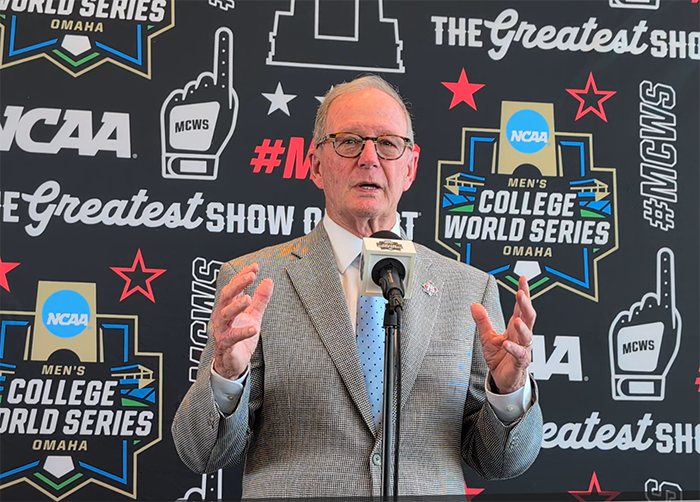
JACK: Well, good morning, everybody. Welcome to the diamond anniversary of the College World Series being hosted here in Omaha, Nebraska. We were just at an investment being made by Creighton University and others in some new baseball facilities, and it’s a testament to what this event has meant and continues to mean and all of its participants in this community and of course, institutions to the success of this event. I’ll just say that Anthony Holman mentioned this morning something that was great. He called this a jewel. So it’s definitely a jewel to be here. It’s nice to be part of it. We’ve had such a great partnership with the NCAA and various individuals who’ve been responsible, working with us to make this event the best it could possibly be for the kids who get to play this game and for the fans. We all seem to be rowing the boat in the same direction, which is a very important thing to be doing for the future. And it was alluded to this morning…it’s been talked about…we all want to have this here for another 25, if not 75 years. But think about it: 75 years ago nobody wanted to host the College World Series. Now everybody…it’s on national TV, and we…together with the NCAA and our partners here in Omaha, we’ve made this a bucket list item for fans. And as people have alluded to, they talk about the road to Omaha; they talk about getting to Omaha. One of my favorite phrases is from Mike Martin, who unfortunately passed away within the last year or so…a famous coach at Florida State…the last time his team qualified here, he said, “My favorite four words are ‘See you in Omaha’.” So there you go. Thanks, all, for being here.
JOEY: Jack, you and your father are the fifth and sixth recipients of the All Star Award. With this being 75 years, can you talk about the legacy of your father as well as the foundation you’ve helped lay for this event?
JACK: Well, it’s really an honor—I’m humbled, and I know my father would be, too—being recognized in the same breath as people like Rod Dedeaux and Skip Bertman and Augie Garrido and Dennis Poppe who is on that plaque also. So what it means is you’ve done something right and you’re working with our partners at the NCAA and the American Baseball Coaches Association. And we’ve formed good partnerships, we’ve listened to them, we’ve shown them that we care. We’ve pulled together, collaborated with partnerships and their relationships here in Omaha that’s made this all work. There’s no “I” in “team,” so one or two people can get recognition, but there’s usually a lot of people behind them that deserve the credit. And I guess I would say that in summary, to me, what it mostly means to me is we’ve been successful in forming collaborative relationships and partnerships in Omaha with the city, MECA, the business community, Creighton, and another host institution, the University of Nebraska at Omaha to pull everybody together so that we can realize how important this is Omaha. And then secondly, we’ve been fortunate enough to work closely with the NCAA to develop a level of trust between the two organizations. And nobody has an ulterior motive. Our motive is basically to do what’s in the best interest of college baseball. So it’s a great honor, and we’re very humbled.
JOEY: Any questions for Jack?
JOEY: Next up is Roger Dixon from MECA.
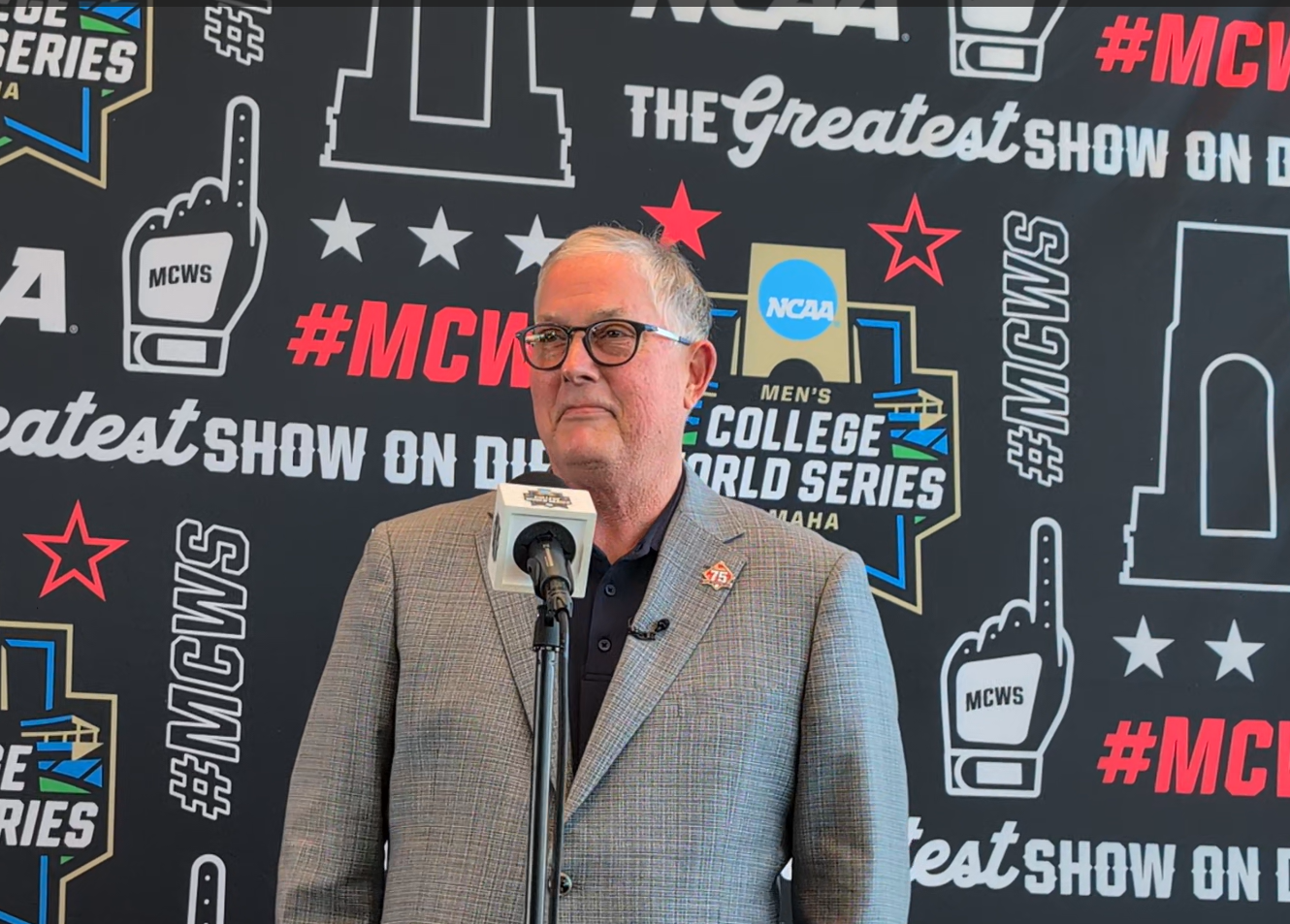
ROGER: Well, it’s always an honor for MECA to host this great event, working with the NCAA, CWS Inc, the City, and all the people that make this happen. We couldn’t do it without a great team, the MECA employees, and the support from the community. And also the support of our board—Diane Durren is with us here today. So let’s play ball.
JOEY: Can you talk about the importance of this facility and how long… having hosted it for a number of years, what it means to have this come back to your facility each and every year?
ROGER: Well, this facility was built for this event, and—most people don’t realize it—so it generates enough to pay it off, so it’s never been a drag on the taxpayers by any sense. It’s also been a great venue for this community to showcase Creighton baseball, Big Ten baseball. And we’re too big for some things, we’re too small for others, but we make it work with the help of the community. We like to keep our facilities as if they look brand new, whether it be CHI Health Center, Charles Schwab Field, or the RiverFront, and we do that by whatever we make at these facilities we pour back into these facilities. I will say one thing: there will be a change next year. Next year you will see a video scoreboard in the left field.
JOEY: Any questions for Roger?
[None]
ROGER: Easy.
JOEY: Finally, we have Anthony Holman from the NCAA.

ANTHONY: Well, it’s a tough act to follow, but I am excited to be here for our 75th anniversary of the College World Series being in Omaha. We’re excited to be back here, obviously. Roger just said something that’s really important. Oftentimes in my role with the association, I oversee site selections and bids and our business strategy for hosting of other championships in other locales and venues and things like that. And oftentimes we’ll hear from cities or things that say, “Hey, we want to be the Omaha of this sport” or “We want to be the Omaha of that thing.” Right? They coined that together to say that when people think about baseball they think about Omaha, right? For other folks, this has become the blueprint of a long-term partnership. And what I share with them is they’re not just the hosts, right? These are true partnerships that we have in Omaha. This is a marriage, right, that we have to nurture, we have to water. It doesn’t just happen overnight, and that comes from commitment from the city, from the state, from the leadership of MECA, the leadership of CWS Inc, and all of the community partners that were so influential in both bringing the championship here and then keeping it here. So with that kind of spirit and that kind of partnership and collaboration, I expect that not only will it be, I think it won’t be 25 years. I think we’re safe to say 75 years and beyond. I think the foundation has been laid for us to have to have that going forward. So we really appreciate you all coming out and supporting the championship, not only today for the announcements, but also throughout the next two weeks of baseball. So I’ll take a couple questions.
PRESS: I was going to ask you about the partnership. There’s a rumor that the CWS is gonna move or somebody’s gonna…
ANTHONY: I love it. Competition is excellent, right? It’s a good thing. It’s a great thing, but it’s the champ, right? Think about a price point. Nobody’s even been able to get the ring. So I think it’d be hard pressed for another city to make this type of commitment: to build a facility. Right? We’re the primary tenants. I’ve got an office here, right? So that’s a pretty cool thing. The College World Series is our second-highest grossing in terms of revenue and attendance of all our championships. And that doesn’t happen without it being in Omaha, so we’re really appreciative of that.
JOEY: Any other questions for any of them?
[None]
ANTHONY: You guys just want to eat. All right, no problem. Thank you.
JOEY: And finally, before doing that, Father Henderson from Creighton University. If anybody has any questions for Father…
FATHER: You’ve said it and the governor and others made reference to it, that Creighton’s been a host for 75 years of the College World Series. Here in Omaha, the partnership with CWS has been terrific. It’s an exciting year, because as we step into a new chapter, another 25 or 75 and another life of CWS… UNO is also a host institution with us. Doctor Lee and I were here in this room at the press conference with Jack and others and the governor and the mayor. We’re excited to share those responsibilities and privileges of working with CWS. So, thank you to Doctor Lee and to the University of Nebraska at Omaha and to my team at Creighton and Marcus Blossom and his leadership as we continue to move forward in this great event. Happy to take any questions. (Silence) That’s the way I like it.
JOEY: Thank you all for coming today. We have the media tasting, which is behind us here. If you also would like to meet with the individuals for individual comments, please let us know. Thank you all.

Omaha, Nebraska.com here with …
Amy Hornocker, Executive Director, College World Series Inc.
You’ve been now doing this for a couple years.
Yes.
And you have the one for the 75th year of hosting it.
Yes.
Tell us about it, please.
It’s the 75th anniversary of the College World Series in Omaha. The event has been running longer. So we just want to make sure that people know that it’s just the one that…for the city. But it is still very important.
Obviously, 75 years in a city is significant. So we’re just doing some things to celebrate. I think our biggest one that we’re doing is the 75th at the Riverfront. [https://theriverfrontomaha.com/events/?&eventid=7971]
Thursday, June 12th at Gene Leahy Mall, we have three bands, food trucks, and then capping it off with fireworks. And it’s free, open to the public. We want to celebrate with the community that’s given so much to this event.
We’ll also just have some other general celebrations throughout.
We have Ashley Spitsnogle. She’s a painter. She started a painting, which is basically Rosenblatt fading into Charles Schwab Field, and then she’s going to finish it on Finals Game 1. She’s going to finish the field piece of today, and then that will be available for purchase when she completes the whole painting, following the Series.
So that’s kind of a cool thing. Yes, that’s about it for celebrating.
I know you celebrate different groups of people too.
Yes.
First responders, teachers…
Yes. Heroes in the Heartland is Tuesday, June 17th. Game 10. We’ll honor heroes within the community. So that’s police, fire, doctors, nurses, military. So that’s a cool night.
Teacher Appreciation is game 11. That’s Wednesday afternoon. The first 250 teachers that show their ID get a Levy concession gift card.
We have a partnership with Omaha Public Schools on a reading initiative. We’ll celebrate some of the top readers that came out of their competition at that game too.
Is that the Readers Are Leaders?
Yes, Readers Become Leaders. We worked with Omaha Public Schools district-wide this year. Before this year, we just worked with one whole school to see if that would be like more intentional. We worked with Skinner Elementary in North Omaha. We did a couple pep rallies there, and it was fun to see the kids excited about reading.
Saturday, Game 4, we have the All Star Award. It’s usually been coaches, former coaches basically for their contribution to the game. But with the anniversary, we’re actually honoring Jack Diesing Sr. and Jr. Obviously, Jack Jr. is the chairman of our board, and his father was instrumental in keeping this event in Omaha and growing it. They’re going to be honored on Saturday night.
And then the very famous Rawlings keychain giveaway is on Monday afternoon at 1, game 7.
I have one of those and enjoy it very much.
They are very popular. People like to collect every year.
Anything the fans should know about this year? I know there’s a clear bag policy …
Yes. So clear bag. And then it will be the same metal detector walk-through. So it should be the same process to enter the stadium.
We actually do have some enhanced security in the way of road closures. This is for fan pedestrian safety mostly. Two hours before each game and one hour after, 13th Street will be closed completely from Cass to Cuming. The only way you can get down here is if you’re escorted by the Omaha Police Department … And we have rerouted the ADA drop off to over by Rocco’s.
All that is available on our website. The information is at cwsomaha.com, and we have updated maps and everything like that.
[The app is located here: https://www.ncaa.com/championships/baseball/d1/app]
You’ve been doing this for many years now. What kind of things have you decided to add to the fan experience? And then I know you’re very active in the community as well as the CWS. It’s not just a couple weeks of the year…
Yes. So I think this year, besides all the stuff for the anniversary, we also have our normal Fan Fest that’s presented by Capital One.
The Ferris wheel will be back, which was popular, and they’re actually extending the hours of its operation on that first Saturday because they usually close with Fan Fest at 6:30, but they’re going to leave it open until the final until the game 2 is over and just see how that goes and then we’ll kind of see if there’s a lot of ridership.
The Air Force also is bringing one of their national assets, which is pretty cool. It’s a VR, it’s called the Hangar. So it is going to be like a pretty big footprint, and you’ll be able to go in and they have some virtual reality simulator.
So those are some new fan enhancements. And you know, Fan Fest is open to the public. So even if you don’t have a ticket to the game inside, you can come down and go to Fan Fest.
Some of the other things that we do besides the Readers Become Leaders program that we talked about is we have a grant program. Since the ’70s, we’ve given over $8 million to community fields and baseball and softball programs in the community.
So again, we’re trying to leave a legacy at home.
What do people need to know besides the clear bags, the scooters, the cashless… Is there anything new?
I think the biggest thing as far as access is definitely those road closures that will take place during the game days because there still is obviously the ride share programs to get down here.
Metro has adjusted some of their normal routes to come down here at more frequent times.
So that stuff’s all on our website. But also if you go to Metro’s, the scooters are around, the bikes, those E bikes and everything. So there’s plenty of different ways to get around down here.
What do you envision for the College World Series going forward?
Because there has to be this balance of the dynamics of the love of the sport, the rich history of the sport and then still going forward into the future.
How do you balance that?
Yes, and we have the contract here in Omaha until 2036.
But our organization did a strategic plan this year looking at what do we talk about next?
Like, when do we go look for an extension to this agreement, and what do we need to do to ensure that it doesn’t look to go somewhere else?
We’ve seen that happen with the Olympic Swim Trials, that there are communities that are willing to get these things.
So that’s still a work in progress. We definitely are looking at fan experience and even student athlete experience upgrades so that we can basically make sure there’s no doubt that people don’t want to leave here.
I remember many years ago I was fortunate to be able to tour the facilities here when things were changing. And it was amazing…the use of technology that hadn’t been even considered before.
Yes. So we have and we’re looking at a technology upgrade next year. It’ll actually start in the fall when the CWS ends, and we’ll have new video boards. The original one is kind of at its end of life… that technology.
Yes.
And we are going to get the long-awaited secondary board that is in left field that people have wanted and then some ribbon panels on the fascia. So being able to do a lot more stuff in the game, a lot of more sponsorship activities. We’re hoping and we’re always just trying to find the best way to make it accessible.
And we actually just had a media availability this morning. This is the first year we’ve worked with Autism Action Partnership. We will have bags at our guest services. So if you have a need, they have the noise canceling headphones, fidget spinners, those kinds of things for anybody neurodivergent, because we want to make it accessible for everyone knowing that the stadium is a big, loud, scary place. We’re trying to help families feel like they can bring everybody,
That’s fantastic.
Yes, it’s great. We’ve been talking to them for about two years, and we were able to bring that to fruition. We’re interested to see how well it does.
Thank you.
Roger Dixon announced his retirement from MECA last week after 25 years. We interviewed him on Friday.
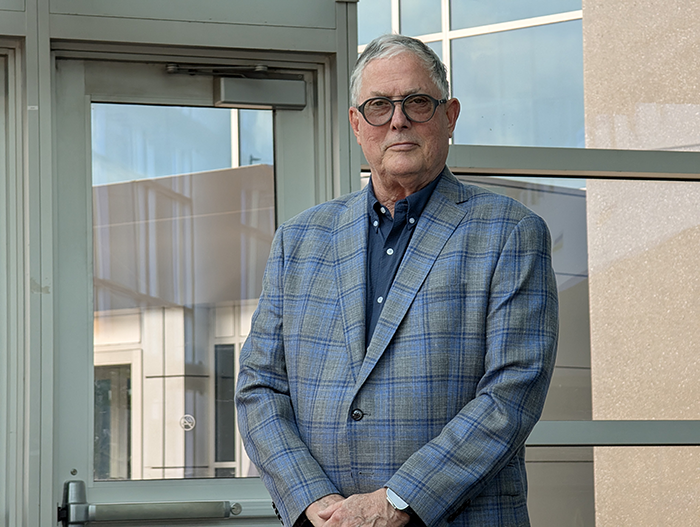
Omaha.Nebraska.com here with…
Roger Dixon
You’ve led MECA since the beginning. What was your original vision for the organization, and how has it evolved?
I came in September of 2000. And we were at the Twin Towers [also called The Duo], which are now being converted into an apartment complex. Basically it was me and my executive assistant, and basically our first mission was to bring on some staff. I brought on a contract administrator for construction, a director of operations, and a finance person, and the process at that point was to validate the GMP, which is the gross maximum price of what this facility did working with DLR, the architect, and Kiewit, our construction management company. We went through the process, and then we got through that, and then construction started in March 1 of 2001. We kept bringing on staff. The vision was to operate this facility at the most optimum level that we could. David Sokol, the chair at the time, said he wanted the staff to be as Disney-like as possible in how we treated our customers, and fortunately in my career I had participated at Disney University in Orlando. And so I had a little background in how they did it, and it’s basically that you treat your front-of-house customers the same as you do your back-of-house customers, so it’s making sure everybody was as happy as they could be… they got what they needed and either enjoyed the event or enjoyed working here. So we just progressed through that and went through the construction aspect. We opened in September of 2003, and then it was just “Katie bar the doors” because it all started coming out so quickly.
Wow. So the successes here helped other things be attracted to it?
So this area, as everybody knows, was the Union Pacific Railroad yard. They were starting to close it down, move it over to, I think Council Bluffs is where it ended up. And to see it today and to see it back then, I tell the story and most people have heard it from me before. My first interview was in June of 2000. I landed at the airport, got in a cab, came down. Back then there was a viaduct that went…which was actually part of Abbott Drive, and it came up, and I looked to the left as I was coming into town. At that time it loaded into Dodge Street, I believe, and to the left was what was left of the smelt plant, not much… dilapidated oil tanks, the Port of Omaha, and to the right was the beginning of the shutdown for the railroad yard. And I asked the cab driver, “Where is the new arena convention center going in?” and he pointed to the right. I thought to myself, “This community has vision.” And that night I was at the DoubleTree. That’s where I spent the night, and I had all the material, and I was reading everything. One of the most fantastic thunderstorms I’ve ever seen. So a nice little welcome to Nebraska.
So there was no Convention Center, just the idea of it and blueprints?
So they had done a design, they had basically priced it out, and there were some glitches in that, and we figured it out. Found out we were… in the pricing out of it, they had forgot to put in a lot of the pilings that needed to go in, so there was a big gap in what was there. So…went back to DLR, went back to Kiewit, went back to the City, and we had to increase the price of the facility by about 20 million.
Which…it all worked out. There were some design changes. The initial renderings showed more of a spaceship-type roof on the facilities. In the pricing out of the project, that didn’t fit the budget, so that had to go. There was a walkway up on the upper level. You walked, and it went to the back end of the property, and there was kind of a room up there. It could have been an observation room, it could have been a restaurant, but it looked into the arena, looked into the exhibit hall. That didn’t work in pricing either. So we ended up with what we have now.
Wow. So you had to make a lot of changes and pivot because of the extra 20 million in one location?
Well, you design it, they price it out, and then you come back in. They call it value engineering. You start cutting things out that just doesn’t work or can’t afford to do it.

You had the previous experience. You just told me about Disney and prior roles in other cities. How did that influence your approach for Omaha?
So I’ve been in the business 49 years. Been here 25, so 24 prior to that. I started out in Louisville, KY, as an event coordinator, got promoted to assistant director of the new convention center downtown. It was open, but we hadn’t done all the furniture and equipment: F and E. I got to finish that off, so that was experience I got.
I was in Louisville for approximately 9 years and then went to Miami, FL, and that was more of a large theater, 5,000, but you could play basketball there, so we did a lot of concerts there—we would do 70, 80 concerts a year. That’s about all we did. And then they took out the retail space in that building and put in meeting rooms and exhibit space. Not a lot. So I had some experience in the construction aspect of that. Again, fitting the furniture and equipment.
Left there, went to Saint Louis. If you’re familiar with Saint Louis, you may remember what was called the Checker Dome. That’s where the Saint Louis Blues Hockey Club played. And that was just keeping up an old, old facility. Not really any… other than just maintaining a facility at the time that was probably 70, 75 years old.
Left there and went to Philadelphia and worked at the Spectrum and was there three years, and during that time they were negotiating with the city to build what is now Wells Fargo Center, which is the new facility, and had a little experience in that…not much.
Came back to Saint Louis and then helped build, then manage, what is now Enterprise Center. It was the Kiel Center back in those days. Again, that’s where the hockey team moved to. So I got a little bit more experience in the construction aspect of it and more of the F and E aspect of fitting out a new facility. I was in Saint Louis another 8 years and then came up here, been here ever since.
There was a little interplay. I went to Cincinnati for about 3 or 4 months in the summer of 2000. And that was just babysitting an old facility. Then came up here, been here ever since.
I’ve fallen in love with Nebraska and the Omaha area since I’ve been here. You must have so many favorite things and stories of your time here.
Too many that…most of them I can tell; some of them I can’t.
Well, it’s always interesting to be involved in the construction and then the opening and the management of a facility. Just the number of people that you encounter, and even on the aspect of when it was under construction, the number of people that weren’t in favor of this facility.
I’ve always found that interesting.
I’ve always said it was the vocal minority, because the vote to get this place was well over 60%. So the overall community supported it, but it’s just the vocal minority as I say, the few people that were in the newspaper and on radio talk shows. But I think we proved everybody wrong, because this place would never work. Actually, I was told from a lot of the concert promoters that I dealt with prior to coming up here that Omaha was never a city you could make money in, and all they had was the Civic Auditorium. And I got that, because it wasn’t big enough. And so I thought once this happens…we started out with 16,000 seats. We upped that number in 2006 up to 18,300. And even with 16, we made things work. We have been profitable from day one. Even through the COVID period we were profitable.
Wow.
And all the monies that we have generated came back in to make this facility what it is and it remains to be, because most people that come in here, they will look around and say, “This facility is 20, 22 years old,” and it is, because we maintain everything.
With COVID, a lot of businesses and organizations had to pivot or at least do some things a little differently. What did you do here?
So we were a little bit different than what most of my contemporaries did in the business. Most people just shut their facilities down. We had a little bit more progressive governor, as far as business-wise, and Governor Ricketts allowed us to stay open and set percentages that we could do. So we turned in, as far as the number of people in attendance, and more so the numbers of people watching, not really participants…and so we kind of turned into volleyball central, basketball central. I didn’t lay off much staff because we let the part-time people go, but we started bringing them back because we became so busy. And I think the fact that we stayed quasi open… I think it saved several of the hotels in the downtown area. And I’m not taking credit for that. That goes to the governor. But we made it through it.
I know there are so many businesses here and then related businesses that really depend on Omaha being alive and active and attractive for a variety of things, including the College World Series being open. It’s amazing the amount of economic impact that MECA has had.
I think the number is, we generate probably about 90 to 100 million a year, just on a normal year, as far as economic impact. So it’s been several billion dollars that we’ve generated for this community. It’s been more than enough to offset the cost of the city’s expense to build this place.
Yeah. I didn’t do the math, but it’s pretty impressive.
Yeah. And it’s the same with Charles Schwab Field, where we have… Creighton baseball plays there, and NCAA with the Men’s College World Series. Most people are like, you know, “It just sits empty.” And it does, a lot, but it was built primarily for the College World Series. It’s not a drain on the taxpayers; it pays for itself, both to retire the debt and to operate it. So it’s kind of a hybrid stadium. It’s too big for Minor League Baseball. It’s too small for a lot of the touring shows that go out in stadiums over the summer, so we kind of deal with that as much as we can. We’ve done some concerts there, but it’s not like what some of the other stadiums do in the country that have 60, 70, 80 thousand seats.
The College World Series is coming up on 75 years. Hard to imagine.
Well, I’ve not been around for that long…at least I’ve not been in Omaha that long. I’ve been around…I’m almost 75. But it’s an exciting time of year. People look forward to it. We’re gearing up. Everybody’s gearing up. We’ll find out the teams that are going to play Sunday, maybe Monday if there’s playoff games that have to have them. But there’s a 16 field out there now. It’s going to pare down to 8. We’ll see who shows up.
One thing that’s going to be a lot of fun, and having covered this for several years now, it’s always an amazing experience and always a positive experience.
Yeah, we do thousands of people that come in…and most of them, they’ll start out in the parking lot or some of the area bars and restaurants, and then they all come in. We’ll put 24, 25 thousand people in the facility, and it’s baseball, and it’s good baseball.

What legacy do you hope to leave behind in Omaha? And what’s up next for you?
I’ve always operated as a—this is a for-profit business and whoever replaces me after I move on at the end of the year, hopefully they’ll continue that process. And I’ve always kept in the back of my mind this facility was built for the city, so it has to benefit the city, either in putting people in hotel rooms, restaurants, or utilizing, where we can, vendors that provide service to it that are from local business. So whoever replaces me, I hope they’re as successful at running this facility as this team has been.
Thank you. What qualities are you hoping that the new person will have and bring to here?
My hope is it’s someone from the industry that understands…but we’re unique. Not many facilities that have an arena have a convention center attached. A baseball stadium sits right off and then a 70-some-acre park that they have to do. That was a little stretch, but I think we’ve done a nice job of running all of them.
My office is right across from the Leahy Mall, and it’s been real interesting to watch all the development here…going on.
Yeah, downtown…I think, from what they did at the riverfront, which is the Gene Leahy, Heartland of America Park, Lewis and Clark…especially at Gene Leahy, filling that lagoon in or whatever you want to call it, really brought the south downtown area and connected with the north downtown area. I thought that was a great idea.
I love watching the economic development, and when I do different stories…you know, what was it like before or how did it thrive or fall into decline… and your story earlier, too, about what this earlier area was and all of that is really a great testament to the work you’ve done and how people have thought about things in the city. And thank you.
Well, I can’t take credit for much other than operating this facility to the point where people want to develop around it. But that’s a driver by the business community and the city administration, so they’ve done a great job. Just had 12 years with Mayor Stothert, and she was an excellent shepherd in getting projects through and getting them done. The streetcar is going to be here. I know there’s a lot of naysayers out there about it, but there’s also a lot of businesses that are…and facilities being built that wouldn’t happen without the streetcar. So I think it’s all good.
Thank you very much.
My pleasure.
